As a guide in Alaska for nine seasons, I always wondered
what it would have been like to have visited that wonderful
land fifty years earlier when it was still undiscovered.
In the summer of 2000 my dream came true when I was offered a
job guiding on the Kolpakova River, situated on the Kamchatka
Peninsula, directly west of Alaska.
Located in the far eastern part of the former Soviet Union,
this highly guarded militarized zone was closed off to the
west in 1917 and reopened in 1990. With roughly the same
land mass as the west coast of the United States, Kamchatka
has a total population of approximately 350,000 people, and
220,000 of those live in the modern city of
Petropavlosk-Kamchatsky or P-K as it is known.
Access to the interior is extremely limited with only one main
road (which turns to dirt after about 80 miles), traveling
less then half way into the interior. With over 1100 different
rivers hosting some of the largest runs of wild Salmon and
Steelhead left on the planet, vast numbers of Rainbow Trout,
Grayling, and different and exotic Char species,
Kamchatka is a fisherman's paradise.
Getting to Kamchatka is a relatively easy affair, especially
in today's world of air travel problems. Flights depart from
Anchorage, Alaska on Friday mornings. A four and a half
hour flight puts you at the international terminal in P-K, where
after clearing customs you are greeted by your American host
and a interpreter who remains with you during your visit.
Once in Kamchatka, the first thing you notice is how warm and
friendly the people are. With so few visitors from American,
you do stand out and it can bring out a lot of interest from
many of the people. I have had children approach me, eager to
put to use the English they are now studying in school. Most
Kamchatkans tend to be highly educated, with many of the people
possessing college degrees.
Reaching camp is done via a Mi-8 helicopter, the Russian equivalent
of the DeHavilland Beaver airplane in Alaska. First produced in
1961, more than 15,000 of these aircraft have rolled off the Moscow
assembly line. With it's 16,230 pound payload, economy, reliability,
and excellent safety record, the Mi-8 is used worldwide by search
and rescue operations and more than 50 different air forces. The
one hour and twenty minute flight leaves you breathless as you
pass over an incredible and diverse topography of volcanic
mountain ranges, endless forests of Birch and Cedar, and countless
streams of all sizes, in a wild and pristine wilderness setting.
 Upon landing the fisherman are met by the enthusiastic and friendly staff,
who after introductions escort you to the camp set on a beautiful,
wooded location, just above the banks of the river. Although the
camp is located in a extremely remote location it is designed with
your comfort in mind. A large central tent serves as the dining
room and socializing area. Delicious and plentiful American style
breakfasts and traditional Russian dinners are served family style.
Lunch is usually a shore side affair, with delicious fresh fish
prepared by your guide served along with local breads, vegetables,
cheeses, and lunch meats. A comfortable, six man heated yurt serves
as home for each two clients during their visit, and a very nice
wilderness Russian sauna (banya), and hot shower room help provide
some creature comforts. After a nice lunch and a chance to settle
in a little, two guests are paired up with a guide with whom they
spend the rest of the day with traveling by jet boat to access
miles and miles of gorgeous riffles, runs, and pools in search
of an incredible variety of different fish species available at
different times of the season, all anxious to take your fly.
Upon landing the fisherman are met by the enthusiastic and friendly staff,
who after introductions escort you to the camp set on a beautiful,
wooded location, just above the banks of the river. Although the
camp is located in a extremely remote location it is designed with
your comfort in mind. A large central tent serves as the dining
room and socializing area. Delicious and plentiful American style
breakfasts and traditional Russian dinners are served family style.
Lunch is usually a shore side affair, with delicious fresh fish
prepared by your guide served along with local breads, vegetables,
cheeses, and lunch meats. A comfortable, six man heated yurt serves
as home for each two clients during their visit, and a very nice
wilderness Russian sauna (banya), and hot shower room help provide
some creature comforts. After a nice lunch and a chance to settle
in a little, two guests are paired up with a guide with whom they
spend the rest of the day with traveling by jet boat to access
miles and miles of gorgeous riffles, runs, and pools in search
of an incredible variety of different fish species available at
different times of the season, all anxious to take your fly.
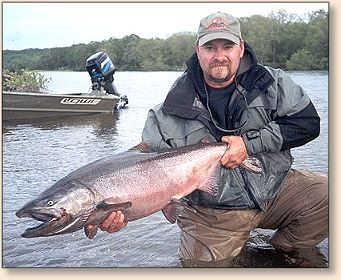
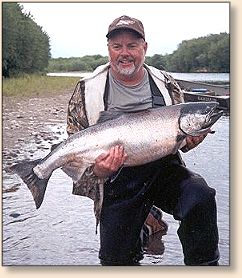
The Kolpakova River hosts all six Pacific Salmon species. By early
June, large runs of King Salmon begin to enter the lower river in
good numbers. Fresh fish usually continue to arrive in the lower
river through early July. The average King caught on the Kolpakova
River is 25 to 30 pounds, however these fish are extremely powerful
and can reach weights of 60 pounds or better. Cherry Salmon, not
found in North America, are next to arrive. Although not large,
these Asian cousins of our pacific Salmon are very aggressive,
and fight great! They look like a cross between a Chum, Pink
and Sockeye Salmon and are a lot of fun to catch. By the first
of July huge numbers of Chum Salmon, Humpies (on even years),
and Sockeye Salmon start to flood the lower river and continue
moving upriver into August. The first of August brings with it
the beginning of the Silver Salmon runs that enter the river in
good numbers and continue through September. Besides offering
great sport fishing opportunities these Salmon species also
provide an invaluable diet of fry, smolt, eggs and flesh to
the countless numbers of char species and Rainbow Trout that
inhabit the entire river.
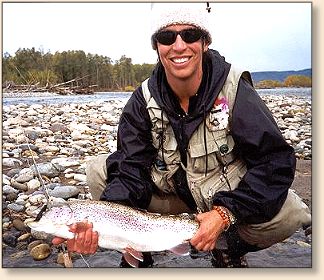
Speaking of Char, the Kundza or Large Spotted Siberian Char
are available all season long. Not well known by western anglers,
these primitive sea run members of the Char family are found only
in Asia. They can reach weights of forty pounds or more and reach
up to forty inches in length. An extremely powerful fish, once
hooked it is akin to having your fly attached to a back of a bus.
Three hundred yard long runs are not uncommon and these fish have
been known to destroy a 10 weight fly rod. Large schools of both
Dolly Varden and Artic Char are also available on a daily basis
and when conditions are right they can be caught on a surface
fly.
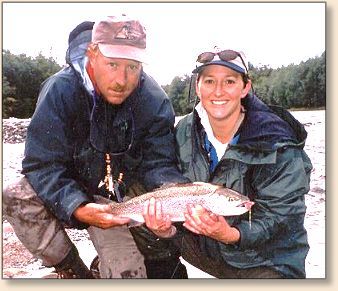
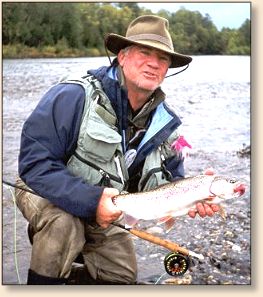
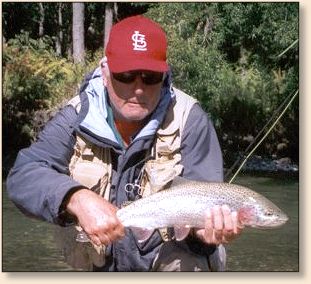 But the main draw for many anglers is the opportunity to catch
the beautiful and wild rainbow trout that flourish throughout
the entire length of the river. These surface oriented Trout
average close to twenty inches and three pounds in weight, but
the opportunity to catch larger specimens is a daily proposition.
Although fishing streamer patterns is the usual method of targeting
these fish, very good hatches of mayflies, stoneflies and caddis
flies help create excellent dry fishing opportunities any time
from June to September. At times a skated mouse pattern can also
provide heart stopping explosive action.
But the main draw for many anglers is the opportunity to catch
the beautiful and wild rainbow trout that flourish throughout
the entire length of the river. These surface oriented Trout
average close to twenty inches and three pounds in weight, but
the opportunity to catch larger specimens is a daily proposition.
Although fishing streamer patterns is the usual method of targeting
these fish, very good hatches of mayflies, stoneflies and caddis
flies help create excellent dry fishing opportunities any time
from June to September. At times a skated mouse pattern can also
provide heart stopping explosive action.
Just visiting the Kamchatka peninsula is indeed taking a trip back
in time. These rivers host some of the largest runs of wild Salmon
and Steelhead left on the planet - vast numbers of Rainbow Trout,
Grayling, and different and exotic Char species not found elsewhere
make Kamchatka is a fisherman's paradise.
An experience of a life-time for this guide - as well as for
those fishermen fortunate enough to find it. ~ Rob Merrill, July 2002
For more information of fishing this region, visit the
Russian Rivers website,
or contact Rob at robmerril@cs.com
|