It is only after a lifetime's flyfishing I feel I can contribute a little to this
never-to-be-settled argument. There is no doubt catch and release is the
"future provider" method of game fishing and that a fish caught and released
will still be there to live on and perhaps to be caught again. But do we want
that? Does it not smell somewhat of fish in a barrel? It makes me feel we are
saying, "I have caught you once and inflicted fear and pain on you but I am not
going to kill you, I am putting you back so I can inflict fear and pain on you
again next week." Humane? I think not.
A few years ago I was a member of a small 30-man syndicate ( although we had
30 members and were so limited by the rules, roughly half our members never fished,
they kept up their subscriptions "just in case. ") They were mostly well past fishing
age but liked to feel they were still members, and of course it made the fishing less
crowded, and cheaper, for the rest of us.
We leased and stocked a seven-acre lake in the beautiful Cheshire countryside.
We had fished here for some thirty years, the older members at least, and all
of us felt it was "our lake". Then, disaster! The estate, of which the lake was
a part, was sold to a pop star. Horror of horrors! Not only was our lease not
renewed but also fishing out the remainder of the season already agreed upon
was made very uncomfortable. Eight-foot high razor wire fences (to keep out
female teenagers) and large almost feral Alsatians (me bruvver breeds 'em,
doesn't he) do not set well with the idyllic ambience we fishermen know and
love. And so our fishing came to an end. For once in my adult life I seriously
considered tears.
However, I digress. While we fished the lake there were the usual committee
squabbles (why do all clubs suffer committees permanently at war with themselves?)
Fred, the Hon. Treas., wanted to put in a lot of little (cheap) fish and let them
grow on. This in spite of the fact we took out at least one large pike each year,
and the others that had to be in there were waiting with gleeful anticipation for
Fred's view to prevail; in spite of the presence of a healthy population of herons
and in spite of a nearby caravan park whose temporary residents found ample
opportunity to avail of the free fishing we had so kindly provided.
Joe wanted brownies. He liked to fish a dry fly in the evenings and felt brown
rose more willingly than did rainbows in the gloaming. In any case-- rainbows
were foreign.
The rest of the committee felt we would be best advised to put fish in, "few
and often," and large rather than small. We also, to a man, felt rainbows fought
better, looked better, grew quicker and tasted better. They also rose to flies in
the evening if they felt like it, and that little bit of uncertainty added the necessary
spice.
We decided in the end, and this prevailed most years, to order, say, 200 fish
of one and a quarter to two pounds, and fifty fish of two and a half to three pounds.
We coaxed the fish farmer to let us have the odd older, larger fish that he might
have surplus to requirements. He usually let us have five or six in the five-pound
range, and so another degree of excitement was included in the mix.
Half of the committee felt we should refrain from fishing for four days after the
fish were put in. This was to let them settle and to save us from catching too
many fish too easily. (They would be confused and take anything they were offered!)
The rest of us took view that we were putting fish in the lake so we could catch
them, and as we were all gentlemen (?) any fish, which gave itself up or didn't
acquit itself sportingly, could be carefully returned.
For my part, I had come to know the lake well and knew, or thought I knew,
where fish could be depended upon to be lurking at every time of the day. I
could have fished in the more unlikely places, but who would? Be that as it
may, three or four days after stocking, in the year when this dilemma first thrust
itself into my mind, I arrived at the lake and carefully plopped a Hare's Ear in
the perfect spot. On cue, as if scripted, a three pound rainbow decided that
Hare's Ear was the flavour of the month and consumed it, first cast! Five
minutes later another followed. I don't want you to think this was too easy,
but I knew the lake and all its vagaries and the fish were willing.
But---- and it is a big but. The members limited ourselves to two fish per
day, twice a week. I now had my two for that day and had only been there
for, at most, fifteen minutes. What to do now? Obvious-catch and release
or go home. Going home isn't in me at a time like that so catch and release
it would have to be.
All fishermen will guess what happened next. Following a leisurely stroll
round the lake, I came to a favourite spot, a spot which habitually held a fish,
usually a good one. After a few exploratory casts under the trees a rainbow
of some four pounds swallowed the fly and made it his own. Landed as
quickly as possible to reduce the build-up of acid, it was to have taken
the fly so far down the gullet that removing it was well nigh impossible,
barbless though it was. What to do?
- 1. Cut the nylon and hope the fish could work the fly in nature's way, a size
14 barbless should not cause too much of a problem, though I wouldn't like
to have it work it's way through my system!
- 2. Subject the fish to long forceps, causing massive trauma, probably
condemning it to death anyway.
- 3. Kill the fish and break the rules, which I had a hand in framing. A hanging offence!
Many fish will be hooked lightly in the lip or mouth edge and can be shaken off
a barbless hook leaving the conscience clear, but the concept thereafter becomes
a little blurred, at least for me. While I am catching fish I am 'Man the Provider,'
taking food from Nature and intending to eat the results of my efforts. That we
shermen have purposely made it difficult for ourselves is beside the point, I can
justify the whole procedure on food grounds. Once my limit is reached, and two
fish should be enough for anyone, to embark on a course of catch and release
gives me the horrible feeling I am subjecting the fish to pain, trauma and possible
death just for fun. Purely for my own pleasure and amusement. That surely
cannot be right.
There must be more to sportsmanship than this.
Hard though it is on a day when things are not going well, I now feel the best
and fairest course is to quickly return any fish which is lightly hooked, taking
care to support it in the water until it is as fully recovered as possible, thereby
allowing it the maximum chance of survival. A fish which is hard hooked or
one that has been difficult to subdue and is obviously exhausted beyond
reasonable chance of survival should be killed humanely and regardless of
size, must be included in one's total bag.
When the limit is reached, home I go. Hard to do on a beautiful day when
fish are co-operative, but I feel it is the right way. Undoubtedly it is easier
to do when the first fish is three pounds and the second is a double. You
can face your children's camera with pride.
If, however the first fish is a pound and a quarter and the second is not in
good condition or even a flaccid stockie, what then?
This is what is called, "taking the rough with the smooth" or even "sorting
the men out from the boys." It is to be a true sportsman if you can abide by it.
~ Jim Clarke
About Jim:
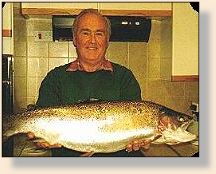
Born in Belfast, Northern Ireland, longer ago than he cares to remember,
and on leaving school went into his family's business - Gunmakers
and Fishing Tackle manufacturers. By the time he joined the firm
it had become more retail than manufacturing , though the history
and reputation of the company was somewhat patrician, which stood
them in good stead in the face of the modern, retail only,
fly-by-night businesses which proliferated in the fifties and
sixties in the climate of leisure time explosion. A few years later,
feeling somewhat stifled in a company run by father and two warring
uncles, he left to take over an ailing gun maker in Chester, England.
He was to stay there for thirty pleasant years, retiring some six
years ago, ostensibly to have more time to fish. He had given up
shooting, but in reality appears to have retired to garden, decorate
and construct THINGS in the garden. He has, nevertheless managed to
fish in Ireland, Scotland Wales and England, with trips to Sweden
and Alaska thrown in. You will find more of Jim's writing in our
Readers Casts section.
|