In my last years at school, when parent-accompanied fishing trips had begun to
seem limited and restricting, but fully independent, distant fishing was inaccessible,
I was, like most young fishermen in those days, restricted to bicycle range.
Good rabbit shooting, my other passion at the time, was to be found a mere three
miles from home, some six miles outside Belfast. There was a glen, or canyon, in the
side of those sometimes benign, sometimes looming mountains which delimit the environs
of that city on the west. Fairly steep sides of sandstone were well covered with stunted
brush and grass, providing admirable cover for the bunnies. There was a stream at the
bottom, though not ample enough to hold fish, that possibility had been explored earlier.
Rabbits abounded (this was long before myxamatosis ) and provided great sport with rifle
or pistol. You can tell that this was before the troubles made all kinds of shooting very
difficult in the province.
I passed many hours talking to John Beacon, a farmer who eked out a precarious
living on the edge of the glen, just above a village which for many reasons must
remain nameless. Sympathising with him one day about the drought which was making
life difficult and stunting the few vegetables he suffered himself to grow, he surprised me
by saying that he had always a little income from the estate to fall back on.
Estate? What estate?
He explained that on the other side of the glen, just above the village outskirts, was
the ruined shell of a minor stately home. Indeed I had noticed the last standing wall at
a distance but hadn't let my curiosity get in the way of the rabbits. It transpired that the
estate had consisted of the big house, the gardens, the glen and apparently the village
as well. Broken up many years before for whatever reason, few traces remained. John
had been appointed "agricultural janitor" and received a small annual stipend from the
solicitors who represented the trust which still owned the, now largely valueless, land.
There was at this time a bacon-producing factory in the village from which emanated at
all hours the strong smell of salt and the aroma of the bacon curing industry. Seagulls
massed around the place, making a great deal of noise and considerable mess.
The big house had been occupied in days past by a line of "sporting squires" who had left
a legacy of tall stories but little else.
" There is no trace of it now," said John, "except the wee dam beyond." ( Quick translation . . ."A
wee dam" means a small man-made lake, "beyond" simply means - over there somewhere).
Dam? What dam? Why haven't I seen it? Where is it? Are there any fish in it? The
questions came tumbling thick and fast, as I followed up this red rag.
It turned out that the strange brick channel I had noticed leading off the stream away up
at the head of the glen had been the feeder channel for an ornamental lake in the gardens
of the house, and had become almost totally overgrown and invisible along it's length .
The lake was still there!
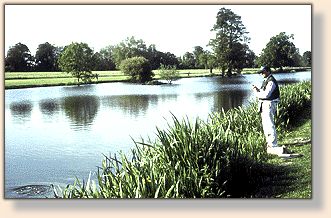
When I could prevail upon John to show me how to find it, I discovered a little paradise.
Crescent shaped, cut into the side of a gentle slope, it was about a third of an acre, stone
built with ornamental cappings and little dwarf walls here and there to break up the line. It
looked beautiful but practically overgrown, even though the cattle had kept nature from
winning completely.
Into my sorrowful musings that such a jewel of a "wee dam" had been so neglected when
it could have been oh! so fishable, came, as from Heaven, the words "Sure there must be
some sort of fish in it, we see them leaping around at night." John had followed me to make
sure I found the spot. It appeared that the dam's water was still used for washing and sluicing
down in the factory in the village, although no-one working there had any idea, or any desire
to know, where it came from. It came out of the taps and that was enough.
Some years ago, the general manager (bacon ) had been, in his leisure, the Hon. Sec. of a
fairly exclusive trout fishing syndicate consisting of some ten or twenty rather tweedy
gentlemen. The Hon. Sec. had the bright idea that if some fish were bought small, introduced
to this rather out-of –the-way water, they would grow on naturally and be used at low cost
to replenish the stocks of fish in their other, naturally stocked, lakes.
Good idea, followed by realisation of bad idea!
The fish were bought and put in. They seemed happy to be there and great things were expected.
The syndicate then found they couldn't get them out. The lake was anything up to twenty feet
deep, even at the edges. Much anonymous material had found it's way into the water over
the years, and together with weeds of jungle proportions made netting impossible.
Plan abandoned.
The wee dam was now subjected to much scrutiny over the next two or three evenings.
As you can imagine. There was no doubt, there were still trout in it! It seemed to be full
of fish, fish rising to flies, fish swirling after the fry with which the water abounded and fish
just plain jumping for fun. Two more days were allowed to pass. Two days of preparations.
These consisted of repeatedly pinching myself, followed by heavily veiled inquiries as to the
present owner of the dam and of the fish. It was soon established that the Hon.Sec. had
passed on and that the entire hierarchy of that syndicate had changed. No-one now in office
or on the member's list remembered the late lamented (not by me ) project.
I was assured by John that no-one of any authority had been in the area for years, and my
way was clear. Now arose a back-of-the–mind niggle. Why had the then members not tried
to remove the fish one by one in the traditional sporting manner? I soon found out. The fish
wouldn't take! The feeding was so rich that fish didn't need to come to the surface to feed
unless they were there anyway, and even so natural flies were present in such quantity that
artificials didn't stand a chance of being singled out for consumption. Even fishing in the last
moments of daylight evoked no response to my wet flies and nymphs. Perhaps a dry fly?
Not likely, in those days dry fly was used upstream on rivers and only there. The exception
was the dapping of Daddies and Mayflies on the big loughs. Any fool could see that one
could not move a floating fly in a lifelike manner on still water, and to attempt to move it
would produce drag which would make the idea a non-starter.
However, I didn't know this, and in the course of throwing everything in the box at these
infuriating fish one evening, I tied on a dry fly. I had what we called a knotted midge, thin
black silk body, black whisk tail and double hackles and wings. The idea was to imitate a
pair of midges in a compromising position, and it worked well on the local rivers when the
black midge was "up and at it." I tied this on and cast it out, only to have it firmly taken
as it touched the water! A trout had thrown a lifetime's experience to the winds and decided
that my little fly was all that was needed to make it's evening complete. Now I discovered
what was probably the real reason my friends in tweeds had not taken their fish out. They
couldn't get the fish out of the weeds! The weed, as I have said was of jungle proportions,
something my enthusiasm had blithely ignored, and added to these were a very healthy
selection of water lilies. It was not just a question of keeping a fish away from weed,
wherever a fish was in this lake, he was in weed, and very heavy weed at that. My fish
regarded clumps of weed as his natural habitat and proceeded towards the closest
example at a high rate of knots.
Sod's Law now made it's appearance. The seagulls which clustered on the roof of the
bacon factory decided that the time was ripe for a return to salt water, some six miles
distant in Belfast Lough. You can guess the next attractive feature of the evening, the
flightpath lay directly over the dam! Seagulls appear not to deposit their trademarks
while on the ground or on a factory roof, but seem to delight in letting it fall from altitude,
a habit which manifested itself on the evening in question by dappling the lake's surface
with a veritable hail of guano. This may, in the past, have helped to fertilise the lake and
the weeds, contributing to the survival and growth of the fish, but tonight it did tend to
make life difficult, having to dodge the airborne missiles while trying to coax a reluctant
trout out of tenacious weed. As luck would have it however, as desperation reared it's
head, a large dollop fell precisely on the dorsal fin of my trout, who was engaged in
burrowing ever deeper into the weeds. He left the green stuff as if ejected, probably
feeling this was unfair treatment. The line came free! I managed to keep the line out
of further trouble after that and eventually slipped the net under a golden brownie of
two pounds.
That was the first fish of many I took from the "wee dam", but it was the biggest. The fish
seemed not to grow to that size very often, most fish I took were in the one to one and a
half pound class, perhaps because of heavenly nitrates, or perhaps in spite of them.
In later years the village and surrounding area became "politically sensitive" and grew
to be a district best avoided. This example of what the troubles have done to Northern
Ireland shows the least publicised but possibly the most far-reaching effect of the
sectarian idiocy on the lives of ordinary people, the restriction on everyday travel. If
you have to think whether or not you dare go to such and such a place, it takes a lot
of the pleasure from wandering about with a fishing rod.
The memories, however, are inviolate, and fishing memories are for life. ~ Jim Clarke
|