I drive down to the river, for the first time this year, on a
damp cold day when even the new lambs in the meadow alongside
the narrow lane look miserable. But the sight of the water, as
I cross the little bridge opposite the fishing hut, and the smell
of it as I pull on my boots, make me realise how much I've missed
the river during the long winter months. And a little later, when
a watery sun appears briefly between the showers, and a thin,
plaintive birdsong can be heard from the alders upstream, I know
that I have arrived back in paradise once again.
I put up my rod in the shelter of the hut, and tie on a hawthorn
fly dressed months ago during one of those long, wistful winter
evenings. There is no fly life of any sort to be seen, either
on the water, or in the bushes along the margins. But this is
the first Sunday in May and, I reason, there ought to be hawthorns
about somewhere.
The river bottom looks cold and empty at this time of the year,
before the lush green streamer weed really starts to fill the
channels. But the water is glassy clear and this is a great
time to get to know the deep runs under the willows and to
see the holes and obstructions that make such good lies for
the trout. Later, this nakedness will be hidden under a great
profusion of growth and only the gravel runs between the weed
beds will be visible.
Suddenly there is a movement under the tussocks on the far bank,
and, moments later, the movement is repeated as my floating hawthorn
fly is taken confidently by a smallish angry brown trout that,
in due course, shakes his way into my net. He's lucky: half an
inch shorter than the strictly imposed limit here (above which,
alas, all fish must be killed) and so he goes back, in a huff
of silt, to recover from the indignity.
Later in the day a bigger, deep-shouldered fish takes the same
fly after my fourth attempt to drop it close to him between the
damp downstream gusts. When I examine him later, while cleaning
him for my supper, I discover that he is virtually empty and
I experience a small bleak feeling of guilt. I tricked him with
this big leggy imitation on a day when he struggled to find even
a single natural fly. I feel just a little ashamed.
Although I see a lot of trout, deep down, dark and remote, I do
not see another move near the surface and I finally pack up,
with chilled fingers, as the wind increases and the sky grows
dark with rain. As I drive past the meadow I slow the car to
look at the lambs, which are now pressed in a tight group around
the base of a sheltering tree, looked on by a circle of doting
mothers, chewing vacantly as they lay in the wet grass. And I
can hardly wait for next weekend.
About the Hawthorn Fly
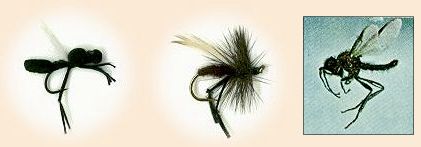
The first tie is the Oliver Edwards foam bodied pattern, with white
poly yarn wing, as given in his Flytyers Masterclass book.
This imitates the distinctive profile of the natural, with its large
thorax and head, very well indeed. The second is a simple
pattern with hackle point wings which is not quite so realistic but is,
nevertheless, very effective. This is dressed with a black dubbed body,
black hackle and white or pale blue dun hackle points as wings. The legs
are black dyed feather fibre - goose or any suitable feather, knotted to
form the distinctive joints. In each case the rear legs are dressed very
long, as in the natural. Both patterns are dressed on size 12 hooks.
The insect photo is from John Goddards book, Trout Fly Recognition,
and is included for your information.
I don't know if this dipteran, or one similar, exists in the States.
Strictly, its a terrestrial since no part of its' lifecycle is aquatic.
It usually appears around the end of April, often in fair numbers, and
is a large, slow flying insect which often seems to gather, as the name
implies, around hawthorn bushes adjacent to the river. The hawthorn is
in bloom at the time of its' appearance and I believe the adult probably
feeds on nectar from the heavy scented blooms. As Oliver mentions, you
often see it 'head down' in the blossom. Although little is known about
its' lifecycle, save that it is not aquatic, it is likely that the
larval stage, at least, requires damp conditions since the adult
definately seems to prefer locations close to water. What is certain,
however, is that it often appears on the water, and, being rather large
and ungainly, probably gets blown there. Trout feed avidly on it during
the short week or two that it is in evidence.
For the flyfisher, it fills in nicely after the Grannom (an early spring
sedge here), if, indeed, Grannom are present at all, and before other fly
life 'gets going'. It is a luxury to be able to fish a comparatively
large pattern at this time.
Although the season is very short, trout will often take an artificial
for some time after the fly itself has disappeared - which is an
additional bonus.
In the North of England and Scotland there is a very similar insect, the
heather fly (Bibio Pomonae), which I believe (not knowing
it personally very well) appears much later in the year. This fly has
bright red legs and is a very distinctive fellow indeed. It is notable
that many traditional 'bibio' patterns incorporate a bit of red in the dressing,
although this is often in the body rather than the legs. There are, of
course, a number of other 'bibio' species around, but I know of none in
the UK with any red colouration. The renowned black gnat of fly fishing
literature is also usually identified as a bibio species - bibio
johannis. In fact, I believe that 'black gnat' is a name given to a
number of species of diptera, all much smaller than the hawthorn.
That's about all I know I'm afraid. There are many traditional patterns
around and it seems that most of the 'big names' of the past have had
their favourites. Hope this stuff might be of interest!
~ Roger Ellis, May 2002
|