After a lifetime in the gun and fishing tackle trade one may be
excused perhaps for a feeling of having seen it all. My feeling is
somewhat reinforced by having seen a rod like no other.
I was fishing the middle reaches of the River Bush in County Antrim
many years ago, the guest of an elderly colonel whose family had lived
by the river for many generations, indeed, his middle name was a
patronym of one of the royal families of Ireland.
I had fished for a morning, taken two fish, grilse of about 8 lbs, and went
up to the house for a bite of lunch as invited. During a very masculine lunch,
doorstep sandwiches and beer (the lady of the house was elsewhere that day,
or we would have had cucumber sandwiches and tea) our conversation
turned to tackle. I was fishing a 12 ft Hardy Hollolight, a light salmon rod
quite big enough for the Bush some 12 miles from the sea. My host
habitually wielded a 15 ft Hardy L.R.H. He used it in Scotland
each spring and on his annual forays to the Cork Blackwater and could see no
reason to change from a rod he could use in his sleep, just because it was a
little large. It was, however 50% heavier than my rod and a day with it left
one in no doubt that one had been fishing! My host responded to my gentle teasing
by replying that it was as nothing to his grandfather's rod. This took some
believing, but to prove his point he took me through the stableyard to an
outlying building which appeared to hold centuries of accumulated rubbish,
gardening tools, saddles and assorted tack, a small trap which looked the right
size for a Shetland pony or perhaps a very large dog, and many bales of aged hay
and straw. This had at one time been the coach house, and was a roomy addition
to the stable block, large enough to house a family of ten. At the far end,
approached by another door, visible in the gloom were an venerable Morris
Minor, the lady's, and an equally veteran Rover, my host's horseless
carriage.
Dragging a ladder fron a corner, the colonel, a man of some 60 summers
at this time, proceeded to climb to the roof beams! He then, with difficulty,
extracted what became on closer inspection, a salmon fly rod complete
with an enormous wooden reel.
What a rod it was!
An 18 ft one-piece Castleconnel!
For those of you to whom this is meaningless, a Castleconnel was a
greenheart rod made beside and for use upon the Shannon, Ireland's biggest
river and a prolific producer of salmon in it's day. These rods were
usually in two or three pieces, spliced together, before the development
of brass ferrules, with string or tape. They were the forerunners of
the much respected Grant Vibration, of which almost everyone must have
heard.
This monster, however, was in one piece! A greenheart salmon rod
weighs a ton, or seems to, and this was no exception. To undertake
the manufacture of such a giant can not have been for
the fainthearted. How such a thing was made on Shannonside and then
transported to County Antrim at the other end of the country defies the
imagination. And this in the 1860's!
We took the rod into the yard and, with respect for it's great age, waved
it gently to and fro. It was so soft and slow in the action that it seemed
to take forever to recover from applied effort, but that recovery had
a sweet inevitability about it that one felt sure it would have been wonderful
to fish with - if one had the muscle power to start it moving
in the first place.
Grandfather had taken hundreds of salmon fron the Bush on his rod,
but, not surprisingly, had never taken it anywhere else! How different
and difficult salmon fishing must have been in those days. Greenheart was
very much a fixed material, by which I mean that little or
nothing could be done to make it stiffer or lighter. To make a rod more capable
thereforeone had no choice but to make it longer and ultimately heavier. You
must realise that to add, say, two feet to the design of such a rod, the extra
material must be at the butt, the heavy end, and the resultant product could be
vastly different to the original design, two feet shorter.
The reel on the rod, fixed by two fairly crude brass brackets, was of
wood, as I have said, apparently walnut, a heavy wood to start with,
and approaching 7 inches in diameter. There was no backplate, the
whole thing revolved, no line guard or check, just a big wing nut
on the spindle which would provide rudimentary drag when required. Handling
the combination can never have been easy. The line used at the time would probably
have been Irish linen, taper unheard of, which absorbed water at an alarming
rate, becoming impossible to fish with, unless liberally coated with a grease of
some sort, usually mutton fat. This was commonly used in those days to to keep
lines dry and to protect reels etc. from water damage. The resultant smell after
a few weeks doesn't bear thinking about!
The only cast or leader material available to Grandfather
would have been silkworm gut, an unbelievably primitive material. It came
in lengths of from 10 to 20 inches, depending on how much it had been
drawn or stretched, and had to be soaked in water for some hours to make
it pliable and knotable. It was also somewhat unpredictable in breaking
strain. A whole branch of the tackle industry grew up around the need
for cast boxes made in wood, bakelite or celluloid, later in
aluminium. These had to be watertight, for the coiled casts would be prepared
before setting out, separated in the box by felt pads, the whole filled with
water. These, it was hoped, would be useable when the river was reached. In
those days there was no pulling a few yards of fresh tippet off a spool when
needed. If you didn't have ready-soaked tippets with you in the box, you did
without.
In 1935 a 16 ft Hardy greenheart rod weighed 35ozs, a corresponding
Perfect reel another 18ozs. That total of 53ozs is 3lbs 5ozs! Compare
that with today's graphite rods and lightweight reels, not much more
than 15ozs for the lot. Today's floating lines are truly miraculous when
set alongside those that our forefathers had to use, while
superfine, dependable co-polymer or fluorocarbon must be unbelievable in
relation to gut.
We have never had it so good!~ Jim Clarke
About Jim:
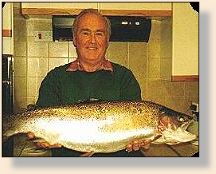
Born in Belfast, Northern Ireland, longer ago than he cares to remember,
and on leaving school went into his family's business - Gunmakers
and Fishing Tackle manufacturers. By the time he joined the firm
it had become more retail than manufacturing , though the history
and reputation of the company was somewhat patrician, which stood
them in good stead in the face of the modern, retail only,
fly-by-night businesses which proliferated in the fifties and
sixties in the climate of leisure time explosion. A few years later,
feeling somewhat stifled in a company run by father and two warring
uncles, he left to take over an ailing gun maker in Chester, England.
He was to stay there for thirty pleasant years, retiring some six
years ago, ostensibly to have more time to fish. He had given up
shooting, but in reality appears to have retired to garden, decorate
and construct THINGS in the garden. He has, nevertheless managed to
fish in Ireland, Scotland Wales and England, with trips to Sweden
and Alaska thrown in. You will find more of Jim's writing in our
Readers Casts section.
|