Lesson 1 - Rusty Rat Hairwing
The Rusty Rat is one of a series of tried and true
patterns and is the most popular of the bunch.
The Rats were originated in 1911 by Roy Angus Thompson
and, his initials R. A. T. are the inspiration for the
name of the patterns. In the book, Flies for Atlantic Salmon
by Stewart & Allen, they give some of the history of
these handsome flies and show several of the other
variations of the series. Not all of the RAT’s were of
Mr. Thompson’s origin but, his patterns inspired the others
so, the RAT initials have followed the various patterns.
Suffice it to say that a good number of fish have fallen
to these flies through the intervening years.
I choose to start this series with the Rusty Rat to introduce
Tyers to what may be new techniques and disciplines to some.
With this fly we will learn my method for attaching and
applying the tinsel tag and how to apply floss and ribbing.
These techniques will apply to most of the patterns the Tyer
might tie be they simple flies such as the Rats or, the complex
fully dressed flies.
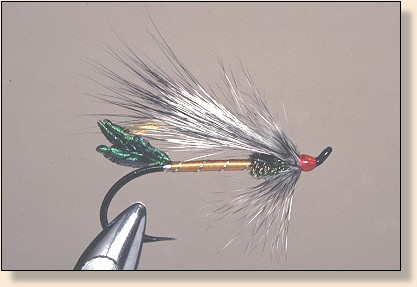
Rusty Rat Hairwing - originated by J C Arsenault
Tag: Oval gold UNI-Tinsel.
Tail: A few Peacock sword herl.
Body: Rear half, Orange-Yellow Floss (UNI-Floss rust
orange), veiled above by one strand of same floss extending
to the middle of the tail, Front half, Peacock herl.Rib: Oval gold UNI-Tinsel.
Wing: Grey Fox guard hairs.
Collar: Soft grizzly hackle.
Cheeks: Jungle Cock (optional).
Head: Red.
Instructions: Rusty Rat
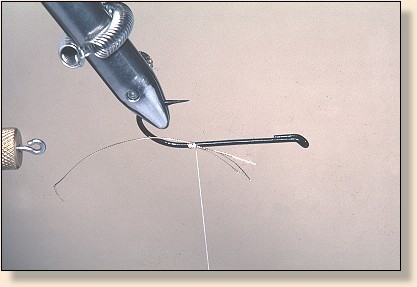
Tag applied and rib attached.
- Tie in the tinsel tag and attach the rib on the back
side of the fly with the waste end below the other two
strands and the working end at the bottom of the hook just
slightly to the rear of the center. When the rib is turned
forward, it will come forward slightly. The intent is to
have the first turn begin at the bottom of the fly and
the last turn at the top. (For step-by-step instructions with
photos of the tag see Tying the Tag.)
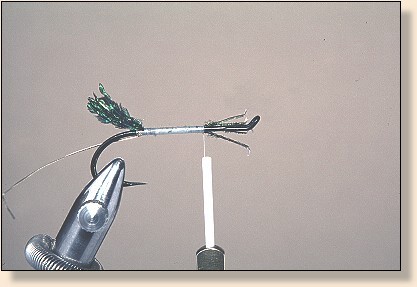
Tail tied in and thread advanced.
2.Tie in the Peacock sword herl (5 or 6) on the top of the
hook and, advance the thread in flat wraps to the point where
the floss part of the body ends.
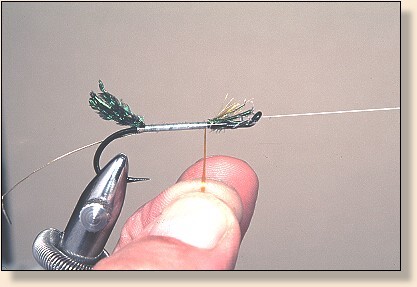
Floss tied in and flattened.
3.Tie in the floss on the front of the fly and flatten it by
untwisting slightly. As noted in the tag introduction, I
recommend UNI-Floss because it is strong and bright. It is
also a single strand floss which makes wrapping a smooth
floss body easier than a multi strand floss.
Note: Floss can be difficult to use for a variety
of reasons, not the least of which is how it tends to flair
out when it is being applied. When the floss has been tied in,
flatten it by untwisting as shown and, while maintaining
constant tension, stroke the floss to align all the filaments
all the way to the other end (you have sanded your thumb and
index fingers and washed your hands by now haven’t you!).
The further away from the hook while you wrap the floss,
the more it will try to splay out. So, holding the floss
as close as conveniently possible, take a turn or two. As
soon, or if a filament goes out of place such as making a
small bump or loop, again stroke the filaments to the other
end. You want to keep the filaments parallel at all times.
Again, do not let up the tension. If you do, the floss will
become a nightmare and, unusable at worst. When you get to the
butt or the area where you change directions or want to end
the floss, make sure you do not build up any extra bulk with
extra or unneeded turns. Do not wrap the floss too loose or,
too tight. Only practice will help you learn what these
parameters are. If you are tying on a in line rotary vise, get
used to applying floss with the rotary function of the vise.
Floss is tough to do well so, practice it and don’t let yourself
be frustrated. Remember what works and repeat that. Remember
what doesn’t work and don’t repeat that. Keep focused during
your tying and, you will be fine.
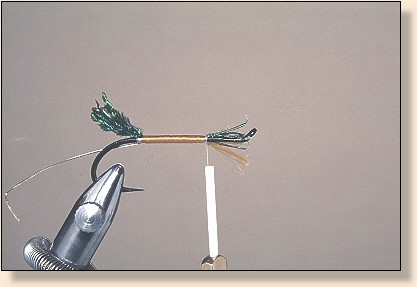
Floss applied.
4.Wrap the floss in fairly tight turns side by side to the
rear of the body and back forward while trying to keep it
as flat and smooth as possible. The highlight area on the
floss will tell you how flat it is. The straighter the line,
the flatter. This photo shows the finished floss. You will
note a few wavy areas in the highlight. This can be smoothed
somewhat with a burnisher
(see the tools section)
and/or smooth faced pliers. Especially with the pliers,
care must be exercised so none of the floss filaments will
be broken. It is very frustrating to have an otherwise great
looking floss body with one or two frayed filaments hanging off one side.
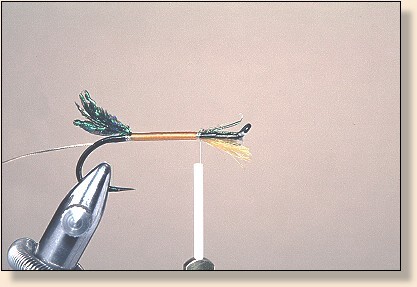
Floss flattened with pliers.
5.This photo shows the same floss after some burnishing.
It’s not perfect but is a little better and, I believe,
worth the effort.
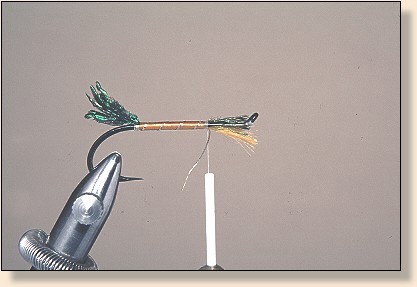
Rib applied in four even turns.
6.Wrap the rib in four even turns ending on top of the
hook at the end of the floss. You can now cut all the
waste ends of the previous materials.
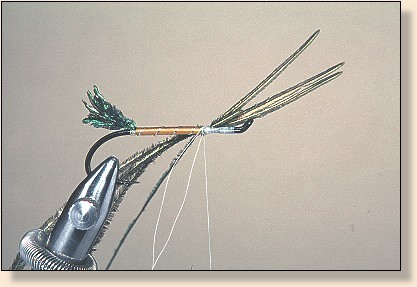
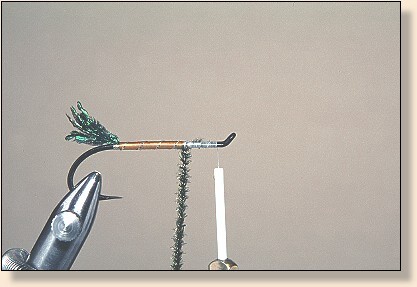
Three herl attached and thread loop.
7.Tie in three or four herl and form a thread loop.
Herl and thread twisted.
8.Twist the herl and thread to form a rope like affair.
This will strengthen the herl.
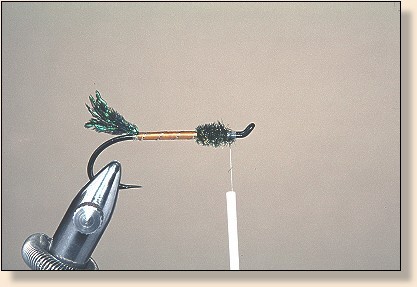
Herl applied.
9.Wrap the herl forward, tie off and trim. Stay back from
the eye of the hook. Leave enough room for the wing,
hackle and head without crowding the eye.
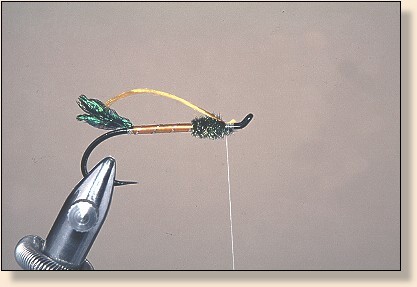
Floss underwing applied.
- Tie in the strand of floss for the underwing. You
can either tie this part in before the herl or after,
as I have done.
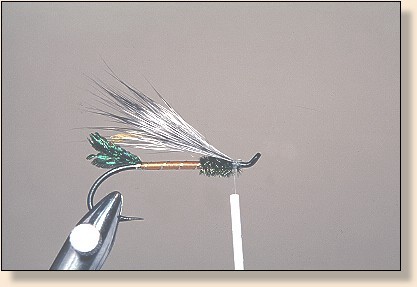
Wing applied.
- Select a bunch of Grey Fox guard hairs. Remove the
underfur and, tie in with very tight turns of thread.
Try to get into the habit of flattening your tying thread
when tying these flies. When you get to the display flies,
every turn of thread means more bulk and, extra bulk ain’t
always pretty. You can put a little head cement on the butts
of the wing at this point.
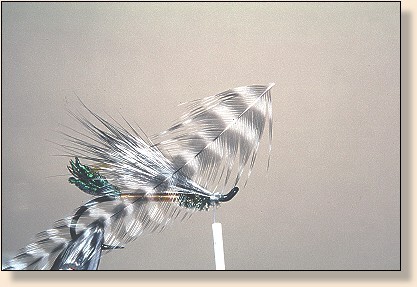
Hackle prepared.
- Select a soft grizzly feather for a hackle. Cut the
shaft and the bottom couple barbs as shown. The stubs of
the barbs will help hold the end in place.
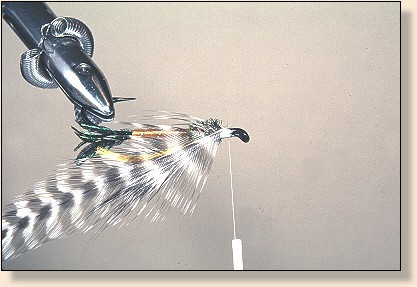
Hackle tied in.
- Tie the feather on the rear side with the convex side
to you.
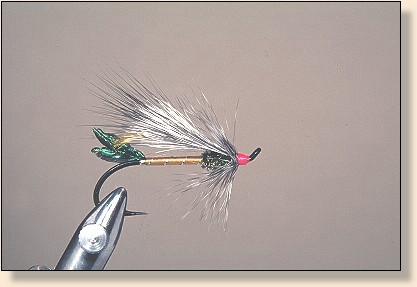
Hackle applied and head finished.
- Wrap the hackle forward while stroking the fibers
rearward, tie off and trim. Put a couple half hitches in
and cut the working thread off. Replace with the fluorescent
red thread and form the head.
Finished Fly!
- The finished fly after applying the head cement.
As always, I am happy to answer any questions you might have
about these patterns. You can reach me at rlucas@cybcon.com or 503-654-0466.
Also, I will be happy to accept any flies you would like to tie
and send to me for inclusion in this series. I will need the
fly, it’s recipe, any pattern info and, a short personal bio.
I will try to include every fly we get in the appropriate
section. The only limitation is that the patterns used must
be for Salmon and/or Steelhead. This includes the display
flies too.
Happy Trails! ~ Ronn Lucas, Sr.
Originally published c. 2006 on Fly Anglers Online by Roy Angus Thompson.