alright well i have only been tying flies for like a week. but i am hooked i have tied the wooly bugger, a hare s ear and a pheasant tail and the guy at the fly shop said they looked great, my first ones not so much but now i have them done and love it. i am looking into the future though and i want to tie all my steelhead patterns and some of them are tubes. should i just buy the tube flies from a fly shop or tie my own. so i was wondering what tube fly vise i should buy or what company has a tying vise that will have a exchange thing for a fly tying to a tube fly vise?
You do not need a special vice to tie tubes…nor do you need to buy any special adapter for your vise…I’ll let others chime in with details…but will add this… an inexpensive source of tubes are Q-tips…the shafts of the colored ones are hollow.
A bicycle spoke…actually you can use a lot of things that are shafts and allow you to jam the tube so it doesn’t shift…much discussion of the subject here on FAOL in the past.
Not all bicycle spokes are the correct outside dia for a hollow Q tips. Not all Qtips are hollow. Dollar General stores are your best bet First get the hollow Qtip then go to a bicycle shop and test the fit. Cut the spoke to the length you want using the nut end. Put it in your vice slide on the Qtip and tighten the nut. Tubes can be used forwarm water gills bass up to muskey steelhead to tarpon Bill
You can make different types of tube adapters but it’s much easier to buy one. I use an HMH starter. They’re around $27.00. I’ve seen a few other styles but they don’t work as well. The Q Tips can also work, if you’re tying lighter flies or if you want to use lead or bead chain eyes. For most of my steelehead patterns I prefer to use the copper tubes. Brass, if i’m fishing real heavy water.
The biggest problem tying on tubes is making sure you don’t build your materials up too much. Keep you thread wraps to a minimum, especially when finishing them. They’re fun to tie and work very well. Good luck!
I use what is commonly called piano wire with a wad of thread and head cement on the end to hold the end of the tube. I bought the piano wire at a hobby shop that sells to the RC airplane crowd.
Don’t try to cut piano wire with a diagonal cutting pliers though, its carbon content can put a notch in your pliers. There are two ways I cut the stuff. One with the abrasive wheel on my Dremel tool. The other way is to notch it with a file and snap it. In either case, wear a pair of goggles for eye protection.
Or in a pinch, you can use a small drill bit from a hardware store.
I buy my q-tips from the dollar store, or just raid a medicine cabinet or two!
…and it only uses a bent piece of wire, If you just want a cheap idea like a spoke, why not just pick up a piece of aluminum or brass in the right dia at Ace and make the little bend on the end? With brass, once you make the bend in th end, you could always sand the sides to have somewhat flat sides for the vice to it hold better?
On the other hand vices like the one picture are not made for to hold anything behind the jaws. My Griffin Mongoose has plenty of room to clamp a wire shaft and stay horizontal. If your vise doesn’t have clearance like the one pictured, you will probably need this kind of adapter.
Sorry for the little drift, but my question has always been “why?” What will a tube fly do that a reg fly won’t? About the only thing that I keep coming up with is that if you fish a very large fly that would allow a very strong fish to gain a lot of leverage and throw the hook, I could see how that a body seperated from the hook could be useful. Tarpon fishing with a heavy fly, but please fill me in on why you like tube flies? Thanks, I need to learn something today since it’s raining out and I can’t go fishing.
I never have understood the concern over the vise holding a piece of wire for tube flies??? The vise is made to hold wires…they are called hooks.:roll:
The tube fly vise that some have mentioned are great but the bike spoke for less than $2.00 cant be beat. Ive tied all sizes on the spoke and never thought of buying one manufactuered for the tying. Another thing i didnt mention --you have to use a file to knotch the spoke in order to cut it to length. BILL :tieone:
Ever tie a fly for a 40 inch musky–think of how big and the weight of the hook you would have to use. With a tube BIG fly small hook. Double or treble type. And then some are using them for warm water trolling and again any type hook. Another new idea is having the tube fastened up the line with a peg and use a circle hook below.Whenn the fish strike the circle hook will catch in its lip. BILL
Based on the bent wire shaft in the HMH starter kit, it seems like a piece of coat hanger wire is all you really need. Of course as far as that goes all one really needs for a tying vise in the first place is a pair of Vise Grips, yet we seem to think we need to spend the most we can afford on some things (like vises). So why then do some of us think $25 is outrageous for a tube kit adapter for your $100, $200, $400 tying vise??? What’s wrong with this picture?
Now my question is, for those of you tying tube flies on a bicycle spoke and q-tips, how much did your vise cost retail?
$80…if it’s any of your business:D;) I will be the first to admit that I have been penny wise and pound foolish.
A real tying vise makes tying easier for me than a vise grips.
And the spoke is just as easy for me to use as a dedicated attachment for tying tube flies…oh, did I mention I have one of those attachments?..only paid $ 12 something though…in case you were wondering.
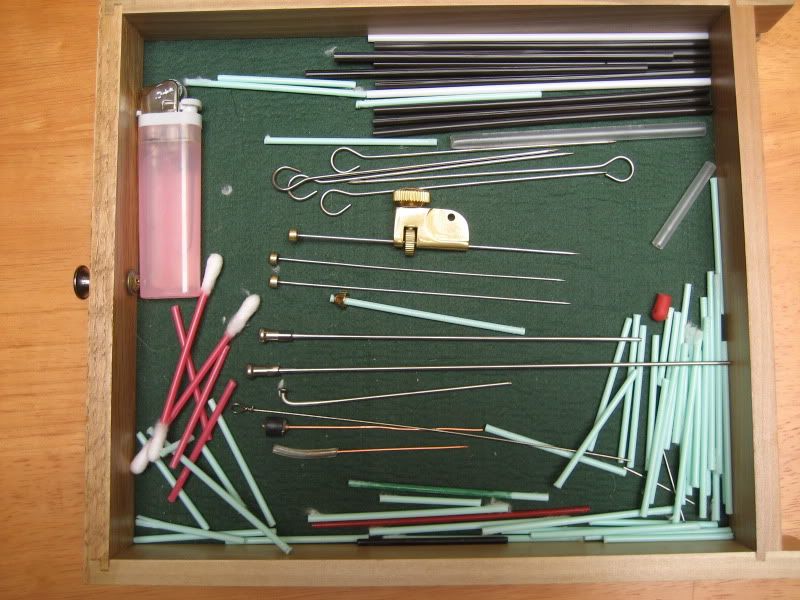
deon…back to your post…the above post caused me to go look in my “junk” drawer…this is a picture of just some of your choices…note the “L” shape of the end that was opposite the nut end of the spoke…also note the similarities of some things to a hat pin…things that were mentioned above…
Exactly! Also, you don’t have to add additional weight (if you use the copper or brass). Also, when a fish strikes, the hook generally pops free of the tube, thus saving the fly.
I was reading an article about the “Morrish Mouse” and the author emphasized that the biggest problem was the hook size and possible fish mortality. If you tie patterns like that, on plastic or light aluminum tubes you can add what ever size hook you want. More hooks ups with fewer wounded fish.