Here’s a quick question for everyone who actively targets carp.
I have 3 or 4 bruisers in the pond that I fish, and I’d like to try and go after them.
-
what kind of set up do you use (rod, tippet, etc)
-
what flies to you use?
-
how do you handle fighting fish in heavy vegetation?
Thanks!
First question, are they grass carp or common carp?
These would be your average, run of the mill common carp.
I cruise down to the marina grab some fish pellets chunk em on the water cast to the feeding dock pets and fight em for 20+ minutes on the 8wt.
I use an 8 wt. but also have caught them on a 6 wt McFarland Glass rod (that was fun!) I use a Type II line and a #12 haresear or #12 bead head Prince. It is sight fishing. When I see a bunch, I cast in front and past them, then slow steady strip.
I have caught them using a floating line and a very heavy fly like with dumbbell eyes or tungsten cone or bead.
Ok, first and foremost, see if you can figure out what they’re eating. We have a lake that we fish down in South Central Oklahoma that is full of carp. It’s nothing to catch 20+ fish in a half of a day. The fish are largely eating algae. So we use flies that imitate pieces of algae. Small, bushy flies tied in olive or brown (depending on the time of year) with either marabou or pine squirrel in a dubbing loop.
Anyway, the way we do it is to wade along, looking for fish feeding along the shoreline. When we spot a fish, sneak up and actually drop the fly in front of the fish. No “casting” required.
Here’s an example:
http://www.youtube.com/watch?v=ApoLbOT0nZs
Obviously, you have to adjust for your fishing conditions, but this will give you an idea.
Oh, and I like a short (7’6" or less), lightweight rod (I’m using a 3 wt).
Seriously, a 3wt? And you can land these? I am using 0X tippet (which I can’t imaging on a 3 wt.) and I am still getting break offs.
I’ve landed 15 lb grass carp on a 3 wt. And I usually just use 3x tippet. Any heavier than that and I find that they become line shy. The short rod is what really matters. When stalking fish that way, you need to be able to maneuver your fly in a hurry if the fish starts to move. Also, the shorter rod gives you more control when you’re trying to sneak a fly back into some reeds or weeds.
I use a 9’, 8 wt rod, and a reel with a good disc drag. I make sure I have my fighting butt attached to the rod. I use a Shooting Taper with a 9’ tapered leader, and a 2X or 3X tippet. My best carp flies are the Canyon Carp Fly, the Clouser Swimming Nympth, the Jitterbee, and the Bully Bugger.
Fly fishing for carp is exactly like stalking bonefish on the Florida Flats, and is great practice for that. You search for cruising and feeding fish, and carefully cast to them. You need to learn the different fish behaviors, such as ‘tailing’, and what it means.
It is a fascinating part of fly fishing, and as I said, great practice for fighting large fish on delicate fly gear. Example: You’ve for just hooked the biggest salmon/striper/LG bass of your life. You don’t get to hook fish this size very often, and most of the time, you’d lose the fish due to lack of experience. However, carp in the 20-30+ range are quite common, and readily hooked. If you lose a carp…who cares? There are plenty of them. Just re-rig and go for another one. Now, next time you hook that World-Class gamefish, you’re ready, and more than up to the task. And another bonus is that carp are delicious, when properly handled and prepared.
You Tube has some great video How-Tos to get you started. Just type in “Fly Fishing for Carp” in the search box.
Good luck, and have fun.
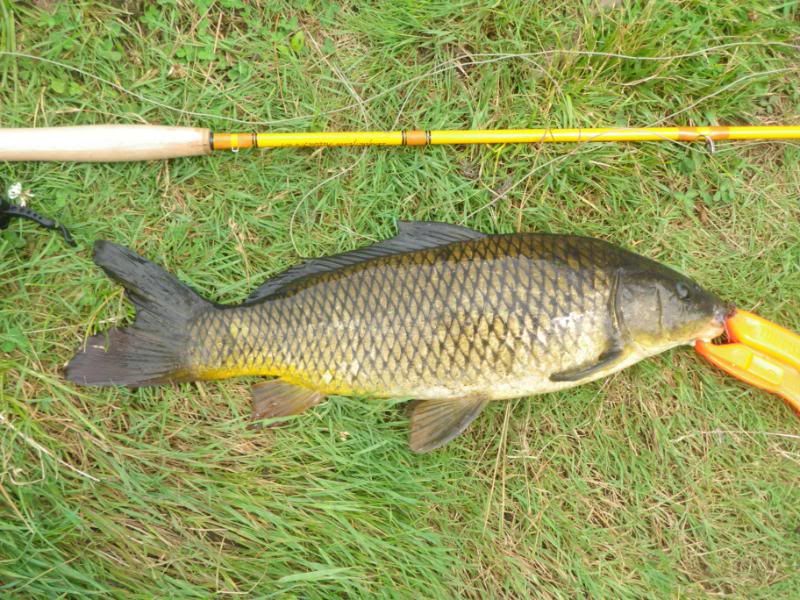
Carp on a 3wt fiberglass rod using 5x tippet
If you’re lucky enough, you can find them tailing just like saltwater bonefish or you can identify them feeding by looking for mud-puffs in the shallows. My favorite pattern is a bead head prince nymph and casting it where you think their head should be judging by where their tail is. I have a favorite lake here in Oklahoma that is surrounded by flats and I just wade the flats with my rod on my shoulder until I see a tailer or mud-puff. It’s strictly sight casting! While Prince Nymphs are my favorites, anything brown, olive or buggy-looking usually works. If they’re not tailing, I don’t have a clue how to catch them. I live on a lake with a good carp population, but it has no flats and I’m not sure how they feed or how to catch. Saw them one time feeding on top on floating cottonwood seeds. I’ve since tied a fly that looks like a cottonwood seed, but haven’t seen them feeding on them since.
HEY POKE - I’m just down the road from you in Norman. I’ve only been in Oklahoma just over a year so I’m trying to get settled and find places to fish.
I’ve been thinking of trying to go out and fish Lake Thunderbird (east of Norman) since there HAS to be carp out there! Have you fished for carp out there? I’d love to hear your feedback.
There is a pond just down the street that stocked with bluegill and bass and I’ve seen a few carp in there, but there are SO many weeds I’m almost afraid of hooking up since I doubt I could land it.
Outside of that I’m not sure where to look since my time to fish is limited to an hour here and there. That’s the life of being a father to two young kids…nap time is NEVER long enough!
Thanks for your help and insight…
Jim
Jim,
My son is also an avid flyfisher and lives in Norman with three young kids. It sounds like you two may have a lot in common. I’ll have to get you two hooked up some time for some local fishing. I’ve never fished Thunderbird, but my son has. He could tell you more about it. The lake I was referring to in my post was Taylor Lake near Rush Springs (probably less than a 45 min. drive from you) and its full of carp cruising the flats. If you have some time, it would be worth your trip.
Tom