"Spotting pike is a skill that must be learned. Trout, since they are
generally in moving water, sometimes betray their location to the angler with the
movement of a fin. Pike, since they are usually in still-water, can be stationary
and next to invisible. On many occasions, I’ve had conversations like this one
with my clients.
“There, cast to the pike that’s to the right of that rock.”
“What pike?”
“She’s a big one, hiding in the shadow of that rock. See her, just off to the
right, over there?”
“You’re nuts. There’s no fish there.”
At that point, I sneak over, tickle the pike with my rod tip, and then start
working with my client on spotting pike. That ability usually evolves in stages.
Stage I is when you see no pike at all and become convinced that there are no
pike in the water you’re fishing, no matter what the state guidebooks say. If you
can persevere through this stage, you’ve got it made. Stage II is when you see
the pike after you’ve spooked them. If you carry ample supplies of a good
antacid, you should survive this stage, as well.
Stage III occurs on one lovely day when suddenly you spot the pike before
the pike spots you. Good glasses will help you reach Stage III faster, but the
ability to spot pike comes mostly with practice. I hope you’ll stick it out, because
sight-fishing for pike is, for my money, absolutely the most fun a flyfisherman can
have in freshwater." ~ Barry Reynolds
About Barry Reynolds
Some years ago, I attended a flyfishing seminar conducted by a young
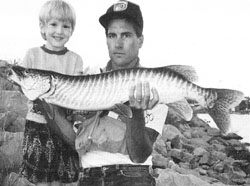
guide named Barry Reynolds. (That’s Barry and his son Mike on the
right.) I was going to Minnesota that summer to
canoe in the Boundry Waters, and I had some vague ideas about trying to take
northern pike on a fly rod. Barry, I had been told, knew more about this
subject than just about anyone.
It was a seminar like many others. Barry clearly knew a lot about pike. His
slide show featured the kind of appetite wetting photos of monster fish that get
any angler’s blood running hot. When he showed us how to tie some of the flies
he had found to be most successful, his demonstrations were conducted slowly
and carefully enough that I was confident that I’d be able to tie the giant, hairy
beasts that Barry insisted would catch northerns.
And that was the rub. Like many anglers, I attend seminars regularly.
Regularly I am assured by confident, tanned fishing pros that if I simply do
thus-and-so I will catch more fish or better fish or add a new dimension to my
fishing. And regularly I am disappointed.
So off to Minnesota I went, fly rod in hand. I also made sure that I took a
spinning rod and some huge Mepps spinners. I’m glad I took the spinning rod,
because if I’d broken a tent pole I could have used it to hold my tent up. It
served no other purpose during my trip. I caught a ton of northerns, all on my fly
rod. I didn’t catch anything very big my biggest one may have nudged twelve
pounds but to someone who considers a three-pound trout to be a big fish, the
size and strength of the northerns I caught were a revelation.
Barry’s flies and, more importantly, his tactics worked very well indeed.
When I returned home to Colorado, I looked Barry up and told him that he had
single-handedly made my trip a success. And I told him that he should write a
book.
“Gee,” said Barry, “I’m more of a fisherman than a writer.”
“Gee,” I said, “it happens that I’m more of a writer than fisherman.”
And so the book, Pike on the Fly, was born.
It is the result of hours and hours of conversations, writing and re-writing.
Barry loves to flyfish for pike, and he communicated his love for the fish,
for flyfishing, and for the outdoors to me easily and gracefully.
~ John Berryman (co-author of Pike on the Fly.)
Originally published c. 2003 on Fly Anglers Online by Barry Reynolds.