While organizing my tying stuff I came across some beads
that sparked my memory of a pattern created long ago, all
lost to the willows or fish and totally forgotten, lucky
for me and my clients I found my stash of glass beads and
went to work on revamping this hot little number.
The yellow sally stonefly hatch isn’t something that I chase
around Montana, it’s sparse at times and only predictable on
a few rivers. I do know it when I see it and at times it can
be as prolific as any caddis or mayfly hatch. The fish usually
take notice of this phenomenon and I have been rewarded with
some great afternoons by having a good selection of yellow
sallies in my boxes.
Over the last few years I have really distanced myself from
tying bead-head nymphs. Castwell would probably call this
evolution of some sort. He probably thinks I’ll give up
nymphs all together sooner or later, though he would be
wrong. Maybe it’s because the fish have seen so many beads
or that the beads render the fly more lifeless in the current,
I don’t know, but I do know that I have been having more success
without them and my tying reflects that. This pattern fishes
great under any modest size dry and really does a number on
the fish when they push into shallow riffles to feed.
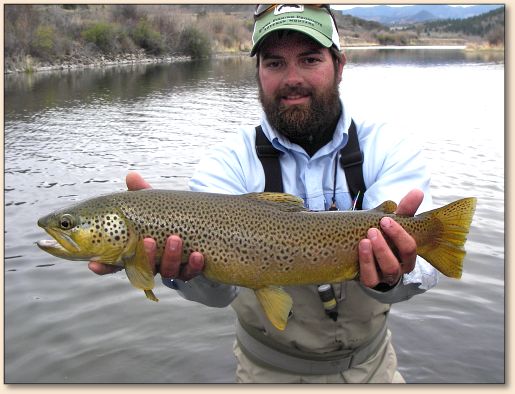
This style can be adapted to any smaller stonefly and you’re
only limited by the color and size of the beads you can find.
I found mine at a bead store.
Benjamin Hart has been guiding in and around Missoula, MT
for 8 years. For questions, comments or booking information
email him at: dryflies@gmail.com
Materials for the Yellow Sally Stonefly:
Hook: Montana Fly Company 7009 Up-Eye Scud, Size 14
Tail and Legs: Yellow Goose Biots
Egg Sack/ Bead Holder: Quick Descent Dubbing.
Body: Miyuki Delica Glass Crafting Beads
Wingcase: Saltwater Flashabou coated with UV Knot Sense
Thorax: Pale Yellow Hareline Dubbing
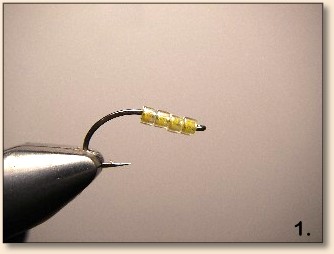
- Put four glass beads on hook shank.
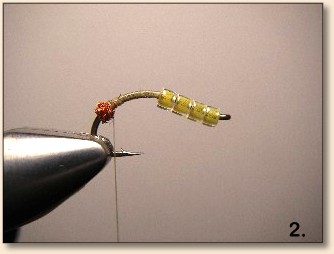
- Start your thread behind the beads and wrap evenly to the bend.
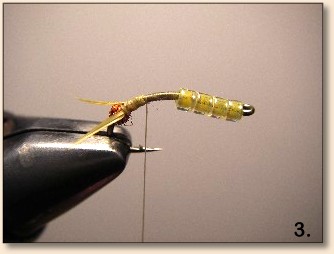
- Dub a very small ball of dubbing, this is going to split
the tails as well as hold the beads on the hook so wrap firmly.
Place one goose biot on either side of the dubbing ball, then
wrap firmly and clip neatly. Create a smooth surface that the
beads will slide over, then whip finish.
- Slide beads over the thread.
- Start thread again.
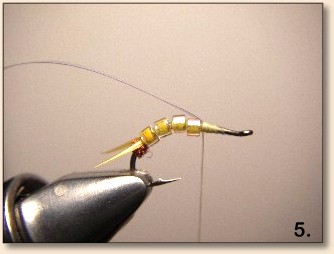
- Tie in one strand of saltwater flashabou.
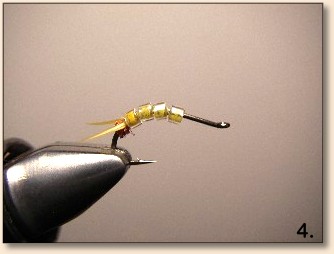
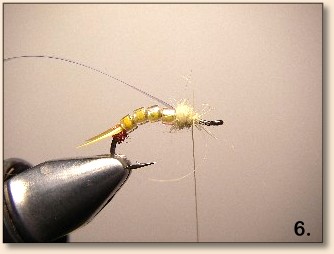
- Put some dubbing on the thread and wrap part of the thorax.
Add two more biots.
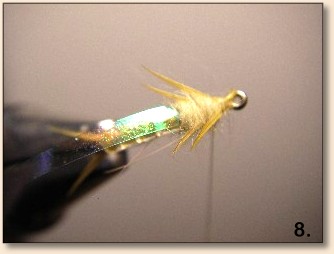
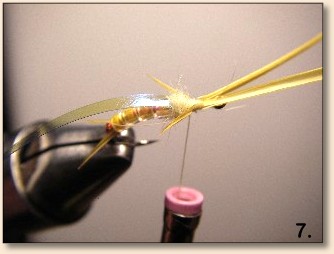
- Dub a little more and then place two more biots for legs.
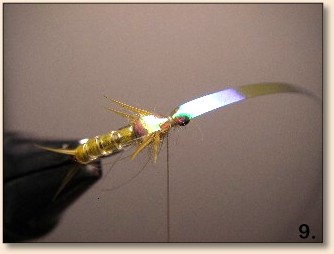
- Add a tiny bit more dubbing then fold the flashabou
forward locking it just behind the eye of the hook.
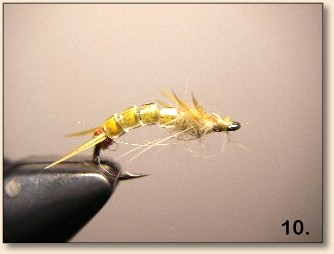
- Carefully place a small drop of Loon UV Knot Sense
on the wingcase, then either place it in sunlight or use
a UV light to harden, you can also use epoxy or omit
this step all together. ~ Ben Hart (Benjo)
For more great flies, check out: and
Originally published March 24, 2008 on Fly Anglers Online by Benjamin Hart.