Nestled on the banks of the mighty River Erne
and located in the scenic North West region of
Ireland, Ballyshannon is one of the oldest and
earliest settled towns in the country. It is also
home to the oldest fly tying firm in the world.
For almost 170 years the firm of Rogan has been
designing and dressing fishing flies for the most
discerning anglers in the world. Since 1830 the Rogan
name, built on tradition, quality, innovation and
above all else, craftsmanship has been carefully
nurtured through five generations of the family.
It was Michael Rogan Senior who first brought world
acclaim to the Rogan flies. Born in 1833, he learnt the
art from his father, James Senior, founder of the firm.
He soon showed a wonderful aptitude for salmon fly
dressing. It is recorded that at the age of 12 he was
dressing salmon flies which were so successful that many
experienced anglers of the period would use no others.
As this craft was handed down from father to son,
none of the mechanical aids developed to assist the
amateur fly dresser were ever used. The Rogan tiers
remained true to the art of hand tying and scorned
the use of a vise, of pliers, bobbin holders and
tweezers. A small pair of scissors and a needle stuck
in a cork were all that was required. Michael Senior
is famously quoted as saying that nature had provided
the ideal tools for he job in the shape of fingers!
He considered this necessary to achieve the correct
amount of tension on the silk, the hackle and the
wings and to eliminate any stress on the hook. Fingers,
he said, were far more sensitive to the pressures and
strains than any steel contrivance, no matter how well
designed.
During the mid-nineteenth century, the great English
angling writer Francis Francis visited Ireland on one
of his grand tours and became acquainted with Michael
Senior’s work. He described his salmon flies as ‘akin
to a piece of jewellery’. This description occurs once
again in Taverner’s book ‘Salmon Fishing’ — “Some of his Claret Bodies and Green Parsons were not unlike
pieces of jewellery.”
Michael Senior was invited to London in the early 1870’s
by the now defunct London Salmon Fishers Club to dress
salmon flies for them personally. During the next twenty
years he spent several months every year in London dressing
salmon flies and was invited a number of times to fish in
Norway, Sweden and Iceland by the gentlemen of the London
Salmon Fishers Club. The quality of his salmon flies brought
him a coveted Medal of Excellence and Diploma at the International
Fisheries Exhibition in London in 1883.
Tradition has it that to achieve the brilliant and
long lasting colors of his flies Michael Senior used ass’s
urine to degrease materials before dyeing them. That from
a stallion was said to be the best for the dying process.
This was kept in a barrel at the rear of the premises at
Bridge End in Ballyshannon. Frequent complaints from
neighbors to the sanitary authorities led to many visits
from inspectors who were often sent away with a box of
flies in their pockets and little more was heard of the
matter! Old Michael reckoned that it was only at this
stage that it was ready to be used as a super-detergent
for preparation of his materials before dyeing.
Of the many salmon flies Old Michael created perhaps
his best were the Green Parson, Rogan’s Fancy and
the Ballyshannon. It is also a fact that he invented
the famous Fiery Brown color via his special dying
process which gave it a brilliance that had not been
in evidence before (and some would say has not been
seen since) He perfected a method of winging salmon
flies which caused each individual feather to react
independently of its neighbor creating a translucent
lifelike effect.
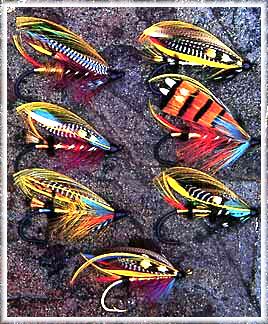
Photo courtesy The Martin Company, Kamiah,ID
In his long life as a fly dresser, Old Michael made
many friends in all walks of society and many shared
his fireside in the shop in Ballyshannon to partake of
a nip of Irish whiskey and to talk of the day’s happenings.
On one occasion, the visitor was Edward, Prince of Wales,
and the son of Queen Victoria. Old Michael offered him the
customary draw of his clay pipe. This was accepted but
before putting the pipe in his mouth, the Royal visitor
wiped the stem of the pipe with a silk handkerchief. He
took a few pulls and returned the pipe to its owner. Michael,
with calm deliberation, broke off a couple of inches from
the stem and replaced the pipe in his mouth, continuing
to smoke it for the rest of the evening!
During his lifetime, Michael Senior trained his two
sons and daughter in his art and after the old gentleman’s
death in 1905 his son James inherited the business. As
the craft was handed down from father to son, they continued
to tie in the traditional method, without use of a vise or
any mechanical aids.
In the early part of the 20th century, the Erne River
came into its own as one of the finest salmon rivers in
Europe and it was from the gentlemen anglers who came to
fish it that James received his business. Continuing his
father’s tradition of tying quality custom-built flies,
he was never short of customers from the discerning
fishermen of the world.
Fortunately, James started training his son Michael
Junior in the Rogan tradition of fly dressing, for when
in 1935 he had a stroke which led to his death three years
later, young Michael was able to carry on the business
as a professional tier at the tender age of 16.
Michael continued to tie flies for anglers throughout
the world and at one stage in the 1960s tied exclusively
for the famous firm of Hardy Brothers of London. He
married Rita in 1941 and trained her in the craft. Sadly,
in 1947, the magnificent Erne became a victim of ‘progress’
when a hydro-electric scheme destroyed the once beautiful
and famous river, but not before Michael had taken a personal
best Atlantic salmon of 30 lbs from it — on one of his own flies,
of course!
American anglers may be interested to note that Michael’s
Uncle Alexander Rogan, who had been trained in the family
business, emigrated to New York in the 1920’s and carried on
the traditional hand-tying trade when working for the now
long-closed Alex Taylor tackle shop on 42nd Street in Manhattan.
Sad to say, he found he could not keep a family on his salesman’s
wages, even with the additional income from his beautiful flies
and decided to quit the business for the more lucrative trade
of barber, a skill he had acquired in the trenches during
World War I. An article about Alex Rogan by Leonard M. Wright
Jr. appeared in the Spring 1999 issue of Fly Tyer magazine.
The Rogan company fell on hard times following the death
of Rita Rogan in 1987. No surviving members of the family
were able to carry on the tradition and although Michael
and Rita had trained several local women in the craft, the
company lacked direction and was almost extinct when David
and Connie Feely, a young couple originally from the area
but then living in San Francisco heard of its plight and
returned home to resurrect the business.
After much heartbreak and tribulation, they finally raised
the capital and realised their dream of ownership of one of
Ireland’s legendary angling companies and have pledged to
continue the great Rogan hand-tying tradition. They have
chosen the name Cuileoga Rogan for the new company which has
been formed to carry on the wholesale side of the Rogan business.
Cuileog is the Irish name for a fly, in this instance a fishing
fly, and it is in keeping that they should chose to promote all
things Irish in relation to the brand name. The business was
formally re-launched in March 1999.
The new management team has developed a business
plan to take the company into the 21st century. The
old premises at Bridge End in Ballyshannon have been
sold and a new development on the Bundoran Road will
eventually house a modern tackle shop, a Rogan Museum
and an Interpretative Centre. If demand is there,
the company will consider the provision of hand-tying
courses for amateurs wishing to learn the traditional
method of tying without a vice. A new factory will be
opened in Gweedore, Co. Donegal, where hand-tied Rogan
trout and salmon flies will be produced.~ Shuck Raider
Originally published c. March 11, 2001 on Fly Anglers Online by Arthur Greenwood.