My preference in fly fishing is to dry fly fish. However, when the trout are not rising, and I don’t wish to nymph, I turn to a soft hackle. Other than nymphing, what do you do when the fish are not rising?
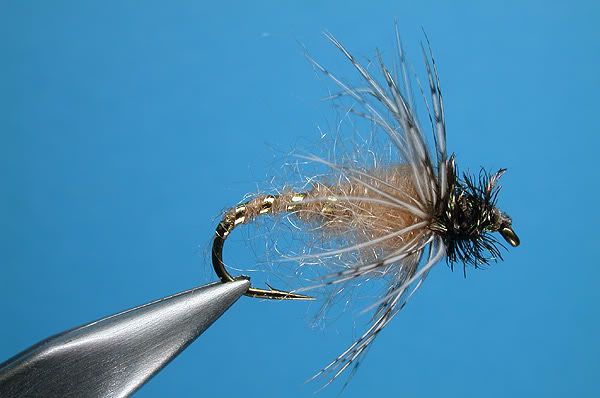
This is my soft hackle which really does produce well:
Ed,
Simple dressing.
The abdomen and thorax are made of my own dubbing. It is made by blending 3/8 inch pieces of Dazzleaire (sort of an antron material) in the coffee grinder until it fluffs up. The color is sort of a peach brown (if that is a color).
The ribbing is small gold mylar.
The collar is natural partridge. The “head” is peacock herl.
Thanks,
Byron
I have a page from Han’s website with Byron’s soft hackle lying on my tying table. I need to try producing a few for this weekend, Saturday is supposed to be good weather wise here in the ATL area.
If nothing is showing I always start with a soft hackle. Depending on the season I choose the size and colour of what MIGHT be hatching, or hatched yesterday.
I hardly ever resort to nymphs, I don’t do well, so find it boring. Byron’s soft hackle is a good medium colour so would be my choice June thru August. this year has been the year of the midge in Ontario so would probably choose smaller and darker with that experience.
… fishing the water, with dries as a first choice and nymphs as a second choice, to sight fishing or fishing to rising fish.
I certainly won’t walk away from rising fish to go fish the water, but I won’t go looking for rising fish and pass up the challenge of finding good holding water and pounding fish up with an original homebrew pattern.
The past couple days have been very interesting - field testing a size 22 loop wing BWO. A nice blend of presenting it to fish that have shown themselves taking naturals and fishing good holding water and getting a good number of lurkers hooked up - the best of both worlds.
I still throw a dry. If nothing comes from that, sometimes I’ll tie on a small streamer or soft hackle. But more times than not, I’ll tie on something like a Royal Coachman. Fish it dry until it won’t float anymore, then pretend it’s a wet fly / streamer and fish it that way. More times than not it works one way or another.
CDC for the loop wing. Between the CDC and a few wraps of hackle, trimmed on the bottom, the fly rides low but will keep on floating for very long drifts on those presentations when it doesn’t get taken quickly. The CDC is surprisingly easy to see in a variety of surface and light conditions.
This has been a very productive fly the past couple days on my home water. It is a bit fragile, which means I now have to go tie a few more for today’s field testing session.
… with water depth and streambed structure making wading not such a good idea, mixed currents to cast over into really jumbled currents below the rock so long line nymphing is not a good option, and there is no bar in the area, so what to do ??
Fish the water with this …
… October Caddis and watch it get attacked by …
… a really fat, healthy, strong 17" West Slope cutthroat, the biggest one I’ve had on in a couple months now.
I was pretty sure that there would be at least one really good sized cutt in that pocket since I raised three large ones yesterday with a Duck’s Green Drake, which they all looked at closely but refused.
The only practical approach here was fishing the water with a dry - which happens to be my prefered approach anyway, and this is a good example why. Presenting the fly, i.e. casting and line control, was a real challenge with the mish-mash of currents and still water below the rock to contend with, so hooking and landing this guy was a highly satisfying and rewarding outcome. I quit for the day after taking the pic and releasing him.


 [b]
[b]


