I’ve seen some very interesting ‘things’ described as flies and was wondering,
How would you define, or better yet, can you describe the difference between a ‘fly’ and a ‘lure’. Is it the way it is: 1)Cast; 2)Fished; 3)The size of the hook; 4)The shape of the hook; 5)The shape of the ‘thing’; 6)The materials used to tye the ‘thing’; 7)A combination of some of the avove; 8)Something else, a)by itself or, b) in addition to some of the above?
I’ve read something somewhere about this but don’t recall where or what was written.
That is a question that has gotten me into many long and heavy debates: When is a ‘fly’ a spinning lure. It actually does matter, especially on waters that are fly fishing only, then you have to make sure that the object you are casting falls within the specifications of a fly and not a spinning type lure. You can’t just say it only matters as to the rod you cast with, since you could put a bass Jitterbug lure on a heavy fly rod and sort of cast with it. or a Mepps Spinner that has some feathers tied to its hook.
It will be interesting to see what others have to say about this topic, if they want to wade in and toss out their opinions.
I will have to think about this more, but right now, I agree with Larry (sagefisher). This could be discussed from now to eternity and I do not feel the outcome would be any different than it was in the beginning. It boils down to the person using the fly/lure on what they call it. There are some “flies” that (my opinion only) I feel could be called “lures”. A Pistol Pete is one of them. I am not sure there is an answer to this question, but, in “flies only” water, you better do your homework and make sure you understand what that particular “flies only” rules are or you could be fined.
Overall, I think it is a question that can never be answered to everyone’s acceptance, but, just opens up a large discussion that could get “nasty” and I am glad this discussion is on FAOL because when or if it starts to get “nasty”, our administrators will put a stop to it.
There have been times when I was using a flyrod flatfish or a #00 spinner wtih a treble hook that I knew I was fishing a lure just as I know I am fishing a fly when I tie on an adams or a fox squirrel nymph. Unless I’m fishing flies only water I don’t worry too much about the things on the borderline. I understand that C.O.s on the Pere Marquette at one time were calling a Clouser minnow a jig. I don’t know if they still are but it seems to be accepted as a fly by most people these days. Similarly some of the flies being made with dremel tools seem very similar to the flyrod flatfish. I’m not sure why they wouldn’t be a fly if the surface bugs made from the same material are. Does it become a fly if I add a long tail and call it a floater/diver? Or if I spin deer hair and trim it to the same shape? if it’s the presence of the dangling treble hooks that makes a lure rather than a fly then tube flies become lures. I guess I’ll just fish what I like tying or fishing wherever it’s legal.
I found this definition of a “fly” in one of the Missouri State trout park:
In waters designated fly fishing only, a fly shall be constructed on a single point hook of feathers, tinsel, chenille, yarn, fur, silk, rayon or nylon thread or floss, with or without a spinner.
I can cast most rapalas with my 14 weight, but that still doesn’t make them a fly. Game and fish departments that have coverage of ‘fly fishing only’ waters are always engaged in debates as to what constitutes a fly, and therefore it can change form year to year, water to water, and state to state, and invention to invention.
My 27" trolling fly is identical to my 12" casting fly af far as the tie goes. It’s just a deceiver pattern. If I had a 30wt, I could cast it, too. It’s a trolling fly, not a casting fly, so is it a lure?
Lures and flies are both artificial baits. As was mentioned, flies are lures, but lures are not flies. The blending of parts of lures and parts of flies makes for debates and opinions vary as to how far one can go. It’s an individual thing until a G&F officer stops you and says you’re out of bounds with that lure in flyfishing water. Another point, is a glue-gun egg a fly? No thread or materials- just a gob of hard glue. Any different from a lure? Tie a piece of white marabou to a multiple glue-gun egg cluster…is it now a fly?
This debate, along with traditional vs new, natural vs synthetic, dry vs wet, bamboo vs graphite, bobbers vs natural drifting, will go on and on as long as flyfishers have opinions. The only times it will matter is if you catch a record or are fishing in a restricted area. (Maybe a few other times) The records board will decide about the fly and the methods used to catch it. The G&F Officer will decide about the fly (lure) in his fly-fishing only waters.
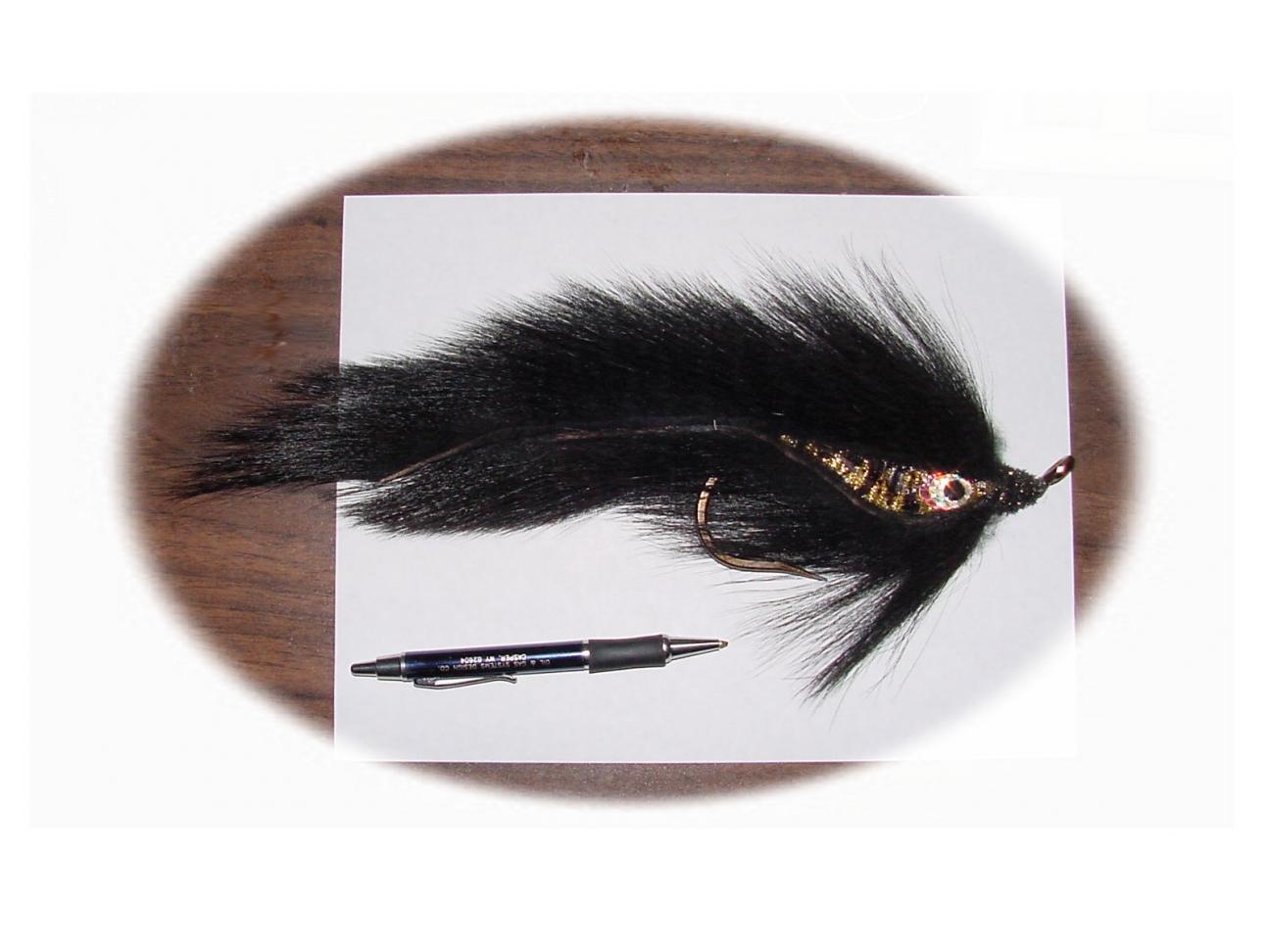
Is this a fly or a lure? 14/0 zonker for sailfish:
To me , in terms of fly fishing , a “fly” is something that tries to recreate something like an insect that natrually occurs in nature. A “lure” is designed just to look like something good to eat to a fish even if theres nothing close to its shape or color present in the water. Like an Adams vs. a Stimulator. Just my two cents
Nothing against the OP for wanting to learn but a true fly fisher knows the difference ,
at least enough to keep out of trouble on fly only water… a panther martin style with feathers won’t cut it.
Plenty of fly tying books if you don’t already have the general idea.
This is a great example of the debate. Flies with a Bead Head, or a cone head by this definition would not be considered a fly, by the Missouri definition.
Not sure about other places, but in those State Trout parks in Missouri, a bead head is allowed. They are primarily trying to get away from rubber worms and the likes. Oddly (it seems to me) they allow: “with or without spinner”…
To me and the old English, a fly is a lure. Made up of feathers, hair, synthetics, whatever…no scent, no taste, it is a lure/fly. PLUS, artificial. As the second post stated, does it matter…
I think it is more in HOW you fish it that people are hung up on. You can fish a worm with a fly outfit. To me, you are fishing bait with fly gear, just like you put a fly on a spinning outfit, NO you are not fly fishing,
you are Spin Fishing, but using a fly.
Fly, hardware, bait…the name of what is on the end of the line. Fly rod/reel/line = fly fishing…spining rod/reel/mono or whatever = spin fishing.
Next step, are you using a fly, mepps, blue fox, kastmaster…LURES or worms, marshmellow, velveta, etc…
You want to get more into details, you could attach a piece of fly line, or even a leader to a stick, then attach a fly…is that fishing Tenkara?
But, again, the old English, used a lot of weight in their flies, sooooo, pretty sure they could cast the line as you put it.
Plus, you can cast hardware with fly gear.
Artificial fly
From Wikipedia, the free encyclopedia
Classic 19th Century Artificial fly-The Triumph
An artificial fly or fly lure is a type of fishing lure, usually used in the sport of fly fishing (although they may also be used in other forms of angling). In general, artificial flies are the bait which fly fishers present to their target species of fish while fly fishing. Artificial flies are constructed by fly tying, in which furs, feathers, thread or any of very many other materials are tied onto a fish hook.[1] Artificial flies may be constructed to represent all manner of potential freshwater and saltwater fish prey to include aquatic and terrestrial insects, crustaceans, worms, baitfish, vegetation, flesh, spawn, small reptiles, amphibians, mammals and birds, etc. Effective artificial fly patterns are said to be killing flies because of their ability to put fish in the creel for the fly fisher. There are thousands of artificial fly patterns, many of them with descriptive and often idiosyncratic names.
I believe the Victorian view was that it was a fly if the “fur and feathers tied to the hook” represented a fly. It was a lure, however, if the pattern represented a baitfish, shrimp, or was just an “attracter”. The NZ matuka patterns, the killer patterns, the “fuzzy wuzzies”, and the pukeku-style patterns are all usually referred to as “lures” here in NZ. All of them, however, would be perfectly acceptable on “fly only water”. Things like the “Butcher”, or the Alexandria, were also referred to as “lures” because they didn’t represent flies.
This topic, which seems to come up every now and then, is really a discussion on definitions. However, for some reason, people seem to find it insulting if their favorite pattern is called a “lure” rather than a “fly”? In the end it’s all just artificial bait. And don’t forget your Shakespear, “A rose by any other name would smell as sweet”.
I may be guilty of trying to be something of a “purist”, but here is my personal feelings on the subject:
It gives me a great deal of happiness to catch a trout on a tiny artificial FLY (by that I mean artificial insect). I will grant you, “flies” are also tied to imitate minnows, scuds, shrimp, etc. etc. However, if given the choice between fishing an artificial insect and any other imitation, I would choose the artificial insect. - any stage of such insect: nymph/pupa through the spinners…