I don’t fish Sparkle Duns, but my assumption would be that the fly doesn’t ride horizontally but rather diagonally with the “shuck” and body hanging below the wing a la a klinkhamer. Your typical parachute doesn’t.
The point would be the position of the husk as the dun emerges. The YouTube isn’t really clear, but the one thing I did notice is that one could see the body of at least one emerger reflected off the mirror ceiling. I think this would support my point but not in a definitive manner.
I’m not sure it does Steven. I do tie my standard parachutes with the tail fibers either split tail or fan tail with a dubbing bump. However, many parachutes are tied with straight tail fibers without the broad support of a fan tail or split tail. A sparkle dun does have the zelon fibers splayed and my impression is that they are sufficient to support the back of the fly, especially in the smaller sized flies.
http://www.charliesflyboxinc.com/flybox/print.cfm?parentID=46
The reason Hans van Klinken put no “shuck” on a Klinkhammer was that he wanted the back of the fly to penetrate the meniscus and sink rapidly without the supporting drag of a tail. That is also why the hook shank is at a downward angle and not parallel to the hackle.
In fact, Han van Klinken says that the support of the tail is not necessary to support a parachute; the hackle is sufficient. This quote is from The Hackle in the reference below: “A parachute fly floats in the surface mainly because of a perfect balanced and well-tied horizontal hackle. A tail can be helpful but isn?t really necessary.”
Hans van Klinken specifically says you need 7 or 8 wraps of oversized quality hackle to support his fly and keep it from sinking. It is tied with more wraps than a standard parachute. We think of the parachute as a balancing act between tail fibers and parachute hackle, but in truth the Klinkhammer Special is more of a balancing act between the rear of the fly trying to sink the fly and the front of the fly trying to keep it up.
“I have seen stories with great pictures and many beautiful variations of the Klinkh?mer but not one of the flies I even would dare to suggest or advise people to use or try. I have some very strong arguments for these comments as well because a parachute hackle made from just two or three hackle windings simply will not work. Even a try will be already a catastrophe because a weak hackle like that never will be able to hold the heavy hook in the surface. If you read carefully then you will notice also that you need a long hackle as well. You have to be able to make a lot of turns. Depending about the size of the fly it can go up to seven or eight and even more.… I have tied a whole bunch of Klinkh?mers especially with what seems an oversized hackle at first. I don?t know what it exactly imitates, it could be a spider but I can assure you that it works well. I don?t know why but when I am in a group and when we put flies together mine seems always bigger.”
http://www.danica.com/flytier/hklinken/klinkhamer_special.htm
I do use sparkle duns AND comparaduns and parachutes. I even tie parachute with zelon tails. I suppose I can call them sparkle chutes.
I really have not noticed much different it the attitude of the fly when I fish them. I have not noticed that the wing is tilted back to indicate that the rear of the fly is sunken. It may be that there would be a discernible difference to a selective trout, but it certainly is not to the extent that a sparkle dun assumes the sunken position of a Klinkhammer Special.
Silver,
Post a pic of your parachute.
Thanks
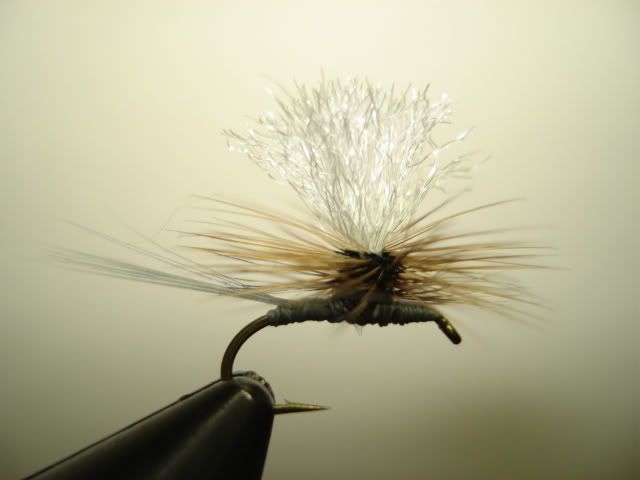
I think this is tied on a Tiemco 921 2XS, 1XL hook. I took it years ago and it must be a small fly because it has a thread body.
SC,
That was kind of long and I’m not sure who said what in your post, but I did seize on your comparison of a sparkle dun to a parachute. I don’t think you can compare the two as the parachute hackle spreads in front, to the sides, and the back of the wing, whereas the wing of the sparkle dun, and therefore its support, is in-line at the front of the fly.
Whereas a parachute might float properly without a tail if the collar hackle is long enough, this most certainly would not be the case of a comparadun without a tail.
Thanks Silver, but I thought you did not tie with such long posts? For that hook, that is a TALL post.
I agree it is long as are the tail fibers. I carry a pair of straight iris scissors with me if I want a shorter wing.
The points I was trying to make is that a parachute even with a zelon tail will float in the film and not angled like a Klinkhammer special.
My second point in posting a URL to Charlie Cravens sparkle dun is that the sparkle dun xelon tail fibers are splayed when tied in so they also provide support to the back of the fly.
My third point is that Hans van Klinken designed the Klinkhammer Special without a tail because any tail will help support the back of the fly.
My final impression was that in fishing fresh sparkle duns myself they do not seem to be angled down in as a Klinkhammer. I cannot say what they look close up or in rougher water. I also think that a fly that has been chewed and abused by a few fish floats lower than a fresh fly. So I think with sparkle duns the look of the fly is not static but changes over time.
The point I was trying to make is that a parachute without any tail will float in the film and not be angled like a klinkhamer.
I didn’t look at the Flybox site so can’t say.
My argument about the tail on a klinhamer is that the tail will support the fly for a short while, but will become saturated and eventually sink. If any material will support the back end of a fly, why am I always searching for decent spade hackle?
I don’t think you will find that the creator of the Sparkle Dun ever splays his zelon tail, nor do I.
The trailing shuck on an insect is not wide.
If you look at the photo of Charlie Craven’s sparkle dun below, the zelon fibers naturally spread out when tied in. I believe they initially they fall on the water spread out and support the fly.

Although I use the image above as an example, I think if you search google images for sparkle dun, the tail is composed of spread out zelon.
I’ve read only a couple of posts in this thread but if anyone has access to the book by Royce Dam(not sure if it’s 1 or 2 m’s), you should see how he tyes a parachute fly. He does the best job I’ve seen in the technique, neatness, durability, and finishing off of the fly.
Allan
[QUOTE=Silver Creek;451873]If you look at the photo of Charlie Craven’s sparkle dun below, the zelon fibers naturally spread out when tied in. I believe they initially they fall on the water spread out and support the fly.
Although I use the image above as an example, I think if you search google images for sparkle dun, the tail is composed of spread
Silver,
I will stick with method of tying the Sparkle Dun that the inventer and promoter does it. You can watch his on utube as well.
But thanks anyway.
PS. The one you show does not appear to have a splayed zelon tail. There is no thread under the
Byron,
To view a good demo clip on tying off around the post, go to KWSU.org, click on “Fly Tying the Anglers Art.”
click on season four and scroll down to episode 404 (Parachute Adams) The fly tyer is LeRoy Hyatt.
Works very good for me.
Crunchy
Crunchy,
That is how I tie parachutes off now. Funny, I started tying back in the early 70’s. There were no videos, youtube, even books with much on fly tying except the old school patterns and styles. So, I sort of learned on my own and tied parachutes the way I figured out on my own. The natural way seemed to be to tie the hackling feather off at the eye.
Now, I like the method of tying off at the post. Keeps things “cleaner”.