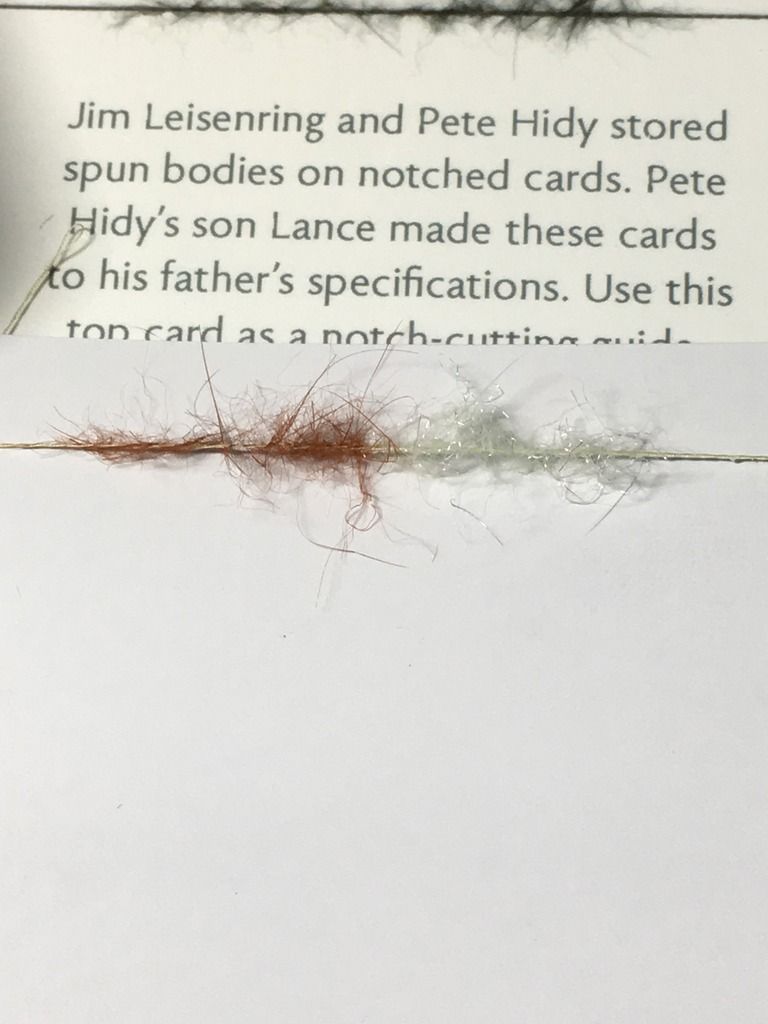
I got one of the Hidy dubbing loop blocks and attempted my first pre-made dubbing loop. Very interesting process. Have to find my tweezers to aid in the placement of dubbing material on the waxed silk thread… Just couldn’t resist trying their old techniques…
Anyone out there still doing it the old-fashioned way?
These are the “tools” I am using. Silk thread, Clark wooden block with slits and a top pin, a card to hold the completed loop. You need, of course to use wax to prepare the thread to cause the dubbing material to adhere to the silk thread.
I hear you Joe. I have watched a video in which Dave Hughes replicates that method. May try it some time, but think I will concentrate on the block method for the time being.
I would add this comment to those who have not used this method: It certainly reinforces the fact that you need VERY little dubbing to dress the hook in ANY method of body dubbing.
Of course. That’s how I tie all my flymphs – and I tie a lot of flymphs.
Almost hate to admit, but what I like best about this method is that while I can’t tie and watch TV at the same time, I can work the dubbing block and watch TV at the same time. I’ll make up a bunch of bodies one night, and tie the next.
It’s also easier to make multi colored bodies with the block – lay down a light color at one end, and a darker at the other for a thorax. It’s fun to experiment.
Last,
I am told that you must use silk tying thread which holds the wax. I got a bunch from Stockard’s and it works well.
I got my tying block through a suggestion on this site…from Dette’s via internet. There are a couple sources for the blocks that I have seen. I think if you just do a search for “dubbing loop wood blocks”…or something similar.
Hope that helps!!
As I said in the original post…“Just couldn’t resist trying their old techniques…”
So, that’s about as simple an explanation as I can provide. I have read for many years about how they created all their cards for later use in dressing their flymphs. I just decided that I would see if I could replicate the method myself.
I happen to be a big fan of the history of fly tying and trying their methods makes it more interesting to me.
Years ago, I tied on eyeless hooks and learned the snell knot for attaching to tippet…just to see.
I understand Duck. However, I personally prefer thread/silk dubbing loops. More delicate.
In addition, there are certain nuances in the Leiserling/Hidy/others’ method. They wanted just a hint of the silk thread to show through. In addition, they desired large heads formed from the tying thread on their flies.
In a way, that just brings things full circle. Leisenring and Hidy fished the Broadhead Creek in PA, near Henryville – home of the Henryville Special, and one of the most caddis-infested rivers I’ve ever fished.
Bob,
I know this will probably bring a chorus of disagreement (it has in the past), but here goes anyway. The early fly fishers (talking very early) did not recognize the importance of the caddis to the trout and the fly fisherman. Some of the early authors discuss the caddis fly and then state that it is not an important food item to imitate because “they are on the water late in the evening”. That is NOT to say that nobody knew of them and their behavior. They are mentioned in old books and their entomological classifications to be sure, but their importance to the fly fisherman was not widely accepted.
Since the late 50’s (with Al Troth’s EHC), perhaps, the caddis fly has been more generally recognized as a very important food item for trout and for the fly fisherman to imitate. Of course the work done by Gary LaFontaine (in the late 60’s-early 70’s), and others as well, did much to popularize patterns and the science of their life cycle and behavior brought the caddis into the mainstream of fly fishing…in my opinion.
Anyway, it is interesting that you point out the ubiquitous nature of the Caddis on the Broadhead where Lessening and Hidy Tied and fished their Flymphs…