I really enjoy working on complex and realistic
looking flies, but when I’m tying to fill my fly
box with flies that work and don’t take a long
time to tie, I usually tie something simple that
does the trick. Productive flies don’t have to
be complex to catch fish. In fact, sometimes it
works better to use a simple, impressionistic fly
when you’re trying to fool Mr. Fins.
When mayflies are emerging, they must float a long
time on the surface before their wings get dry enough
for flight. In fact, sometimes the time it takes
from the moment they begin to emerge until they are
capable of flight can be measured in hours. During
this time, they are easily picked off by hungry fish
looking to fill their stomachs with extra protein.
That is one main reason so many flies are tied to
imitate mayflies. Caddisflies, stoneflies and midges
aren’t on the surface very long, so fish rarely get
to eat those bugs at their leisure, but mayflies
provide some leisurely dining.
This mayfly pattern uses dyed light dun snowshoe
hare foot hair for floatation. The coarse hairs
on the bottom of the feet of a snowshoe hare float
as good or maybe better than CDC, but unlike CDC,
snowshoe hare can be treated with your favorite
floatant without matting it down and ruining the
floatation effects. When I tie bunny flies (that’s
what I call flies tied with snowshoe hare foot fibers),
I usually pre-treat them with RainX to help them
shed water and float better. That’s why I often
use snowshoe hare instead of CDC on emergent flies.
However, if you have CDC and no snowshoe hare, use
the CDC on this pattern and you’ll do just fine.
The extended body looks more like a real mayfly
than a standard dry fly does (in my opinion).
Too Simple Extended Body Bunny Mayfly
List of materials:
- Hook - Any curved, caddis style hook. I’m
using a size 18 Mustad chemically sharpened hook.- Tail - Same as body.
- Body - Micro ultra chenille. I’m using
golden tan here, but you can use any color to match
the insect you want to imitate.- Legs - None.
- Thread - 6/0 tan (or colored to match the body).
- Wing - The hairs off the foot of a snowshoe
hare, in this case dyed light dun.
Tying steps:
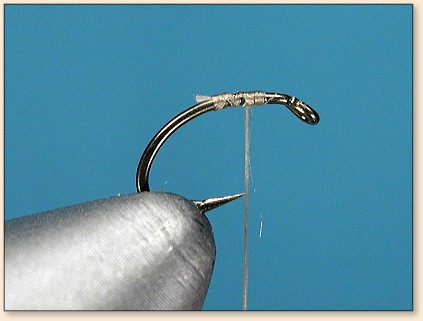
- Place the hook in the vise so that the eye
is fairly high. Start the thread close to the hook
eye.
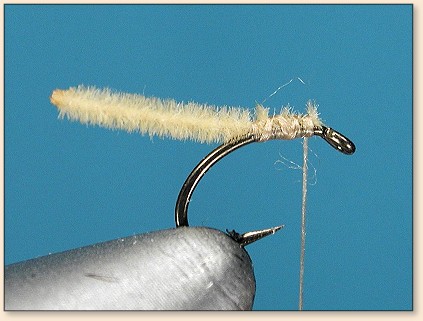
- Secure the micro ultra chenille to the hook
letting the chenille extend to about twice the hook
shank before you trim it. If you want, you can
carefully melt the tip of the chenille with a lighter,
but be sure not to let the flame touch the chenille.
Ultra chenille burns fast.
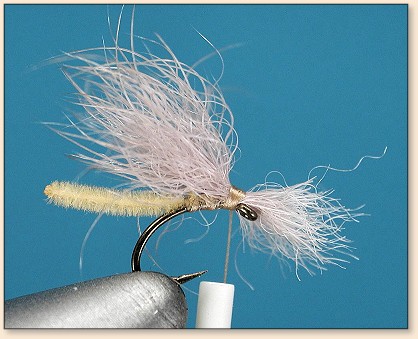
- Clip a small clump of hairs from the bottom
of a snowshoe hare’s foot, remove the short under-fur;
then tie the hair to the top of the hook so that the
tips of the hair extend to about the tip of the
chenille body.
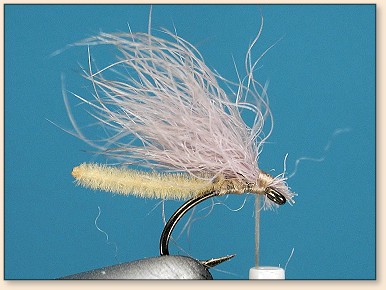
- Trim the hairs that extend over the hook eye.
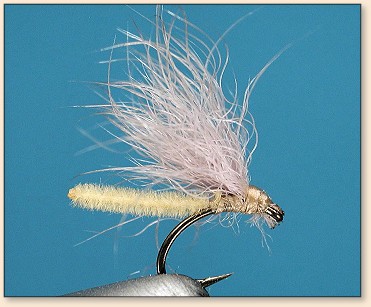
- Build a head, whip finish and cement the head.
I use a metal hackle guard and a lighter to singe the
hairs back from around the hook eye, but sometimes
I still have hair blocking the hook eye. For that,
I use a needle heated until it is red hot, then push
it through the eye of the hook to melt the hairs back
out of the way. I don’t get too careful about looks
since this fly is designed purely to catch fish, not
fishermen.
Scroll back up to the top of the page. Does this
fly look close enough to the real thing to fool a
fish? If you can’t decide, compare an Adams to
the real thing and then decide. If you want a
fly that will catch fish, but is real easy to tie,
you might want to tie up a few of these simple
flies. I doubt the fish will complain about the
fact that you didn’t spend a lot of time tying them.
~ AC
Originally published March 8, 2004 on Fly Anglers Online by Al Campbell.