Tinker Mackerel By Bill Catherwood
Previously published in the
Fly Fishing New England magazine. We thank them for sharing
this with our readers.
To write about my Tinker Mackerel pattern I
had to look back and recall just when I originated
it. Back in the 1950s I went to Stoddards in Boston
to find some suitable fly-tying hooks. Back then,
Jerry Rosenfield managed the fishing department.
Jerry and I hadn’t met before and he inquired as
to what I tied. I told him I tied trout flies and
bass bugs on a commercial and custom basis for money,
while for my personal use I tied Herring and Mackerel
imitations for use in saltwater. Jerry was surprised
to hear this and was pleased to learn I had a few
in my pocket. He then ordered some for Stoddards.
Back then, both patterns were only about three
inches in length.
I was aware that Mackerel are sometimes blue and
sometimes green, and I originally tied Tinker Mackerel
Blue and Tinker Mackerel Green, which were what Stoddards
sold. Not long after our initial meeting, Jerry told me
he and some others were forming a fly-tying club and
invited me to attend. It was the first meeting of
what was to become The United Fly-Tyers.
By the time the first meeting took place in Jerry’s
parent’s Mattapan kitchen, my Tinker Mackerel had
grown to six or seven inches. Instead of two color
variations of green and blue the pattern had become
a composite of the two colors and has remained unchanged
since 1959. Many of the streamers also had blunt
bullet-nosed, deer-body hair heads. This style was
to prove to become my favorite.
It was during this meeting that I first met outdoor
film-maker and narrator Paul Kukonen. After introductions
and folks learning who was who and who did what, Paul said,
“You’re the guy! My buddy and I found one of your Mackerel
streamers lodged in Badgers Rocks and we wondered who
did such a thing and how was it done.”
Badgers Rocks are on the Salisbury side of the Merrimack
River near the Tooth Pick, a large red marker shaped like
a pyramid. Paul and I became lifelong friends and he
is sorely missed by so many sporting folks.
When tied with a clipped deer-body hair head this
streamer has almost neutral buoyancy and will only
sink to a depth of six or seven inches. The blunt
nose creates a wake and sends out vibrations announcing
its position which attracts fish. The Tinker Mackerel
has taken just about all predatory game fish including Tarpon.
Enough said, tie one as follows:
Materials
Belly: White marabou.
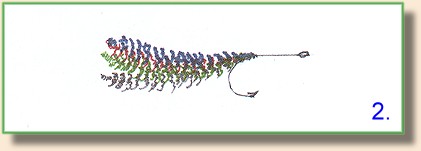
Shoulder: Green, pink and blue marabou.
Underwing: Green saddle hackle.
Overwing: Blue saddle hackle.
Wing: Grizzly saddle hackle.
Head: Blue and green deer body hair.
Eyes: Crystal eyes colored with orange marker.
[Hook: 2/0 to 4/0 saltwater.]
Tying Steps:
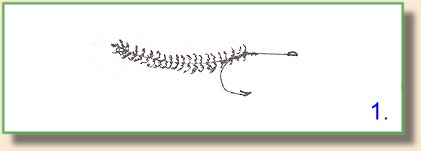
- Tie on a white maribou feather concave side
facing upwards. This represents the mackerels belly.
Originally published May 7, 2001 on Fly Anglers Online by Bill Catherwood.