Thunder Creek Brown Trout By David Klausmeyer, Editor Fly Tyer Magazine
For the life of me I don’t know why I don’t see
more Thunder Creek-style streamers in the fly
boxes of other anglers. These patterns are durable
and do an excellent job of imitating small baitfish.
Big fish eat little fish, and almost any freshwater
trophy will eat a Thunder Creek (large pike and
musky, which want large bait, are the only
exceptions that come to mind.)
According to the essay “A Brief History of the
Thunder Creek Series,” which appeared in Joe
Bate’s book Streamer Fly Tying & Fishing…, Keith Fulsher tied the first
members of the Thunder Creek Series in 1962.
In 1972, he published his book Tying and
Fishing the Thunder Creek Series…A
few years later, he contributed articles to
the first editions of Fly Tyer magazine
in which he described new patterns and ways
to dress Thunder Creeks.
A Thunder Creek is a unique way of tying a
streamer. The key features are the wing and
belly of the fly. Small bunches of bucktail
are tied on the top and bottom of the hook
with the tips pointing forward (out over
the hook eye). The hairs are the pulled back
and tied down to form the wing (the back), belly
and head of the fly. You can change colors of
bucktail to create new patterns. Fulsher used
the Thunder Creek format to create an entire
family of streamers designed to imitate specific
baitfish - shinners, darters, minnows, trout, and
bass - but you can also tie attractor-style
Thunder Creeks. (Tip: In recent years, one of
my favorite landlocked-salmon patterns has been
an all-white Thunder Creek. This fly works all
day, but is especially effective at dusk.)
Many members of the Thunder Creek family are
about forty years old, and I consider them modern
classics. Keeping with that theme, I’m going to
show you how to tie an updated Thunder Creek
Brown Trout. Rather than lacquering the head
of the fly, as Keith did, I am going to use epoxy.
And rather than painting the eyes, I am going to use
adhesive Mylar eyes. I’m also going to add a few
pieces of Krystal Flash to the wing to give the fly
extra fish-attracting sparkle. Tie this fly and
go catch some fish!
Materials: Thunder Creek Brown Trout
Hook: Straight-eye streamer hook, sizes 4 and 2.
Thread: Clear monofilament for tying the body,
and red 6/0 for tying off the head.
Body: Gold-embossed tinsel.
Underwing: Red and black bucktail, mixed
together and tied on top of the hook, and red
Krystal Flash.
Belly: Yellow and white bucktail.
Wing: Brown bucktail.
Eyes: Small adhesive eyes.
Tying Instructions: Thunder Creek Brown Trout
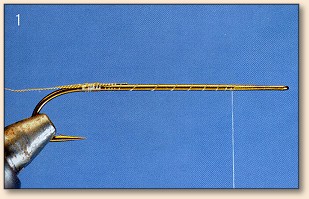
- Start the monofilament thread near the
end of the hook shank. Tie on a piece of
gold-embossed tinsel.
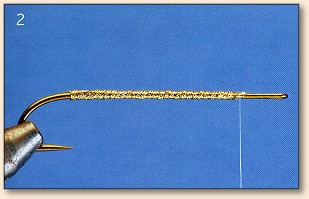
- Wrap the tinsel up the hook shank to
form the body.
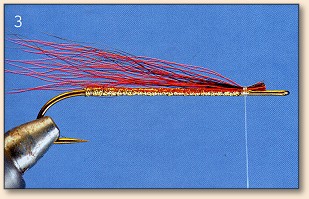
- Mix together a few pieces of red and black
bucktail. Tie the bucktail on top of the hook.
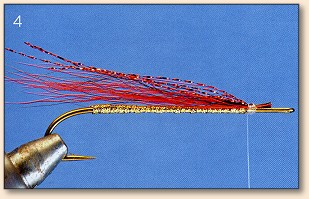
- I’m tying a slightly modernized version of
the classic Brown Trout Thunder Creek, and am
adding four strands of red Krystal Flash to
the underwing.
- Clip a small bunch of natural brown bucktail.
Remove any short hairs from the bunch, and even
the tips. Tie the bucktail to the top of the
hook with the tips pointing forward.
- Mix together two very small bunches of white
and yellow bucktail. Tie the bucktail on the
bottom of the hook with the fibers pointing
forward. Wrap the thread to the base of the
underwing. Tie off the monofilament thread and
clip. Start a spool of red thread.
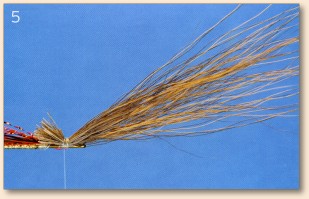
- You’ll want to keep the bunches of bucktail
separate when you fold the material back to form
the wing and belly of the fly. It helps if you
apply a dab of dubbing wax on the tip of each
buch. Lightly twist the hairs when you apply
the wax. Don’t get wax on the bucktail near
the hook shank; the last step is to coat the head
with epoxy, and the wax will prevent the glue from
clinging to the hair.
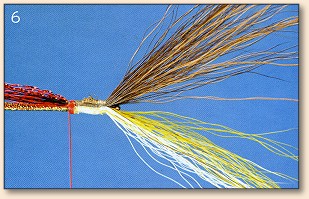
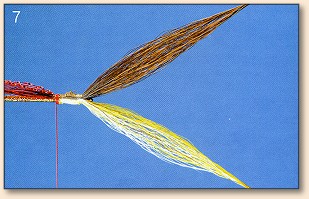
- Fold the bucktail back to form the wing and
belly; make sure that the hairs cover the sides
of the head. Make two or three wraps of thread.
Pull the hair back to form a trim head, and
tighten the thread. Make three more firm wraps
of thread. Tie off the thread and clip.
- Keith Fulsher covers of the head of a
Thunder Creek with two coats of varnish, and
then paints an eye on each side of the head. I
prefer using one coat of epoxy. Place an
adhesive eye on each side of the head. Coat
the head with five-minute epoxy.
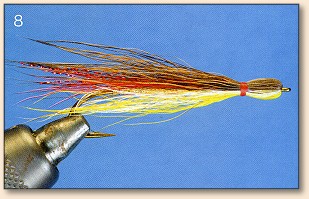
- The Brown Trout Thunder Creek is a
modern classic. I altered the pattern with
a few strands of Krystal Flash, adhesive
eyes, and an epoxy head. This pattern is
very durable, and has the streamlined
silhouette of a baitfish. ~ David Klausmeyer
About David:
David is the editor of Fly Tyer
magazine. In addition to traveling far
and wide in search of good fishing, he
also makes split-bamboo fly rods. His
articles have appeared in many American,
Canadian, and Japanese angling magazines.
This fly is an excerpt from his book,
Tying Classic Freshwater Streamers,
published by Countryman Press. He has also
authored three other Countryman Press books:
Trout Streams of Northern New England,
Tying Contemporary Saltwater Flies and
Guide Flies.
Originally published July 11, 2005 on Fly Anglers Online by David Klausmeyer.