The Velcro Crab By Jeff Pierce - AKA “Dr. Fish”
The Velcro Crab is another simple fly to tie that
is very effective on a wide range of species and
is ultra durable. I have Velcro Crab’s in my fly
box that have caught over 40 fish and still look great.
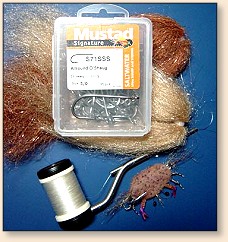
Materials List: Velcro Crab
Hook: Mustad Signature All Around hook from a
size 2 to 4/0 (S71S SS). The Mustad Signature Circle
Streamer (C71S SS) is also a very good hook for this pattern..Thread: Danville Flymaster Plus in White.
Body: Loop Velcro.
Legs: Rubber legs / Silly Legs cut to length and knotted.
Claws: Rubber Band cut to length and knotted.
Eye’s: 50lb monofilament cut and burned.
Head: Rabbit strip in Red
Tying the Velcro Crab
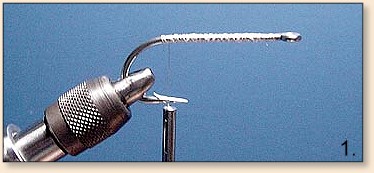
- Start behind the eye and wrap a base of thread
back to the start of the bend.
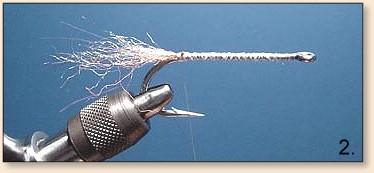
- Tie in a small clump of tan PolyBear or Antron
or Sea Fibers extending out past the bend — the shank length.
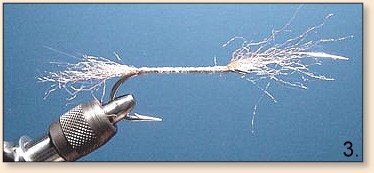
- Tie in a small clump of tan PolyBear or Antron or Sea Fibers extending
out past the eye — the shank length.
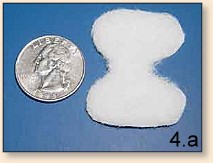
4A. Double over a piece of adhesive backed loop Velcro. Trim a piece that
when opened up appears to be a flattened 8.
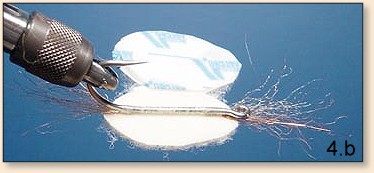
4B. Peel back — the adhesive backing and stick
the Velcro to the hook shank.
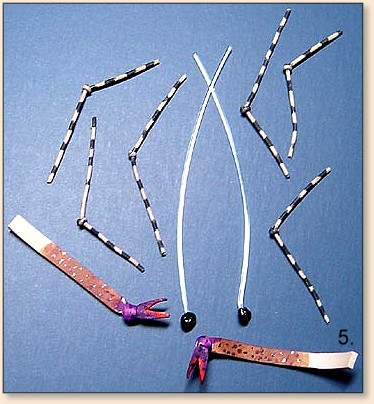
- Now it is time to prepare the guts and add them to the body.
Legs - Cut 4 pieces of rubber legs to a length of 1 inch.
Tie a single overhand knot in each piece just slightly
off center.
Claws - Cut 2 pieces of rubberband to a length
of 1 inch. Tie an overhand knot in each piece so that
the knot is about 1/3 of an inch from one end. Trim
the shorter leg to look like a pincher. You can use
markers to color the claws to match the local species.
Eyes - Cut a couple 1-inch pieces of 40lb or 50lb
monofilament. Use a lighter to burn one end of each piece
to form an eye. Use a pair of pliers to form a 90-degree
elbow — inch from the other end. This will help hold
the eyes in the body better.
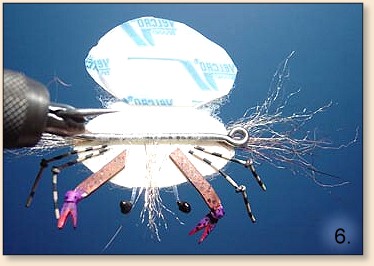
- Ever order stuffed crab at a restaurant? Well, now
it’s time to stuff your own. Place the legs into the
adhesive. Place 2 legs on each side of the crab, next
to the hook shank. Position the legs so that the legs
will angle down. Now you can add the claws and then
the eyes. I like to add a little PolyBear, Antron or
Sea Fibers between the eyes to act as the mouthparts.
If you are trying to imitate a Blue Crab you can add
one extra set of legs on body on the opposite side of
the hook shank. These legs are the swimmers so wide
rubberband can be used effectively.
You can also insert a rattle at this time if you wish.
This had proven very effective when targeting Redfish
in stained water.
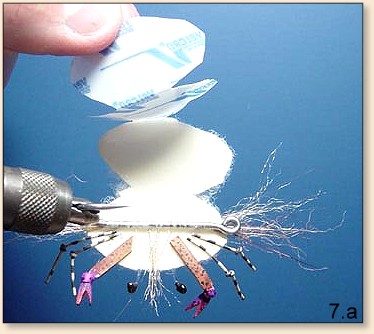
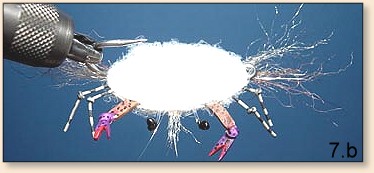
- Peel the rest of the adhesive backing off and fold
over the top of the Velcro body and press firmly.
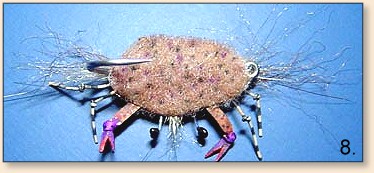
- Use markers to color the crab so that it closely
resembles the crabs in the area you will be fishing
the fly. You will be surprised just how finicky
the fish can be, refusing crab flies that are not
colored exactly like the local prey species.
Fishing Suggestions:
The Velcro Crab is a very effective pattern for many
saltwater species as well as a few freshwater species.
I have had great success with the Velcro Crab on Tarpon,
Bonefish, Permit, Cobia, Dolphin, Triple Tail, Bluefish,
Striped Bass, Redfish, Jack Crevalle, Snook and well
as others.
This is primarily a cast and wait fly. Better than 90%
of the time I’m fishing the VC I cast the fly and let
it sink without any action. The fish will take it on
the sink or as it rests on the bottom. Stripping the
fly will often spook the fish. If you watch how a crab
reacts to an approaching fish you will see just what you
need to do. Generally, if a crab is moving along the
bottom and it spots an approaching predator it will
freeze and attempt to blend into the bottom. If that
fails to work, it usually stands its ground and tries
to defend itself.
So, if a fish approaches your fly it’s best to let it
sit or give it a very, very slight strip, just enough
to move the crab a tiny bit. If you strip the fly too
much or at the wrong time it may appear to the fish that
the crab is coming at them and this will spook them
as this is not normal crab behavior.
If a fish passes by or over the VC without reacting I
have triggered some strikes with a couple short, quick
strips. This has been especially effective with
Striped Bass. This can also trigger a strike after
a fish inspects the fly and refuses it. Just be sure
to wait to strip the fly until the fish has turned off
the fly, not while they are looking at it.
I’ve had great luck with this fly-casting around shrimp
boats that are culling catch. Jack Crevalle, Redfish,
False Albacore, King Mackerel, Tuna and Sharks till
all take the fly under these conditions. Casting the
VC to a piece of floating debris is also effective for
Tripletail and Dolphin. Whatever species you target
with the VC you will be very happy with just how well
it holds up. It’s nearly impossible to destroy the fly.
Tie up a few for your next saltwater outing and be
ready for some action. Happy tying! ~ Jeff Pierce
About Jeff Pierce:
Jeff Pierce, AKA “Dr. Fish” is the Sales Manager of
Fly-Fishing Products for O. Mustad & Son and Partridge
of Redditch. When not in the office, he can be found
chasing fish wherever possible. Whether it’s Sailfish
off Borneo, Payara in Brazil or Brook Trout in the
Adirondack Mountains, you can bet that Jeff is no
doubt casting flies as something that will bend a rod.
Originally published October 13, 2003 on Fly Anglers Online by Jeff Pierce.