Q.
For years a local trout
stream has been stocked annually with Brown
Trout yearlings. This has taken place at
bridges and other places of easy access. In
recent years volunteers have been “float stocking”
in order to spread the fish out and to prevent the
new larger 2-year old fish from being caught
during the first few days after socking. Many
fishers objected to this (spreading them out)…
one of their reasons was “The fish will all die
in a few weeks, may as well catch and cook.”
I did an impromptu survey and found that no
one had ever observed even a small fish kill
of trout. (I did observe a kill of about 250
chubs of some kind under a bridge about 15 miles
downstream of the stocked area but no dead trout
there). The surface water temperature measured
90 degrees that day. I went up on the bridge
so that I could see further downstream and there
as big as life were two trout out in the sunny
part of the stream and alive. I had located a
good number of trout further downstream but
they were in a shady spring. Although I probed
for it, I could not locate a spring in this spot.
It may have been a feeble seep that saved them.
(I have also measured the vertical distribution
of temperature in some refuge areas and found
temperature differences of 20 degrees F in 4 ft)
I believe the chubs favored the shadow of the bridge
for protection which wasn’t enough to save them.
When it comes to trout, I believe that we are too
quick to condemn a stream as too warm to stock!
There are springs all along this river and it doesn’t
take the fish that survive the initial onslaught long
to locate them. This is not a stream with long
periods of dangerous temperatures and we were
able to prove to the state, NY, that an unstocked
portion 20 miles downstream has been a source of
some very good fishing. Fish from a stocked tributary
find their way there in big enough numbers to make
some very pleasant fishing at times. I have no
education along biological lines but I think that
it may make sense to stock these springs with eyed
eggs in order to increase the total number of fish
in these lower sections. Hopefully fish born there
would be stream imprinted and capable of reproduction.
(There has been an increase in the number of juvenile
wild fish since the float stocking program was started).
The availability of food was described as phenomenal
by a private ichthyologist, M. Elizabeth Conners, Phd,
Cornell U. We have no money to hire private consultants
to help in this endeavor and must rely on private and
club funds to do so.
We hope to get permission to stock twenty miles of
occasional springs. I am old (73) but hope to locate
a good number of these springs this summer in
preparation for stocking this fall. I feel that we
have at least a chance of a moderate success and would
like your opinion. Ol’ Bill
A.
First of all, I strongly disagree with your definition
of old (73), because I’m 74 so what does that make me?
I know, older. Second, your submission, though thorough,
makes it pretty tough for me to give you any definitive
answer; there are so many things involved in evaluating
a stream for successful stocking that it really takes
someone more familiar with the situation — not just the ecological characteristics of the
stream, but things like fishing pressure, availability
of fish, state policies, etc.
Now having covered my rear for not giving you a
straight answer, I will attempt an answer to your
question and offer some other observations that might be
pertinent.
Given that you’ve found what appears to be a
successful fishery 20 miles downstream, I would
think that there is a possibility of success in
your proposal.
I’m a little surprised at trout surviving 90 degree
temperatures; this is significantly higher than their
preferred temperature range. However, much depends on
what temperature they have been acclimated to and how
rapidly the temperature reached these high levels.
They have a better chance of survival if the
change is gradual. The fact that you say that fish
find their way from tributaries may also indicate
that resident trout may find refuge from adverse condition
in these tributaries. The tribs and the springs
obviously are important refugia for the fish.
Your suggestion to stock the springs with eyed
eggs is with the use of Vibert boxes, I assume.
These can be quite successful, but somewhat pricey
if you do it extensively.
Well, I’ve talked around this a bit without giving
you much positive to hang your hat on. Good luck
with your efforts. ~ Older Bert
If you have a question, please feel free to contact me.
~ C. E. (Bert) Cushing, aka Streamdoctor
105 W. Cherokee Dr.
Estes Park, CO 80517
Phone: 970-577-1584
Email: streamdoctor@aol.com
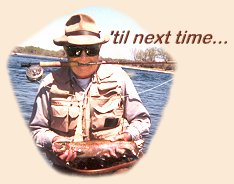
The ‘Stream Doctor’ is a retired professional stream ecologist and
author, now living in the West and spending way too much time
fly-fishing. You are invited to submit questions relating to
anything stream related directly to him for use in this Q & A Feature
at streamdoctor@aol.com.
Originally published March 28, 2005 on Fly Anglers Online by Older Bert.