Q.
My question is twofold. I live in Connecticut
and the local stream I fish (the Salmon River)
has been undergoing Atlantic Salmon restoration
for quite awhile with limited success. I’ve
had a number of theories about why this is,
and one of the first is that they stock the
salmon as parr, rather than eggs, thereby
reducing the “Survival of the Fittest” attribute
and/or imprinting of the rivers smell. Would
that be an accurate statement? Also, this
stream is heavily fished and therefore heavily
stocked (browns, brookies, and rainbows) and I
have seen trout parr so I know the river is of
good quality. But I can’t help but wonder if
they should remove the browns and rainbows while
replenishing the brookies with native strains
to try to get the ecosystem somewhat closer to
what the salmon need. Do you believe this could
be another piece to the puzzle?
A.
Not being familiar with the fisheries management
program in Connecticut, I’m not going to be able
to give you very satisfactory answers to your
questions; you need to talk to the local biologists
who are familiar with the fisheries present and the
thinking behind the stocking policies. I will,
however, take a shot at some of your points.
You’d be surprised how much fisheries work is
done with little or attention paid to the ecological
characteristics of the stream.
First, stocking as parr vastly improves the
survival rate; stocking of eggs is rare, costly,
and not always very efficient, especially on a
large scale. I don’t think it has much to do
with “survival of the fittest.” In fact, this
attribute applies to the parr just as much as it
would to the eggs. The importance of imprinting
the river’s “smell” would only be important if
they were expecting these fish to migrate and
return to spawn; your later statements make me
wonder if these fish are put in only for
“put-and-take” fishing, thus making imprinting
of little importance. Again, not being familiar
with what the biologists are trying to do makes
my comments just guesses.
Your comments about ecosystem restoration raises
a ton of questions, but again, without knowing
details makes it difficult for me to comment.
I can’t understand why an Atlantic salmon
restoration project is being done in a stream
heavily stocked with three trout species. So,
rather than wildly speculating as to what might
best be done, I think I better just not say
anything. Sorry.
If you have a question, please feel free to contact me.
~ C. E. (Bert) Cushing, aka Streamdoctor
105 W. Cherokee Dr.
Estes Park, CO 80517
Phone: 970-577-1584
Email: streamdoctor@aol.com
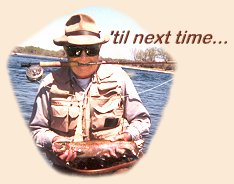
The ‘Stream Doctor’ is a retired professional stream ecologist and
author, now living in the West and spending way too much time
fly-fishing. You are invited to submit questions relating to
anything stream related directly to him for use in this Q & A Feature
at streamdoctor@aol.com.
Originally published June 7th, 2004 on Fly Anglers Online by Robert Younghanz.