Q.
I have been trying
to decide whether to post this question or not
due to the ecological considerations involved
but I just can’t help thinking about it!
We do not have big hatches of any insect
different than midges and mosquitoes and
then they are not as big or last as long
as other insects’ hatches.
I happen to dream about thousands of mayflies
and other insects of the kind filling the air
above hungry frantic trout.
Here are my considerations:
Trout is an alien species here in Colombia and
some studies have revealed that their size is
under the average seen in other places where
they were also introduced like Chile, and that
it is due to the lack of insects and other
aquatic life forms that would sustain large
populations with large specimens.
If trout did help in the extinction or notorious
decrease of native species that’s already
irreversible or very difficult to reverse. If
trout have already been introduced to any water
suitable of being stocked many years ago, why not
helping a now established population to have better
conditions by introducing another living form that
may help raise the standards of those populations?
(with the possibility of generating income to
riverside communities that may benefit from more
fishermen and women visiting, as well as other
fields of the market like fishing stores, etc.)
So my questions are as follows:
1- Are mayflies and other ephemera species
considered dangerous or harmful if introduced
to places that don’t have them? Why?
2- Would that process of introducing them be difficult in terms of
transporting the eggs, finding very specific conditions in which they
live, etc.?
3- Speaking of ethics and ecological issues and all sort of other
philosophical and “spiritual” considerations, what do you think about it?
I hope not to hurt any feelings or anything, and surely don’t want to
be stoned, thx Dave
I have to add that I live in Bogota, Colombia.
So my conditions are tropical highland conditions
(periods of rain for a few days in a row
followed by sunny intervals with stable temps
that range from 10-19 degs C, and then 1 month
or a little more every 6 months with dry, sunny,
cloudless, “very warm” days 19-27 degs C and
frigid nights -4 to 8 deg C. We have trout in
running waters (from little springs to 20mts
wide rivers) and still waters (large lakes
formed by electric generation dams to small
private “backyard” ponds).
However I’ve once seen large trout inhabiting
some waters I read two research reports stating
the average size issues. That’s when the idea
came to my mind.
thx so much, Dave
A.
Dave, you’re not the first person that has
asked about the feasibility of trying to
establish insect populations in water bodies
where they don’t occur.
In general, the idea of trying to stock
macroinvertebrates to develop self-sustaining
populations is impractical. Certain very
prolific organisms (zebra mussel, New Zealand
mud snail) have the ability to invade new
habitats and spread widely. However, these
are organisms that can tolerate an extremely
wide variety of ecological conditions. This
is not true for many other organisms, especially
mayflies, stoneflies, and some caddisflies that
have narrow tolerance conditions. I know of no
case where aquatic insects have been successfully
“stocked” into natural streams.
There are instances when an introduced predator
(trout?) have had negative impacts on existing
populations of macroinvertebrates; in this case,
the food web is upset and either the trout or
the macroinvertebrates (or both) may eventually
be decimated. If the trout and their food supply
(insects) continue to flourish, it means that
some kind of balance has been established among
the organisms in the food web. The point I’m
trying to make here is that even if you successfully
“stocked” insects into a trout stream, that doesn’t
mean that they will become established. Many a
trout may stand between them and success.
If there are species, such as mayflies, that
exist in nearby habitats and the gravid adults
can reach the mayfly-less stream, there must be
some ecological reason why they haven’t established
themselves in that stream. There can be many
reasons for this - chemical, physical, biological,
or any combination. The point is, if they aren’t
there it’s probably a waste of time trying to
force them there. Further, transporting and
introducing foreign species into new habitats
can also result in unintended adverse ecological
consequences.
Here are my specific responses to your 3 questions:
1- Are mayflies and other ephemera species
considered dangerous or harmful if introduced
to places that don’t have them? Why?
I know of no instance where mayflies were
considered “dangerous,” and I’m taking that by
“dangerous” you mean detrimental to the stream
ecosystem. As I said above, I know of no case
where they were successfully introduced into new
waters; thus, the question is moot. The only
instance I’m aware of where mayflies are dangerous
is in regions of the country around large lakes
where they emerge in such huge numbers and swarms
around bridges, the dead bodies accumulate in such
masses as to make the road slippery for cars.
2- Would that process of introducing them be
difficult in terms of transporting the eggs,
finding very specific conditions in which they
live, etc.?
Not only difficult, but essentially impossible.
You simply could not collect and transport enough
mayfly eggs to a new habitat to produce a
reproducing population. If mayflies are
present in other nearby streams, there must
be a reason why they aren’t present in your
stream of concern.
3- Speaking of ethics and ecological issues
and all sort of other philosophical and
“spiritual” considerations, what do you
think about it?
As I said above, introducing new species
into foreign habitats may have bad results;
this is both a philosophical and practical
consideration. I don’t know what you mean
by “spiritual” considerations, but ecologically,
there are a number of reasons why it would be
a waste of time. Despite the good intentions
of trying to supplement the food base of a
stream, it is essentially impossible to do
this - ecologically, practically, or any
other way.
Best wishes, ~ Bert
If you have a question, please feel free to contact me.
~ C. E. (Bert) Cushing, aka Streamdoctor
105 W. Cherokee Dr.
Estes Park, CO 80517
Phone: 970-577-1584
Email: streamdoctor@aol.com
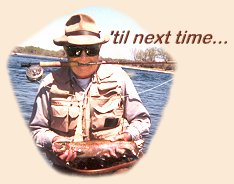
The ‘Stream Doctor’ is a retired professional stream ecologist and
author, now living in the West and spending way too much time
fly-fishing. You are invited to submit questions relating to
anything stream related directly to him for use in this Q & A Feature
at streamdoctor@aol.com.
Originally published July 25, 2005 on Fly Anglers Online by Bert.