Q.
I live in southern
Utah, and last year regularly fished a small
(tiny) high mountain stream (I think it’s
elevation is over 9000 feet) that has what I
presume to be wild Brook Trout since it isn’t
stocked. There is no lake that feeds it. As
far as I can tell the water comes from run-off
only. The stream in normal years varies from a
couple feet wide to maybe 10 feet at its widest
point. It is for the most part less than a couple
of feet deep and in some of the “wide” points less
than a foot. There are also occasional “pools.”
But again these are probably no more than a few
feet deep and five or six feet across. About the
only thing that signifies that it is a “pool” is
the speed (or lack there of) of the current running
through it. By the way, a “big” fish here is 10"
or so.
This past winter has been a banner year
for snow fall, and this stream has
been under a lot of snow (over ten feet)
for a very long time. I checked it a few
days ago, and it is finally clear and
accessible, and flowing quite a
bit higher than I’ve ever seen it.
My questions are:
-
Do fish survive these winter conditions,
or are all of the fish in these upper elevations
from “migration” of fish further down stream? -
How “deep” and or “big” do pools need
to be to allow fish to survive through a
winter, or is it simply a function of the
water not freezing? -
I know that snow is actually a pretty
good insulator. So does a stream like this
continue to flow through the winter beneath
the snow pack? Or is it more likely that
it was nothing more than ice?
Thanks, David Shumway
A.
You’ve posed some good questions here and
I’ll respond in order.
-
The fish you find are more likely to
be winter survivors rather than migrants
from downstream. I say this mainly because
fish don’t migrate as far as most people
think they do, and I’m speaking here of
resident populations. As long as there
is available water with sufficient oxygen,
it is likely that they will survive; I’m
assuming an adequate food supply. What
you’re likely to find in these situations
is that the fish tend to congregate in the
deeper pools during the winter and then move
out to the riffles. -
As I said above, as long as the pool is
large enough to have free water that is
adequately oxygenated, the fish will survive;
surface ice is rarely a problem in streams.
The fish do need some food, although metabolic
functions are at low ebb when the water is
near freezing. There are a couple of conditions
that are detrimental to the fish. You mention
one of them and that is when the water freezes
solidly; obviously, this will kill the trout but
is fairly rare where adequate flows prevail.
The other condition occurs when the water
reaches super cooled conditions (clear, cold
nights) while it is still flowing and the
surface is unfrozen. At this time, ice crystals
(called “frazil ice”) occur as slush in the water,
or ice forms on the bottom (called “anchor ice”).
Anchor ice forms initially in riffles, but can
spread to larger areas if low temperatures prevail.
Break-up of anchor ice scours the bottom, resulting
in a loss of immature insects, abrasion of the
periphyton community, and, in some cases,
transport of embedded stones and gravel. -
This one is harder to answer because it
could vary with several things, especially
the severity of the winter and adequacy of
the water supply. Given that there is
adequate flow throughout the winter, the
chances of the stream freezing solidly beneath
the snow pack probably depends on how cold the
air temperatures are and how long they last.
Prolonged sub-zero temperatures are more likely
to result in a greater portion of the water
freezing; conversely, warmer air temperatures
will probably allow the water to remain flowing.
Also, as you imply, the thickness of the snow
pack may affect how much of the water column
freezes. ~ Bert
If you have a question, please feel free to contact me.
~ C. E. (Bert) Cushing, aka Streamdoctor
105 W. Cherokee Dr.
Estes Park, CO 80517
Phone: 970-577-1584
Email: streamdoctor@aol.com
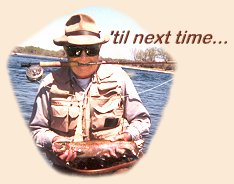
The ‘Stream Doctor’ is a retired professional stream ecologist and
author, now living in the West and spending way too much time
fly-fishing. You are invited to submit questions relating to
anything stream related directly to him for use in this Q & A Feature
at streamdoctor@aol.com.
Originally published July 11, 2005 on Fly Anglers Online by Bert.