Comments: GREAT INTERCHANGE ON FAOL RE THE
TRANSFER OF E. GUTTULATA FROM PENN’S CR TO MTN STREAM.
HOWEVER ONE IMPORTANT FACT WAS NOT INCLUDED. THAT BEING
IT TAKES THREE YEARS FROM OVIPOSIT TO SUB IMAGO EMERGENCE.
RESPECTFULLY, TERRY TATERUS
NEW CUMBERLAND, PA…
Responses: Thanks for your input. I hadn’t forgotten
you, it’s just that your email arrived as I was leaving for
eye surgery. Back now, though still blurry in one eye.
As to the life cycle of E. guttulata, there
appears to be a bit of controversy. My statement in my
exchange with Dr. Wahl was based on Edmund et al. (1976)
that states that based on available evidence, it appears
that Ephemera has a one-year life cycle.
After receiving your email, I consulted several of my
references and texts and found only one other piece of
information. That was in Burk’s (1953) classic where
he states that large ephemerids take 2 years to mature.
Given these differences, I hit the phone to some colleagues
to see what they had to say. Dr. Boris Kondratieff (Colo.
State U.) said that from Japanese literature, where a lot
of work has been done on this genus, that both a 1 and 2
year life cycle has been found. He feels that, given the
amount of tissue that needs to be elaborated during maturation,
that a longer life-cycle would be indicated.
I then called Dave Funk and the Stround Water Center in PA.
He says that their work in the northeast indicates that a 1
year life cycle is common although it could extend to
one-and-a-half to two-year cycle the further north you go.
So, from what I can gather, it appears to depend on where
the population you are concerned with is located and that
a life cycle can take anywhere from one to two years for
this group.
Bert Cushing
Sincerely, ~ Bert
In a message dated 2/16/07 8:01:33 PM, Llektek writes:
THANKS FOR YOUR PROMPT RESPONSE. SORRY, I DIDN’T MEAN
TO IMPLY THAT DR. HOOVER HAD ANY EVIDENCE THAT DISPUTES
YOUR INFORMATION. TO BE PERFECTLY HONEST, ALTHOUGH I HAVE
DISCUSSED SOME OTHER “BUGS” WITH HIM, I HONESTLY CANNOT
EVER REMEMBER DISCUSSING E. GUTT. SPECIFICALLY.
I BASED MY UNDERSTANDING OF IT BEING 3 YEARS ON CONVERSATIONS
WITH A MULTITUDE OF ANGLERS DURING MY 35+ YEARS OF FISHING TO
IT ON PENNS CR.(NOT VERY SCIENTIFIC, I’LL BE THE FIRST TO
ADMIT).
IT’S BEEN A PLEASURE. MANY SUCCESSFUL DAYS ASTREAM TO YOU THIS YEAR.
REGARDS, TERRY TATERUS AKA LEKTEK
Hi:
Again, I enjoy exchanges like this; keeps the old mind
working during retirement. This, writing books, and
fishing when the ice isn’t covering the streams!
Anyway, as I said, I contacted 3 top folks in this
business and here are their replies. I’m astounded
that all three responded so quickly!
Dr. Richard Merritt: Rich took time out from sending
me his usual lousy jokes on email to respond by saying
that I should contact the co-author of the mayfly chapter
in the major book on aquatic insects that he co-edited
with Ken Cummins. Rich is sending me the co-authors
email address (I don’t know him) and I’ll contact him
and let you know what he says.
Dr. Kenneth Cummins: Ken responded by saying that
E. simulans has a 2-yr life cycle in the
Great Lakes. He further said that a 3-yr life cycle
would be real news and that he could guess that it must
be in a very cold and stable system.
Dr. Bruce Wallace: Bruce responded simply by saying
that he has had no experience (he’s in Georgia) with
this insect group and couldn’t be of help.
So, in light of your recent response, it appears that
the 3-yr ephemerid is still conjecture. I’ll let you
know if I learn anything further and if your fishing
buddies have something positive, I’d like to hear about
that.
Take care,
Bert
If you have a question, please feel free to contact me.
~ C. E. (Bert) Cushing, aka Streamdoctor
105 W. Cherokee Dr.
Estes Park, CO 80517
Phone: 970-577-1584
Email: streamdoctor@aol.com
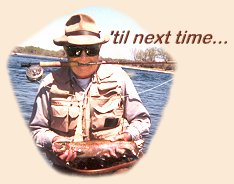
The ‘Stream Doctor’ is a retired professional stream ecologist and
author, now living in the West and spending way too much time
fly-fishing. You are invited to submit questions relating to
anything stream related directly to him for use in this Q & A Feature
at streamdoctor@aol.com.
Originally published February 26, 2006 on Fly Anglers Online by Bert.