It had been a long, and not a very productive day, and we were about ready
to call it a day. As we began the long walk back to where we had parked the
car the sun began to touch the tops of the western hills, and as we walked
along the edge of a long flat I caught the glimpse of a set of ripples slowly
spreading out from the far bank. Squinting into the sun, hand held above my
eyes to shield them from the glare, I could see the barely discernable dimples
made by the noses of a line of several fish feeding quietly along the bank.
Suddenly all thoughts of getting back to the car were discarded, and we set
about trying to determine the food source that was causing this very interesting
situation.
Leaving my rod with my fishing partner I waded across the stream well below
the last riser in the line, and using my aquarium net, I began to check what
was coming down in the drift line. It did not take me long to collect several
small mayfly spinners, and the solution to our delightful dilemma was at hand.
Wading back to my fishing partner we quickly selected a suitable imitation
and within a few minutes we were busy casting to the line of feeding trout.
When the sun had finally set we staggered from the stream having redeemed
the day by catching and releasing several bragging sized trout.
In Marinaro’s book, The Ring of the Rise, [Crown Publications,
1976] Vince illustrated this rise form and made the following observation.
“This is the riseform that invariably accompanies the taking of
tiny mayflies and minute terrestrials imprisoned in the surface film, resulting
in the mysterious and very obscure flush float, scarcely known or appreciated
by many fly-fishermen. Recognizing and understanding the implications contained
in the sipping rise will lead to greater fly-fishing skill and the multiplication
of fishing pleasure far beyond the normal mayfly season.”
Brian Clarke and John Goddard in their book, The Trout and the Fly, A
new approach, [Nick Lyons Books, 1980] called the sipping rise ‘the
sip or kiss rise.’ They wrote:
“The “sip” or “kiss” rise embodies two distinct
characteristics. The first is the distinct, audible kissing noise we hear;
the second is a small, pinpoint, almost imperceptible disturbance of the surface
film – little more than an ebbing full-stop that is swiftly contorted
and then dispersed by the current.”
On very calm water and when the wind is not disturbing the streamside vegetation
it is often possible to hear the kissing noise described by Clarke and Goddard,
but in most angling situations the fish that is engaged in sipping insects
from the surface film is detected by sight and not by sound.
When a trout takes an insect from the surface film there are three forces
that move the food into the trout’s mouth; the push of the current,
the upward movement of the trout, and the suction created by the trout’s
mouth.
In the book, The Rise, by Paul Schullery [Stackpole Books, 2006]
he described how a trout creates the suction necessary to pull an insect into
its mouth.
“The trout creates suction by enlarging its mouth capacity, which
it does by opening and extending its jaws, as well as dropping and widening
the floor of the lower jaw, deepening the oral cavity. This is facilitated
by the pleat-like structures that run the length of the bottom of the lower
jaw.”
A trout can control the size and strength of this ‘vacuum cleaner action’ with
pinpoint precision. This accuracy and pinpoint control is what we witness
when we observe sipping risers, and it is this ability that makes the detection
of these rising fish so difficult for many anglers.
The key to successfully detecting sipping risers is quiet and careful observation.
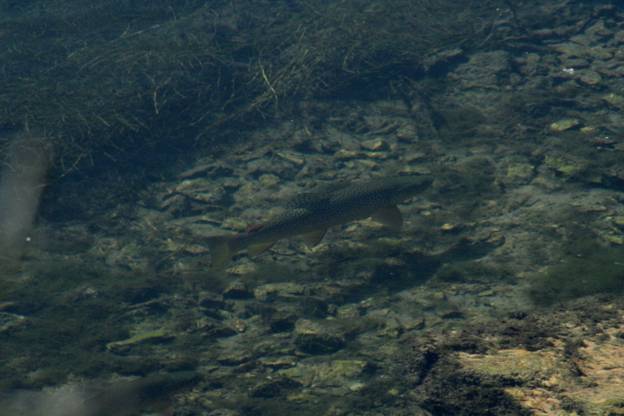
A nice trout holding near the bank
Trout holding in very thin water are particular wary, and a careless cast
will quickly send them dashing for deeper water but a properly placed cast
will often produce a solid strike. Generally the fish holding in such situations
are ‘on the fin’ and looking for something to eat. The angler
that is aware of this tendency will often find action when other anglers are
fishless.
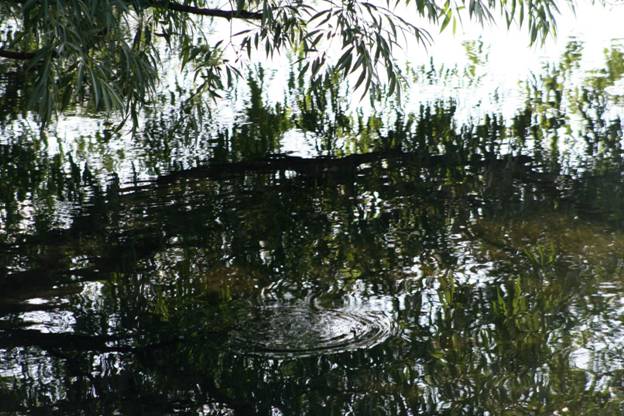
A sipping rise beneath an overhanging tree
Trout holding beneath trees offer the angler another challenge. This is a
favorite holding spot for sipping risers since the trees provide some protection
from overhead predators and the vegetation reflected in the surface film provides
further cover and confidence, especially for larger trout. The fish holding
under this tree were all very respectable fish, and while they were quite
obvious it takes a very careful approach and pinpoint casting to get a fly
into this particular spot, but the rewards are worth the effort.
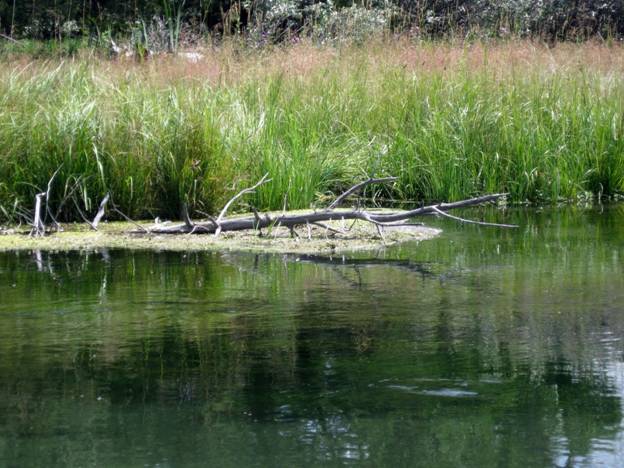
Another ideal holding area for a sipping riser
This holding area next to the bank is typical of a place where an angler can
expect to find a sipping riser. In this area trout tend to hold right next
to the weeds. They only stick their nose out and suck in a victim, never revealing
more than their head. This is often a spot where the angler will find a truly
memorable fish. This particular spot produced a very respectable Yellowstone
Cutthroat for me when he stuck his nose up and sucked in a #18 PMD imitation.
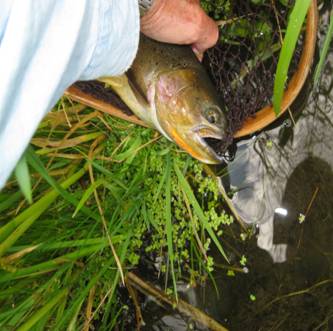
A resident sipping riser – a nice Yellowstone Cutthroat
Flies for sipping risers
As with any situation fly selection and presentation are the keys to success
in fooling a sipping riser. Once again, the key is observation, and a hasty
or ill-prepared approach will likely result in a missed opportunity. Early
in the morning when there are no obvious insects on the water the trout
may be feeding on flush floating spinners or midge pupa. A small aquarium
net stuck in the water downstream from the sipper should produce an answer.
During a hatch a sipping riser may not be feeding on the adult insects but
on emergers or cripples. Again, observation and sampling of the water will
usually produce the answer.
It’s during the off times; the heat of the day or when no obvious hatch
is in progress that fishing for hidden sippers is often a very productive
technique. I like to use a terrestrial imitation trailing a midge pupa. I
plan on covering a lot of water, hitting each potential holding spot with
two or three good casts and then moving on. I am constantly looking for the
subtle rise of a sipper, but even if I do not see any visible signs of rising
fish I keep hitting those areas where a sipper could be hiding. I have rescued
more than one day of fishing by using this technique.
If you are into challenging fish then finding and fooling sipping risers will
provide you with a challenge that will keep you come back for more.
~ The Chronicler
Originally published August 10, 2009 on Fly Anglers Online by By Neil M. Travis.