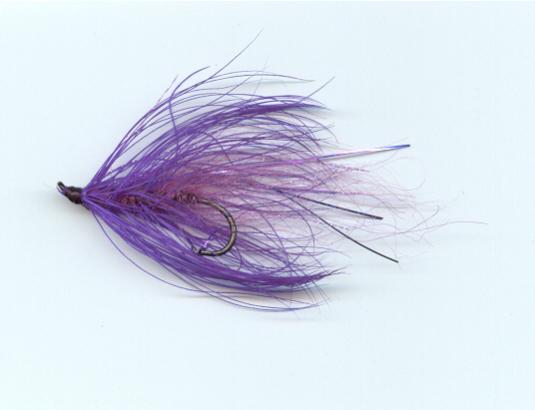
I have seen the “purple fly” movement gaining acceptance in recent years. I guess my first notice of this was watching Walter Wiese’s video of tying the Loop Wing Purple Haze. Since then, I have seen a lot of pretty famous tiers/shops extolling the virtues of the fish catching ability of purple bodied flies.
More recently, I have found that using a small number of “sprigs” of UV pearl ice dubbing on my caddis flies really did seem to improve the number of takes.
I took this somewhat grainy photo of a little caddis pattern on the water in my slant tank the other day. Granted, I am sure it all depends upon how the light hits the fly, but I noticed that some of the few sprigs of UV material presented some “purple” spots around the fly.
Just wondering if others use this material; does it also improve your take %; and do you think it might be because, given certain light conditions, it gives off a “purple” reflection?
Just talking about purple colors in flies, yes, they are very effective as you know. The Purple Haze is a great dry fly and very productive at times on the rivers of eastern WA and western MT. Purple San Juan Worms can also be very effective as are purple Woolly Buggers and Leaches. For the dry flies, the purple remains purple on the surface, but for the wet flies, depending upon the color of the water, after about 4 feet in depth the purple can actually turn to red.
I know a couple of guys that incorporate purple somewhere in all of their flies - dries, nymphs, streamers, everything.
As far as the UV pearl Ice Dub, I tried it in a bunch of flies when I saw Galloup’s video about it but I haven’t seen any increase in takes at all. I do use pearl Mylar for ribbing in a lot of flies, though.
What I’m wondering…is the improved success I have found by adding some sprigs of UV pearl ice dubbing, because it tends to appear to have a purple tint/spots? Or do the strands help for a totally different reason?
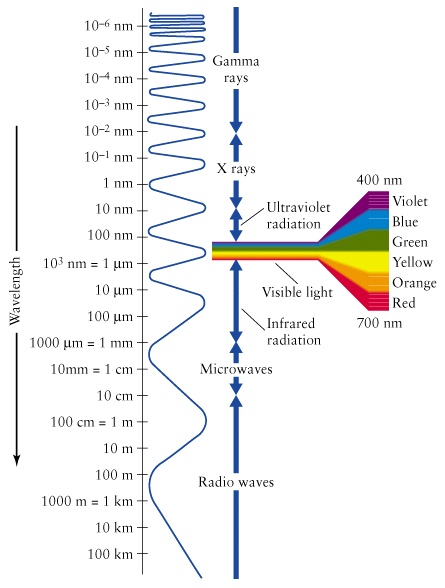
Violet (purple) is right next to UV in the color spectrum. As far as light goes, UV is only special because it’s outside the range of human vision. If our eyes had photo detectors for UV wavelengths, they would just be another color.
I’d guess that fish that react to UV reflectance will also react to purple. It’s like bright green and chartreuse. They are close in color, so sometimes the fish will accept either.
Of course, the 800 pound gorilla in the room is why purple/near purple is attractive to them…
If one were fishing a hatching period of, say, PMD’s, would you dress a Dun in purple?? Or, is purple more effective as an attractor in non-hatch periods?
Byron, sometime it’s the reason your mom gave you, “because that’s the way it is.” One of my favorite baits when using casting and spinning rods was a purple plastic worm. It was my favorite because it caught fish and it caught fish because it was my favorite and I kept on in the water more than other colors. The greatest factor in catching fish with a lure or fly is keeping it on/in the water.
I developed this fly in 1986 for fishing to Great Lakes steelhead. I still use it a often. It has been used on the great lakes streams as well as west the coast from northern California to Alaska.
Jesse,
I get it…Thing is, that the fly fishing community is a broad group. There are casual fly fishers, new fly fishers, long-time fly fishers, fly fishers who only fish with purchased flies and those flies they are told will work. There are fly fishers who only fish with the flies they tie. There are those who read voraciously all the books on flies, fly fishing, insects, etc. etc.
I guess I happen to be in that last category…those of us who are pretty much obsessed with all things fly tying/fishing…and always curious about insects, imitations, trout biology, stream ecology, reading water, etc., etc., etc. As an often quoted phrase: “Enquiring minds want to know”…
Whatfly,
Understand that. However, it has become more widespread in dry fly tying (trout flies) in this decade, I believe. Am reminded of a recent post by Craig Mathews of Blue Ribbon Flies in West Yellowstone over some purple died feathers, as I recall.
I can tell you that back in the 70’s I was fishing in a trout stream in Missouri. Another guy was catching trout on a jig. I asked him about it. He said “Use a marabou jig…any color is fine, as long as it’s purple”.
So, again, I’m talking more about purple bodied trout dry flies over the last 7-10 years. Seems to me that there has been a decided uptick. And, I’m wondering what the principal reason for their touted effectiveness is.
The snipe and purple is one of the basic flies if you’re fishing soft hackle wets. Right up there with the partridge and orange, grouse and green, and starling and herl. Must be a reason for that, no?
When you get down close and look at a trout stream, there’s a lot of stuff floating down the river. Most of it is not trout food. I think trout learn to ignore stuff that’s not food. They are looking for things that don’t look like common debris.
I have no evidence for this, but my theory is that purple makes the fly stand out from all the rest of the flotsam. Sparkly stuff or orange hotspots have the same effect. Once the trout is focused on the purple fly, it may decide to eat it, if the fly looks like food.
Why is attractive? Because they can see it better.
I might fish a purple dun during a PMD hatch just to see what would happen. I did quite well with a a bright pink dun during a sulfur hatch a few years back (because I’d grabbed my box of Hendricksons rather than my box of Catskill-style sulfurs by mistake before setting out.) This was an outrageously pink fly that I’d won in a raffle. I probably wouldn’t have fished it even during a Hendrickson hatch, but I wanted to see what happened. (This was after a fairly frustrating hour or so of fish not taking either Compardun or parachute flies that were a more reasonable color.)
There’s no doubt that the S&P is a great fly – I use it a lot – but when wet, I don’t find the silk to be all that purple. It’s just a dark fly. The older name for it is “Dark Snipe”, which may be a better description. I suspect (but can’t prove) that it uses purple thread for the same reason that Stewart’s Black Spider is tying with brown thread – black silk thread was (and still is) notoriously fragile. (It’s got to do with the ding process.)
Has it? One or two new guide flies from MT in the last 10 years is a trend? Are the a number of others I’m unaware of? I’m assuming you are not merely asking about the UV craze, which has been dealt with elsewhere ad nauseam.
In some ways the question just boils down to, does a bit of flash help or not. While you may be fixating on purple because of the additive you are using, you are in fact adding purple FLASH, and it is the latter that is significant I suspect. Have you tried adding blue or green flash? Result? If you were actually adding purple natural dubbing, then this might be a different question.
As always, just depends on how much you believe in the order of importance of presentation, size, color. Question reminds me of the craze not too long ago surrounding the ‘magical’ qualities of blue nymphs.
Since I started fishing in January 2003, I’ve averaged about 125-130 days per year fly fishing for trout, almost exclusively freestone streams and rivers in the Intermountain West and the Northern Rockies.
Over the 14 year stretch through December 2016, total days fly fishing comes out to about 1800.
For each of those 1800 fly fishing days, I guesstimate that an average of 25 or so fish took the fly ( nymph, streamer, or dry ) I was offering them.
Not one time over the course of those 1,800 days did I fish a fly that incorporated any purple material.
The color purple will, for me, continue to be irrelevant.
Although I love Red, White and Blue, some shops are selling and guides using Purple Patriots as attractors. Not my cup of tea, but something is going on. John Scott, maybe you should try purple and see if it ups your catch rate:-) You probably won’t, but if you do, let us know the outcome.