For the waters I fish I prefer a lighter wire hook so I can fish the fly in the top 5" of water. Primarily a caddis imitation on the local trout stream. When I fish them on bottom I hang one off of a weighted bead-head something or other.
Size-wise I like 10’s and 12’s for warm water, 16’s and 18’s for trout
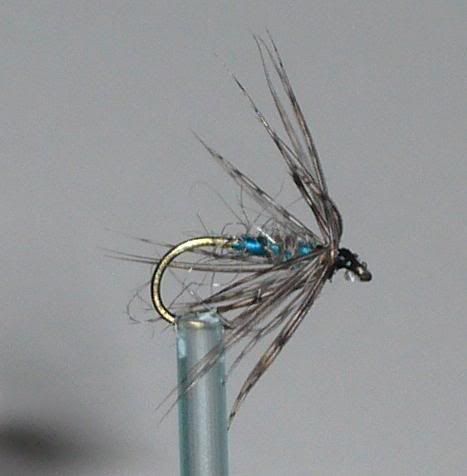
The “classic” spider flies are wonderful!! Always my “go to” fly when nothing else is working…or if I want action straight away! Yellow, olive, orange, and of course, blue. Use the uni-stretch aqua blue for the body. Still haven’t figured out why the blue works so well, but I’m just happy it does!
Betty, Your mention of blue on a spider reminded me of something, it was this -
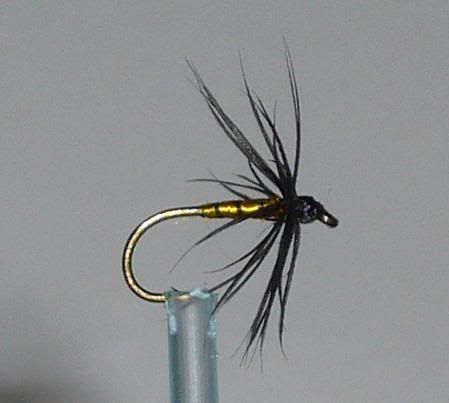
Number 6 (Blue & Black hen)
Hackle : Black hen.
Body : Blue plastic tinsel
(underbody blue).
Head : Orange fluorescent
nylon.
Hook : No 11 to 13.
Season : Summer.
*Number 7 (Blue & Grouse)
Hackle : Grouse.
Body : Dark blue nylon.
Head : Orange fluorescent
nylon.
Hook : No 11 to 13.
Season : All season.
These Italian spiders were tied by Walter Bartellini, and are modernised versions of traditional Alpine spiders.
I haven’t tried blue on spiders myself but blue is a favourite colour on sea-run brown trout flies.
These Italians seem to have been doing everything longer than everybody else, except the Chinese.
Off to the tying desk!! Kewl fly, Donald!! I’ve never tied them with the reversed hackle, but I will now!
Ed, I’ve not tried blue pheasant for the bodies, yet! Will give that a go too. The uni stretch gives a smooth, clean body that holds up well to continued attack by little trout teeth!!
Mine are typically tied on a 14 or 16 size wet fly hook…a little heavier than normal hooks, also they are 2x short meaing that they a 14 has the length of a 16 but the hook gap of a 14…
Snipe & Purple.
Hook: 18 to 14.
Thread: Unwaxed purple silk. Pearsall?s shade 8.
Hackle: A dark marginal covert feather from the snipe, or jack snipe for preference. Choose a spoon-shape feather.
Body: Purple tying silk or floss silk.
(A double layer of tying silk used on this example.)
Hi,
Most of my spiders ared tied on size 12 or 14 hooks. Most are on wet fly hooks, but I’m now tying some on dry fly. I do tie a few size 16 and 18, and have a couple size 22s (using osterich hurl for the hackle).
I will vouch for Betty’s Blue spider, which I use a lot here in two forms. One is similar to the aqua blue and snipe that she uses and the other is Uni Floss Royal Blue and Black hackle. I’ve had great luck with these, and have had times when these were clearly the fly of the day!
Since we’re sharing “secrets” about soft hackle flies, a few of mine:
A few turns of soft hackle on midge patterns seems to improve the fly. On a recent trip to the White River (Arkansas), a soft hackle midge outfished the standard Zebra midge by at least 2 to 1. The pattern:
Body: Black thread
Rib: Fine silver wire
Thorax: A tiny bit of hare’s ear dubbing, antron, or synthetic peacock
Hackle: A few turns of grizzly hen
UTC thread has more sheen for bodies that Danville’s, and flattens bettern than silk.
For small midges on scud hooks, don’t try to use hooks smaller than 20 or 22; the eye on some brands is too large in proportion to the hook gap. A fly tied with size 24 proportions on a size 20 hook will bring more fish to the net than a standard size 24.
One of Pritt’s flies used blue as well. A “partridge and blue”, which was:
Hook 1 (size 14)
Body : blue silk, lightly dubbed with grey fur (I forget what type of fur, I use some grey possum fur)
hackle: from the back of a partridge (which, on my skin, would suggest a brownish partridge feather rather than the white with black speckles)
After reading this thread, I tied one up last night using the aqua blue for the body and it looks very fishy. The colour plate image for the Pritt pattern seems to show mostly the greyish dubbing, so I’m assuming the blue silk Pritt used was quite a pale blue since dubbing on his flies follows the maxim of “less is more”. Meaning the dubbing should imply bulk rather be bulk (I can’t recall where I first read that advice about dubbing for spiders, but once you tie one with that in mind the whole approach to spiders as an impressionistic pattern starts to really come into focus and you start stripping the hackle on one side, and one turn and one turn only of that hackle, and suddenly, you are fishing with something not far off from a bare hook! ha!). Anyway, I’ll try and take a photo and add it to this thread.
And I agree with your assessment of Donald’s site. I’ve picked up a lot of interesting ideas from his site (Thanks Donald!).
Jeff
P.S. Just checked out Donald’s hen hackle page, and the “bluebottle spider”, with a dark blue tinsel body and black hen hackle looks very similar to the “Dark Betty” that I tie (but I use a Royal Blue floss for the body).
Also, I have furnace cape for tying dries. There are some feathers that are useless for dry flies because they are entirely the “centre dark strip”, with soft fibers. When the light catches these feathers, they have a sort of green shine to them, very insect like. These are excellent feathers for soft hackles. Similar “soft feathers” can be found near the back on my micro-barb grizzle cape for a grizzle soft hackle collar. Sometimes these feathers can tie down to quite small sizes for those who want really tiny soft hackles.
Here it is Jeff, just as Pritt gave it :-
"No. 44 Blue Partridge. Hook 1 (14).
Wings: Hackled with a feather from a Partridge’s back.
Body: Blue silk dubbed with a little lead-coloured lamb’s wool.
A first-rate killer in a biggish water any time after the middle of May."
I had a look in Edmonds & Lee, but could find no mention of this fly.
The grey 'possum sounds like a good substitute.
I’m glad your finding the web-site useful.
I think I may add a list of Pritt’s and Edmonds & Lee flies.
Donald, gread site, truly appreciate what you have done…thank you!!
Arnie, the fly you describe seems like a deja vu to me - in fact this is the first soft hackle I’ve had success with, the only difference being black hen hackle instead of grizzli and very sparse /no more than one turn…maybe less …/. I am using size 16 fine wire scud hook for this fly /the smallest available in local fly shops/ and only use 2/3 of the shank in order to make it as small as I want.
That’s the one! I had read it at home in S. Neme’s book “The Soft Hackle Fly Addict” but was posting from work. I’ve tied up a number of Pritt’s patterns, and really like the look of them. I’ve had the most success with his #1 (the Water Cricket, tied in yellow with a black rib and starling hackle), but have tied up a number of others. I usually have to make a few substitutes since many of the feathers are not easily obtainable here (or anywhere). I don’t think, for example, there are a lot of shops selling Brown Owl wings these days.
And yes, your site is a treasure trove of information. I’ve got a few Tummel style flies ready to try, and a full collection of Stewart Spiders (yes, all 3! ). I’m interested in seeing some of the Bumbles in picture form. I assume Bumble is a category name for wingless/tailess palmers, like a Bibio, since the patterns listed are both tailless and wingless. However, could a Bumble include a tail making a woolly worm or wooly bugger a form of a Bumble. What about a wing and a tai? Would an Invicta be a form of a Bumble? I’ve not heard the term before, though I’ve fished various palmered patterns with good success.
Ok, here’s a photo of Pritt’s Partridge and Blue (No 44) that I did up using possum fur instead of lead coloured lamb’s wool (hmm, I probably had some wool like that actually):
I’ve not fished the first pattern yet, but the Water Cricket is very successful for me. I’ll sometimes include a turn or two of peacock herl on the head, just in front of the hackle.
Thanks! I think you would find Pritt’s Partridge & Blue a productive fly since it looks very similar to your Snipe & Blue. The Water Cricket’s rib is optional (I just leave extra tying thread sticking out the end, then wrap it as the rib), and it can also be tied in orange.
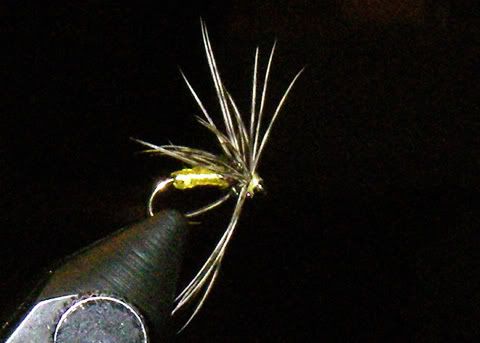
Here’s one that based on a classic but I use modern v-rib material for the body, throax peacock.
(I don’t know what I did but the camera black out everything but the fly…a very cool pic, I think)
Have you ever used a product called “Liquid Lace” in the same manner? It’s a very stretchy hollow lace that you fill with babyoil. It’s available in very small sizes and would be ideal on your fly. The translucency of the stuff is amazing. Just a thought. You can see it at www.liquidlace.com and www.tyingsupplies.com


 …/. I am using size 16 fine wire scud hook for this fly /the smallest available in local fly shops/ and only use 2/3 of the shank in order to make it as small as I want.