The Cahills By Skip Morris, Port Ludlow, WA
To me, the Dark Cahill and Light Cahill represent
the ideal of the traditional dry fly. Their soft,
muskrat- or badger-fur bodies, the subtle contrast
of their hackle and theirs against those bodies,
and their gracefully curved, finely marked wood-duck
wings all tell of elegance. These characteristics
also make the Cahills a fine choice for imitating
mayflies from dark to light, and for imitating
other insects.
Wood duck is currently scarce and quite expensive;
mallard feathers dyed wood-duck color make a good
substitute. You may find wood-duck wings a bit
tricky to handle; the trick is to measure carefully,
master the wing variation of the pinch, and handle
the fibers firmly and deliberately. The leftover
tips of wood-duck feathers also make good wings.
The Light Cahill and Dark Cahill were created on the
East Coast by Dan Cahill, but are now in use across
America. For more on the history, and tying the
wet versions of the Cahill see
the Old Flies section for the
[Cahill.]
Materials List: Dark Cahill
Hook: Standard dry fly, sizes 20 to 10
(the hook shown is a Partridge L3A).Thread: Tan, brown, or black 8/0 or 6/0.
Wings: Wood duck or dyed mallard.
Tail: Brown hackle fibers.
Body: Muskrat fur.
Hackle: Brown.
Light Cahill
Hook: Standard dry fly, sizes 20 to 10
(the hook shown is a Partridge L3A).Thread: Tan or cream 8/0 or 6/0.
Wings: Wood duck or dyed mallard.
Tail: Ginger hackle fibers.
Body: Cream badger underfur.
Hackle: Ginger.
Instructions - Dark Cahill Dry:
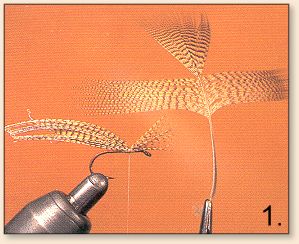
- Strip the fuzz from the base of a wood duck
feather, and then strip a section from each side
of the feather. Set the sections back to back,
measure them against the hook, and tie them in
about three-quarters up the shank using the wing
version of the pinch. Each section should be at
least as wide as the hook’s gape, even as wide
as the shank is long.
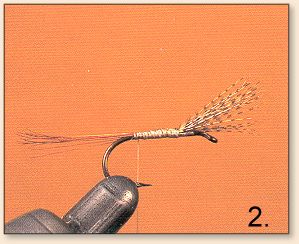
- Trim the butts of the wood duck at an angle
and them bind them with thread turns. Strip some
hackle fibers, measure them against the hood, and
then use the pinch to tie them in as a tail. Trim
the tail’s butts and bind them with thread.
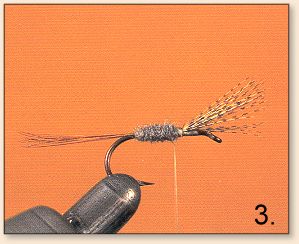
- Snip some muskrat fur from the hide, and with
it dub a tapered body to just past mid-shank.
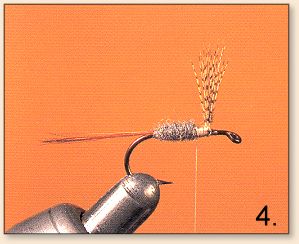
- Pull the wings firmly upright, add tight thread
turns against the front of the fibers, divide the
wings, set each wing upright with thread.
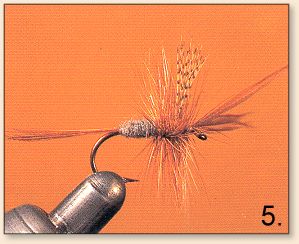
- Size, prepare, and tie in two hackles. Wrap
the hackles one at a time to just behind the eye;
secure each hackle with two or three thread turns.
Trim the hackle tips; build and complete a thread
head.
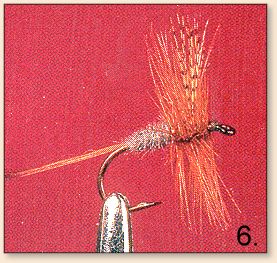
- Finished fly. ~ Skip Morris
Credits: The Cahills are two of the fourty or so step-by-step
instructional flies in The Art of Tying the Dry Fly by
Skip Morris and published by Frank Amato Publications.
Originally published May 19, 2003 on Fly Anglers Online by Skip Morris.