For Gretchen and me fly tying falls into categories based on
expectation/purpose. Production tying is a way we make a
portion of our income. Therefore speed and quality are
major considerations at those times. When we are teaching
a class speed is not the issue, clarity of the message is our
top priority. When we tie to relax, often just constructing
different from what we had been tying through the day fills
the bill. That’s how Gretchen created the Tarpon Tamer.
She was looking for a little escape from an order of Lime
Trude flies we were tying for a fly shop in Montana and
a box of materials from Rocky Mountain Dubbing UPS
delivered that day was sitting on the floor next to her work
station. Part of the contents from that box when on a hook
along with other available materials. When she showed the
completed “relaxation fly” to me I thought it looked good and
suggested we put it in the book we were writing. At the time
it seemed like a good idea and I called it the Green Tarpon.
Let’s fast-forward a few weeks as I’m leaving home to catch
a plane to Florida to go on my first tarpon-fishing trip. I was
quite excited because all my life I had fished for freshwater
species with an emphasis on trout, I had never landed any fish
that was darned near as big as me. Now I was getting that
opportunity.
When I opened my suitcase in the motel at Big Pine Key, Florida
I found six of the green tarpon flies Gretchen had slipped in as
a surprise. The next day I got shots at seven fish and four of them
ate the fly. Each time I raised my rod tip to set the hook I lost
the fish. The guide explained (very patiently) I needed to yank
on the rod very hard because the tarpon had a mouth like a cement
building b lock. I never did land a fish in the three days I was in
Florida just because I couldn’t get away from the trout hook-set
ingrained in my brain from forty-five years fishing in fresh water.
When I returned home Gretchem asked how the flies had worked
and I told her they attracted the fish but I just couldn’t tame them.
The name stuck and the fly became the Tarpon Tamer as a
reminder to me of a time when I had to eat “humble pie” proving
I wasn’t the expert in all aspects of fly-fishing I thought I was! Oh
well, humble pie is a great motivator and has pushed me to learn
a lot about tarpon fishing since that first trip.
Materials for the Tarpon Tamer
Hook: Size 3/0 to 2, saltwater.
Thread: Flourescent green.
Tail: Chartreuse bucktail, green Tiewell flash.
Tail flank: Green hackle.
Collar: Chartreuse neck hackle.
Eyes: Dumbbell, stick-on, gold/black.
Snout: Tying thread coated with Aqua Flex.
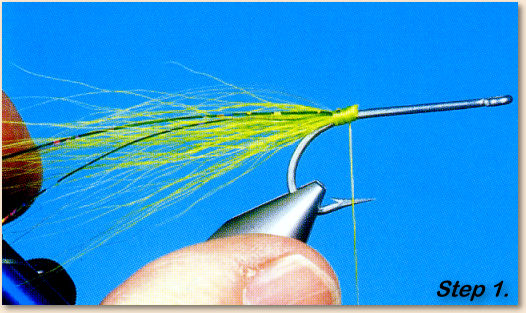
- Place the hook in the vise and apply a short thread base at the back
of the hook shank. Select a clump of chartreuse bucktail and tie it to the
hook as a tail about twice as long as the shank. Top the tail with several
strands of green Tiewell Flash that are slightly longer than the tail.
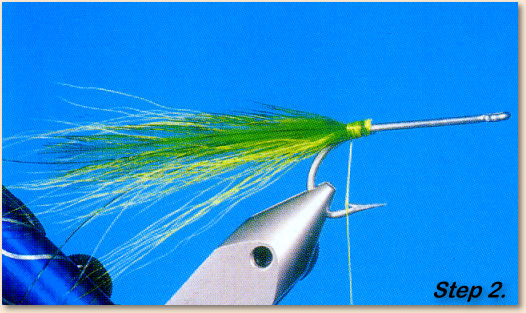
- Pluck two feathers from a cape dyed dark green. Tie one to
the near side of the tail and the other to the far side. Adjust their
length so they are a bit shorter than the bucktail. Trim off the
waste ends. Up to this point I’ve applied the materials using
stationary tying techniques.
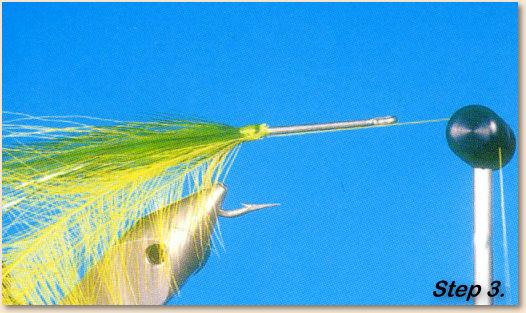
- Select two strung neck hackles dyed chartreuse. Fold the
fibers on each and tie them to the hook by their tips. Place the
thread on the bobbin rest.
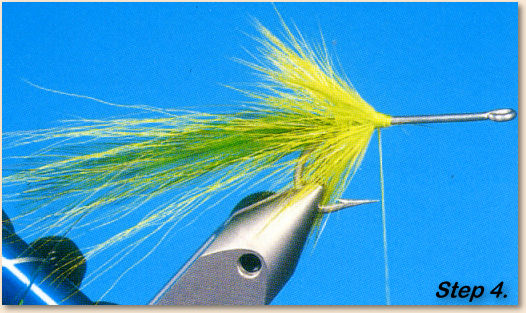
- Hold the feather with the right forefinger/thumb and rotate the
vise with the left hand to construct the collar. Tie off the feathers
and trim their waste ends. Place several thread wraps tight
against the hackle to force the fibers back collar style.
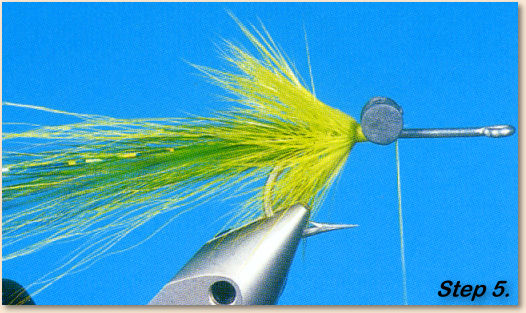
- Tie on the dumbbell eyes directly in front of the collar. I
used several figure-eight wraps to firmly anchor them then
followed that with a drop of QuickTite super glue.
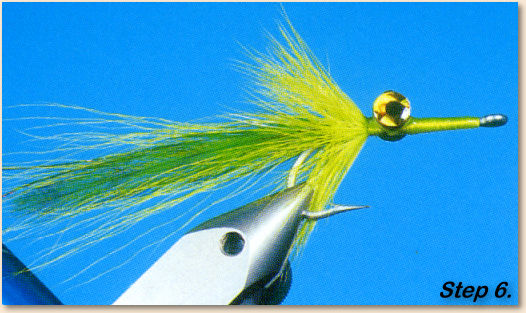
- Build a tapered snout, whip-finish just behind the hook eye,
and trim off the thread. Attach the stick-on eyes then coat the
whole assembly (eyes and snout) with Aqua Flex. Place the
fly in a turner to dry. Apply a second coat of Aqua Flex
if it is needed. ~ Al and Gretchen
Credits: This fly is an excerpt from Al and Gretchen’s
latest book, Rotary Fly-Tying Techniques,
published by Frank Amato Publications.
For more great flies, check out: and
Originally published September 8, 2008 on Fly Anglers Online by Al and Gretchen.