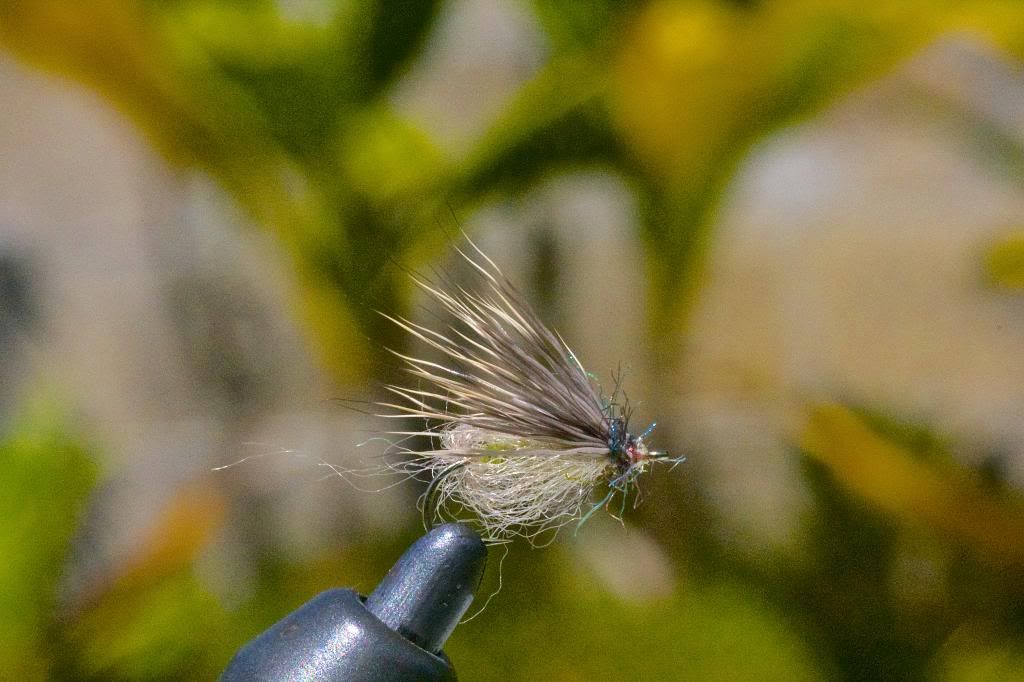
Gary’s directions in Caddisflies has the tier tying down two strands of antron, one on top of the shank and one on the bottom of the shank. I never did understand this advice as it has the tier struggle to negotiate the bend and sharp hook point&barb.
I strongly suggest tying in the bunches on either side of the shank instead, as indeed Matt Grobert in the Vimeo video demonstrates
I’ve never been able to get the bubble to encompass the entire hook.
I saw a video recently featuring a somewhat similar fly. The tier tied down the veil right behind the eye, then pushed the veil back towards the body. Got a nice round bubble.
I have quit doing the two bunches of antron entirely. I tie in one larger bunch with the fibers around the hook the same way I would tie in the deer hair for a Robert’s Drake. This leaves the fibers evenly distributed around the hook. You do have to be carefull not to make the veil to heavy so it can be seen through since this method does not leave gaps at the sides to see the underbody through.
I tie them as Gary did I believe he did it right, and for me they work well. Not difficult to tie his way either. Also try using the right material, sparkle yarn as the original pattern was tied.
Gene
Sparkle yarn you get today is not the same, the original antron formula has been changed over the years. If you can find some of the old stuff thats fine but the newer stuff is just not the same. The last Rail car of the original antron was bought by a friend (supplier) of mine…I can tell you there is a difference in the materials…Here is some original antron hank…
Bob,
I spoke with LaFontaine twice about the correct material. He recommended Dazzleaire as I said. He also suggests Dazzleaire on his video. As he says on his video, “There is no “sparkle yarn”. That’s a name I made up”.
I bought a box of Dazzleaire skeins and still have lots of it.
Byron I have skeins of old sparkleaire in gold, green, brown and black. I know the “sparkle yarn” is now difficult to find except Gary’s old Bookmailer still has some which is Dazzleaire. I met Gary a few times and have a couple of his sparkle pupas framed. His flies evolved somewhat from his first book, where he used 3 strands of yarn and marabou for the head. He claimed it was the clear antron fibers in the yarn that helped to trap air bubbles. Probably why the solid antron does not or might not be as effecient. Gary was working on a book about BWO’s when he passed away, I bet that would of been informative.
Gene
Well, if I remember correctly, LaFontaine recommended 3 different manufacturers or brands of yarn for use in his ‘sparkle caddis’ patterns I’d have to go back to his books or maybe it was in one of his videos to read or see where he said that. Dazzelaire was one but I don’t recall the name of the other two.
Regardless, my question was not about whether there’s a difference in the types of ‘sparkle yarns’. It was whether anyone actually experienced a difference in the effectiveness of flies tied with LaFontaine’s recommended brands compared to the same flies tied with other brands?
Not taking anything away from LaFontaine’s work and contributions. #1 - I doubt that anyone would try to actually perform a true scientrific test. #2 - I doubt that a true scientific test is even possible.
Oh, and I too have plenty of Dazzelaire yarn. I’ve used it to make ‘touch dubbing’ and I’ve tied plenty of caddis’ per LaFontaine’s recipes and instructions.
Allan I have heard people complain that they can’t catch fish on the pupa or emergent. When I inquire about the materials used the usual reply is Antron yarn. I can only suspect that the proper yarn has fish catching appeal. That said I carry many different types or styles of caddis patterns. The sparkle yarn I use was purchased at a Ben Franklin store probably 30 years ago. It is to my recollection sparkleaire, I also have dazzleaire which is somewhat a softer texture yarn.
Gene
I say this with all truthfulness and no B.S. Immediately after reading LaFontaine’s book perhaps 10 years ago, I tied over 250 caddis’ in his styles, recipes and in several sizes using the methods and exact materials he specified. Since then I’ve caught as lot of trout on caddises. However, out of all those trout, probably less then a handful were on ‘his’ flies. Oh well.
I’ve tied ESP and DSP’s since reading Gary’s book back in the 80’s. The dubbing used by Gary was chopped-up sparkle yarn. He used the touch dubbing method using sticky wax on the thread. The body was tied very sparse and spiky which created air bubbles that became trapped in the veil. The ESP & DSP are my most effective caddis patterns…by far. If the materials and/or methods of tying are right, the fly is very effective…for me anyway.