When I was a boy, my father would occasionally
take me fishing for Slough Sharks. That was the
name my father used when referring to a Northern
Pike. My Dad was a true sportsman. He hunted,
fished, played golf, hockey, baseball and curled.
He was very accomplished at all of these sports
but the one sport that really caught my attention
other than hockey - 'cause as we all know every
Canadian kid plays hockey- was fishing or rather
fly-fishing. My father used to guide American
fly fishermen on the famous Miramichi River in
New Brunswick. He was born and raised in
Fredericton, New Brunswick and after many years
in Germany, Manitoba and then Alberta with the
Air force he was transferred back to New Brunswick
to Canadian Forces Base Chathem. That’s where I
was born and held my first fly rod.
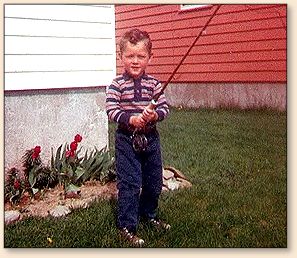
The Miramichi was and still is famous for it’s Atlantic Salmon
and when my father left the Air Force and we finally
made our way to Alberta the only fish that my Dad
would consider to be in the same league as his
beloved Atlantic Salmon, was trout. So Pike wasn’t
on the top of my father’s list of favorite fish and
he often told me, “you can catch these fish on a
cigarette butt, son”. I was always under the
impression that the only reason we fished for Pike
or any fish other than Trout, was to benefit me,
so that I had the full experience of all of Alberta’s
game fish. And it seamed whenever we went fishing
for Pike, which wasn’t very often, he would tell me
the story of when he was stationed at the Cold Lake
Air Force Base here in Alberta. In this story my
father made a bet with an Air Force buddy that he
could catch a Slough Shark on anything in the boat.
His buddy called him on the bet and he chose the
cigarette butt hanging from my father’s mouth. So
my father brought out his fly rod equipped with just
a bare hook and his cigarette butt. Casting to the
shallows and using a quick strip he did indeed catch
a Slough Shark (or so the story goes).
Trolling for Northern Pike in my father’s 12ft
aluminum car topper with spinning gear wasn’t
quite the same as trolling for trout and we never
took our fly rods with us when Slough Sharks were
our quarry. The Pike seamed easier to catch
compared to trout and the mystery and finesse of
fly-fishing wasn’t a part of our days on the water.
I guess the result of his story and the lack of
the fly rod magic when fishing for Pike made me
somewhat prejudice toward these fish. It wasn’t
until many years later when I decided to give
writing a try that I would find a whole new
respect for the Slough Shark.
I was looking for some feedback on an article
that I had written regarding lunker trout close
to home - Walter Is In My Backyard - and decided
to get in touch with author Clive Shuapmeyer who
lives right here in Alberta. While corresponding
with Clive the subject of fly-fishing for Northern
Pike had come up. I started reading many articles
written by Clive regarding Pike on the fly and before
I knew it I was fighting Slough Sharks on my eight
weight and loving every minute of it.
I do enjoy fishing Alberta’s mountain streams
and Blue Ribbon Rivers but my passion lies in
the local lakes and ponds that surround Alberta’s
capital city. There are no trout streams close
enough to the city of Edmonton to get out for a
few hours and although the fishing is incredible,
driving three hours to Calgary, fishing all day,
then driving three hours back again is not something
one can do often (especially when one’s body is
used to working the night shift). So it wasn’t
much for me to grab my eight-weight rod and head
out in search of Slough Sharks on the fly. It was
really the idea of catching Pike on dry flies - or
more correctly, top water flies- that captured my
imagination. Clive had given me information on
when and where to fish for Northern Pike and
specifically when to use top water flies and
what patterns work well. I started tying up
some poppers and sliders in anticipation of
the coming spring, of course Clive’s recipes
were much more elaborate and complicated than
my own but the Pike didn’t seem to mind and
neither did I.
Wabamun Lake is about 45 minutes west of Edmonton
and is known for it monster Northern Pike. This
lake is also known for it’s open water throughout
the winter months. In a certain section of the
lake, there is a warm water discharge flowing
out from the Wabamun power plant. The plant
takes the cold water from the lake and uses it
to cool down the generators inside the plant
then the water is discharged back into the
lake.
With this heated water, the bug life
thrives here all year giving the many species
of fish plenty to eat. Since Northern Pike
are predators, these sharks can grow very big
(some well over 20lbs) by feeding on the Perch,
Whitefish and the occasional Walleye that benefit
from the plentiful insects and aquatic life.
And because of these lunker Slough Sharks, my
decision on which lake to experience my first
Pike on the fly was easy. Yes, it would be
Jack Fish Lake (a little closer to the city
but in the same direction). You see, Pike
have very sharp teeth (and lots of them, which
is probably how they got the alias Slough Shark)
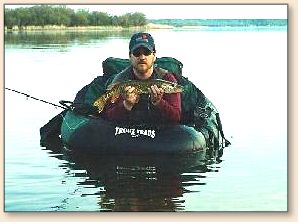
and since I fly-fish from a tube, I felt a little
uncomfortable with the thought of pulling Jaws
up to my rubber donut. So for my first experience
I thought it best to try for some Sharks a little
smaller in the tooth department.
The best time to fly-fish for Northern Pike
is in the spring when the Pike are shallow
and hungry after spawning. Summer is tough
for fly anglers because the Pike tend to go
to deeper waters and autumn can be a crapshoot
(some days are good and some not so good). So
it was in the spring that I went off for my
first Slough Shark adventure. Armed with my
eight weight rod, both floating and sinking
line, long needle nose pliers, jaw spreaders
and some plastic coated wire leaders, I performed
my best bozo the clown impression and entered
and launched my round tube onto the home waters
of the mighty Northern Pike. It was early morning
around 5:30am and the sun was just lighting up
the sky. There was absolutely no wind and the
lake was like glass. I tied on my own version
of a popper. It wasn’t pretty but it worked
and may even have looked a little better than
a cigarette butt (maybe). The popper was made
with a yellow rabbit strip tail, green crystal
chenille for the body, yellow deer hair for the
wing and a green foam popper head made from those
cheap foam sandals you can buy at Wal-Mart. The
first thing I noticed once I got my rig together
was the casting. I figured out quickly why it
called for an eight-weight rod (those big Pike
flies were not easy to cast and called for a
double haul right off the bat). The second
thing I noticed was just how ferocious these
Slough Sharks were. These fish don’t mess
around when they see something they like. I
cast out my fly towards shore and landed it
about 10 feet shy of the cattails. I gave my
line some slow strips and then paused. I then
gave it some quick short strips. The presentation
and retrieve may have to vary according to what’s
turning the Pike on that day and experimenting is
all a part of the fun.
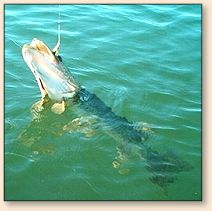
Before I could pause again
I saw the wake coming up behind the fly and my
heart started pounding. I continued stripping
the line in using quick four-inch strips. Then
I saw the wake again coming from the side of my
fly and before I knew it…WHAM! I lifted my
rod to set the hook and…hmm; no fish. It
seems Pike are not as precise as Trout when
taking food on top of the water so it’s best
not to get too over zealous. Mr. Slough Shark
wasn’t done yet however. I quickly stripped
my line in to make another cast towards the
cattails but before I got it close to the tube…WHAM!
He hit it again. This time I waited to feel the
Shark on my line and when I felt the tug I set
the hook. Within no time I had my first Pike on
a fly. I had never experienced such an aggressive
take, it was one of the most exiting and explosive
strikes I had ever seen. The closest I could get
to describing some of the hits I’ve had by a
Northern Pike would be the breach of a Great
White Shark taking a seal off the surface of
the ocean (I’d seen that on a National Geographic
special once). The only difference was that the
Pike rarely left the water completely and nine
out of 10 times struck from the side as apposed
to directly underneath. The Pike I tubed was
only about two pounds and it got me thinking
about Wabamun Lake and what it would be like
to take a 10 plus pounder on a floating fly.
The rest of the morning saw the same action
as my first Slough Shark and many Pike were
brought to hand. The biggest was about three
pounds and all the hits were just as explosive
as the first. I even caught one right beside
the tube. After noticing how badly my popper
was chewed up, I decided to tie on a new one.
The fly was floating about three feet in front
of me while I put my fly box back into the pocket
of the tube when that shark struck, and it scared
the pejeebies out of me. It was around ten o’clock
when the Pike slowed to the top water flies and I
had tubed close to 20 Sharks so far, so I thought
I would try a sinking line and a large streamer.
I chose a yellow and green Perch pattern and I
did catch a few but the streamers just didn’t
do it for me after the Pike explosions I witnessed
on the top water flies. Happy with how my morning
had turned out, I decided to head back to shore and
call it a day. I successfully fished Jack Fish Lake
several more times that spring and it wasn’t until
the next year that I went after the big Sharks at
Wabamun.
Wabamun is a very large lake and when
you’re fishing in a float tube and the
wind picks up, it’s best to get to shore.
Around the warm water discharge however,
the wind isn’t as menacing because of the
bay it’s in. The problem is the current
you have to fight because of the discharge.
If you don’t pay attention, the current can
push you pretty far out and away from the
shelter of the bay. It’s hard to get back
to the mouth of the discharge fighting the
current and if there is a good wind, you
could be in trouble if you get forced out
too far.
In the spring, Pike will sit in some very
shallow water. Two, three or four feet of
water is quite normal. So this is were I
look for Slough Sharks first. I’ll try and
match my streamers with the forage fish in
the waters that I’m fishing. In Wabamun,
Perch and Lake Whitefish are what the Pike
like to fill up on. For poppers, sliders
or floating flies, you can either match the
forage fish or go with a frog, a mouse or
even some bright gaudy pattern. When there
is chop on the water I use a weighted streamer
on a dry line and if I can’t find any interested
Sharks, I’ll try a little deeper with a medium
sink line. My first time fly-fishing Wabamun
was with a good friend of mine in his canoe.
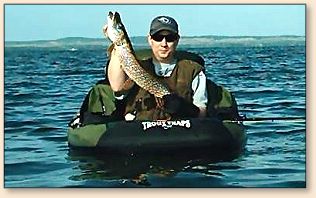
Due to what I guess was some wishful thinking,
I brought only my floating line, a lot of poppers
and only a couple of un-weighted streamers. There
was a decent chop on the water so my top water
flies were not going to do it for me this day.
I tied on a streamer but I couldn’t get it down
to where the Slough Sharks were as they were
sitting in between four and six feet of water
so I borrowed a fly off of Joe. He tied up some
streamers using large barbell eyes and after I
tied one on, I was soon into fish as well.
This taught me a valuable lesson. Don’t take
Pike for granted. Yes, some days they’ll eat
anything you throw at them but other days you
may have to work hard for them and coming prepared
for all situations is just as important when
fishing for Slough Sharks as it is when fishing
for Trout.
It was several weeks later when I finally got
a chance at Slough Sharks on top water flies.
I hadn’t had the opportunity to toss the
poppers at the Wabamun Pike while in the tube
yet because of the choppy water on all my
previous trips but I knew this calm spring day,
was going to be my day. I walked with my tube
over my shoulder and made my way to the mouth
of the warm water discharge channel. Once again,
I did my clown impression and got my finned feet
into the donut. I made my way out not even 10ft
when I felt the current taking me away. I worked
my way toward the edge of the channel and dug my
fins into the bottom. It was only about two feet
deep here and with my fins dug in I knew I wasn’t
going anywhere, although I did have to struggle
somewhat to stay in position. The edge of the
channel dropped off quickly to maybe 8ft and it’s
along this drop-off that I made my first cast.
Unlike Jack Fish Lake, I didn’t see any wake before
the Pike hit the popper. It was simply an all out
ambush. It scared me at first; the explosion was
just as I remembered it at Jack Fish Lake but this
was no two pound Pike. I didn’t actually weigh it
but I’d guestimated this Pike at about six or seven
pounds. At first the fight was intense, the Slough
Shark pulled line off my reel like string coming off
a yo-yo. Then it rested and it felt almost as if
pulling in a log off the bottom of the lake. I got
it close to the tube and it decided to go for another
run. Four more times like this and I finally got
it to the tube. Thank the Lord I didn’t forget my
Jaw spreaders because if I were faced with the
choice of either sticking my hand in that mouth
with all those teeth or cutting the wire leader,
I’d have lost a lot of flies that day. The action
for the remainder of the morning wasn’t as good as
the year before at Jack Fish Lake but Pike were
bigger. I managed to land six Slough Sharks with
my biggest around eight pounds and my smallest at
four. All the strikes were explosive, almost
frightening. And the rush I got will not soon be
forgotten. To this day I still haven’t caught that
Slough Shark over 20lbs but I’m working on it. A
project like this has no deadline and I don’t mind
gaining the experience. I don’t fish for Northern
Pike any where near as much as I fish for trout but
every spring I do look forward to windless days at
Wabamun and Slough Sharks on the fly. ~ Doc
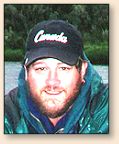
About the author:
Mike (Doc) Monteith is the owner/guide of
Edmonton Float Tube Adventures, owner of the
information web site Fly Fishing Edmonton and editor/publisher of the information web site
Float Tube Fly Fishing.
Originally published November 28, 2004 on Fly Anglers Online by Deanna Lee Birkholm.