Scott Sanchez’s Double Bunny By Scott Sanchez
The idea for the Double Bunny came to me almost 20 years
ago while on a fishing trip to Belize. John Hanlon and I
were trying to catch some barracuda that were not being
cooperative. The two flies that ended up working the best
were a Kiwi Muddler and a FisHair Cuda Fly.
What could happen, I wondered, if I put together the
pulsating action of rabbit fur and the undulation motion of a
'cuda fly? I didn’t have the necessary materials to tie
the Double Bunny on that trip, so it had to wait until I was
home.
Some months later, while fishing my home waters of Jackson,
I watched a large trout chase a smaller fish on the end of
my line. The idea of the “super barracuda” fly came back to
me. That night the first Double Bunny popped out of my vise.
The first time I fished the new fly, the lake trout and
cutthroats in the Snake river below Jackson Lake were
chasing it harder than a politician looking for Florida
votes. I’ve used it successfully ever since. It’s a
great fly for finding and catching large fish. So far it
has subdued more than 30 species ranging from cutthroats
to tarpon - even a catch-and-release fly-rod record channel
catfish. The 1992, 1993, and 1994 Jackson Hole One-Fly
competitions were won on Double Bunny variations.
…I used to incorporate Zonker strips in the pattern, but wide
rabbit strips such as Harelline’s Magnum Strips make it easier
to cover the lead underbody. If you do use Zonker strips, I
suggest you cover the lead with Mylar dubbing such as Lite
Brite or Angel Hair.
…The numerous color combinations you can tie and fish are
limited only by the colors of rabbit you can find. Typical
of bairfish patterns, the darker color is tied on top of the
fly. The following are effective variations for trout.
-
Chinchilla over white - baby whitefish.
-
Olive over gray - baby rainbow trout and sculpin (One-Fly Winner.)
-
Natural brown over ginger - baby brown trout.
-
Natural brown over yellow - Platte River Special.
-
Black over fluorescent yellow - for dirty water and low light.
-
Black over white - Integration Bunny.
-
Dark gray over shinchilla - small trout and sculpins.
-
Black over ginger - for low water, bright light.
Materials List: Double Bunny
Hook: Dai-Riki 700, size 2.
Thread: White Gudebrod G.
Weight: .035 lead wire on the front half of the
hook shank.Body: White Magnum Rabbit Strip for the belly;
chinchilla Magnum Rabbit Strip for the back.Sides: Pearl Krystal Flash and silver Holographic Flashabou.
Eyes: 6 mm molded 3D eyes glued on with Goop.
Adhesive: Val-A-Tearmender.
Tying Method: Double Bunny
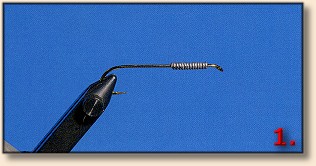
- Wrap .035 lead on the front half of the hook.
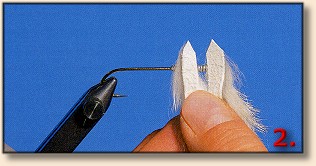
- Prepare rabbit strips by cutting the tip of each to a point.
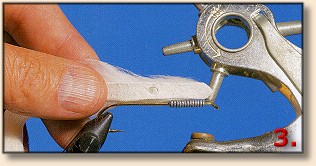
- With scissor points, a knife, or a leather punch,
pierce a hole in the belly strip one and a half shank
lengths from the tip. This will allow you to pre-weight
hooks. You can also impale the belly strip with the
hook.
- Push the rabbit strip over the eye of the hook.
Start your tying thread to secure the lead. Lash some
loose rabbit fur to the lead to help the glue bond and
cover the lead. (You can use Mylar dubbing such as
Lite Brite as well.)
- Tie the bottom rabbit strip bu the tip just behind the eye.
Hold the fur out of the way with your left hand to prevent
trapping it.
- Secure the top rabbit strip by the tip. Hold the
fur out of the way with your left hand to prevent trapping
it.
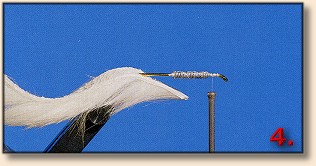
- Holding the back end of the top rabbit strip away from
you, use a toothpick to apply a light amount of
contact cement on the hide only - if you put too much on the
toothpick, you risk getting it on the hair.
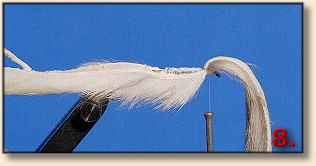
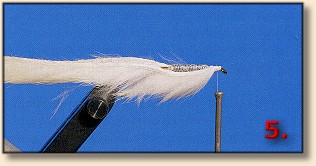
- Coat the hide side of the belly strip and cover the
lead with contact cement.
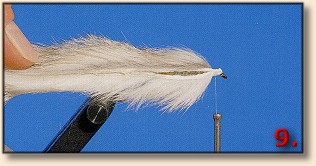
- Hold the tail ends of the rabit strips in your left hand
and pull them straight back. With your right hand, pinch
the strips together and down into the lead.
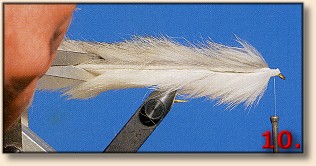
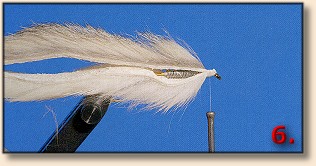
- Cut the body to length. Push your scissor tips through
the hair to prevent cutting off the fur.
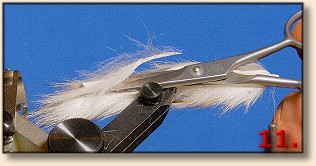
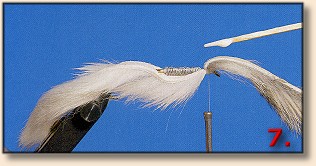
- Rotate the fly so that the top faces you. Cautiously
taper the tail so that it is lighter and more flexible
when wet. Slide your scissors and cut just a little at
a time.
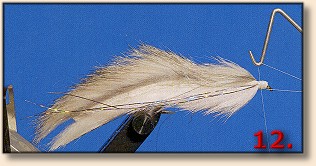
- Take a few strand of Krystal Flash and Holographic
Flashabou that are double the body length and tie them in
at their midpoint just behind the hook eye. Next, pull
the forward-facing material to the far side of hook and
tie it in place. Cover the ends with thread, whip-finish,
and cement.
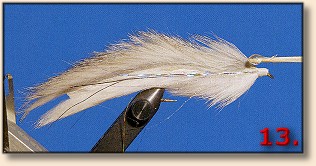
- Attach the eyes. Stroke the rabbit hair back. With a
toothpick, coat the area just behind the thread head with
Goop.
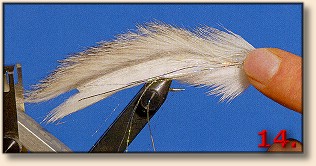
- Place an eye on the glue. Repeat this on the other
side. Make sure you use enough glue to hold the eyes.
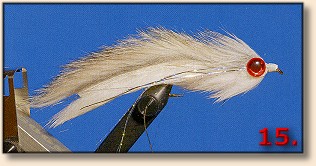
- The finished Double Bunny.
There are a number of good choices for Double Bunny eyes and heads.
Stick-on eye can be used in place of the 3D models, but you still
need to make a glue base. I epoxy over the head and eyes for
more durability, and to add weight to the front of the fly.
EZ Sparkle Body or acrylic T-shirt paint can also be used to
build up a head and reinforce it. Some commercial versions
use dumbbell eyes. Orvis sells a Conehead Double Bunny.
When using cone heads, place the cone on first and then tie
the fly. Use some lead behind the cone and super-glue it
to keep the body from sliding back as you fish the fly. ~ SS
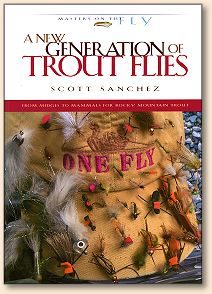
Credits: The Double Bunny is Scott’s signature fly and
just one of the many excellent creative flies in the new book,
The New Generation of Trout Flies by Scott Sanchez, published by
Wild River Press. The actual full-page photos are outstanding.
You can order a hardbound, spiral edition ($39.95)directly
from their website.
Originally published November 21, 2005 on Fly Anglers Online by Scott Sanchez.