| Sysadmin Note |
|---|
BAITS - PART THREE, - MINNOWS
If you fish the saltwater then you are very familiar with what bait minnows are in season and where they should be found. Furthermore the savvy saltwater angler learns about the baitfish that the gamefish feed on, how they swim, at what depth of the water column they are generally found and if they school or are found as singles. In this column we will discuss four of the minnows that I have found to be effective in Florida and patterns that I use to imitate them. I will list the scientific name for each baitfish that I cover, just like in trout fishing where a single Mayfly can be known by several different common names the same is true with baitfish minnow they all have several different names depending on the part of the country you are from.
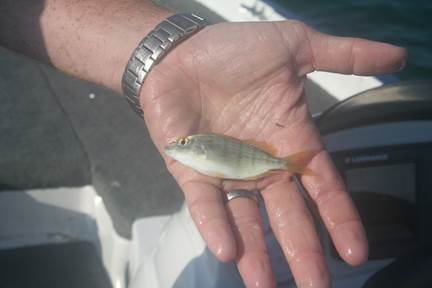
PINFISH
Pinfish [Lagodon chomboides] are also called shiners, sailor’s choice, porgy, scup. They grow to fourteen inches and are edible but are seldom eaten; however as bait the pinfish are also excellent. The juvenile pinfish of one inch to four inches can be found in large numbers in shallow coastal waters and estuaries and can be especially heavy around grass flats. Pinfish are primarily a non-schooling fish but can be found in loose groups on the grass flats and around the dock. They feed on fish eggs, shrimp, crabs, various worm and plant matter. They are in turn eaten by tarpon, snook, redfish, sea trout (Spec’s), Jack’s and many others. Oh by the way they also care caught be fly angler especially on shrimp and crab patterns.
One evening I spotted a large number of Pinfish off one of the docks and I used a small shrimp and popping bugs and had a good time using a four weight on these scrappy baitfish until a larger snook came along and ate my fly, I was using a light tippet which finally gave way as I was wondered how long it was going to take me to land what appeared to be a twenty five inch or so snook.
Now I don’t recommend using a four weight as a matter of course, but I admit that I do carry one with me and use it in special situations.
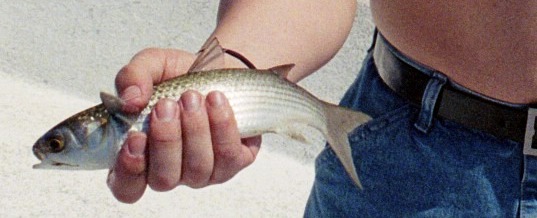
STRIPPED MULLET
The Mullet is without a doubt the most well known of all the baitfish as there are 80 species of mullet throughout the world and the Stripped Mullet alone is found in two thirds of the oceans and coast lines worldwide. The Striped Mullet [Mugil cephalus] is also called black mullet, bright mullet, bully mullet, callifaver mullet, flathead grey mullet, common mullet, mangrove mullet, river mullet and other names which I haven’t recorded.
Though there are other species of mullet in Florida the striped mullet is the most common and abundant mullet found in the waters of Florida.
As a side note; for those of you who can throw a cast net or wish to learn these prized fish are easily caught. There are many instructions on how to throw a cast net on the Internet. Mullet are very edible and the roe is highly prized. I know that several have tried to catch them on flies but nothing I have found seems to work consistently. Possibly someone will solve the problem and the anglers will have another hard fighting gamefish to tackle. The few that I have hooked on flies have fought very well and are very strong and they jump so what could be better.
The Stripped Mullet lives for up to sixteen years and the largest reported striped mullet was forty seven inches long and weighed seventeen and half pounds; this is according to the Florida Museum of Natural History.
Often angler are fooled into thinking the fish are feeding on something else when they notice the schools of larger mullet and the schools of small silvery fish and they too are mullet only they are juveniles.
The Mullet spawn off shore during the early winter and during the migration of the schools to the spawning ground they are heavily preyed upon by everything in the ocean. Once the eggs hatch the larva move inshore when they reach ½ to ¾ of inch and are silver in color, the young juveniles spend most of their time in the shallow waters of the coastal rivers, estuaries where move into the grass flats and among the mangroves where they feed on plankton and algae they mature to spawn in their third year therefore mullet are always in the system and available to the game fish.
Mullet will move upstream into brackish water and even into freshwater. Here I might note that the best eating mullet are caught in the saltwater the ones that are taken in the freshwater in my area have an undesired taste. Beside people, just about everything in the saltwater feeds on this abundant baitfish!
ATLANTIC MENHADEN
The Atlantic Menhaden [Brevoortia tyrannus] is a member of the Herring Family and are possibly the most important baitfish found on the Atlantic coastline. Why is this baitfish so important because they are very important to the health of the Striped Bass populations and that they are filter feeders, they feed on plankton and care filter up to four gallons of water a minute as the feed and are a natural check to red tides.
Atlantic Menhaden are also called alewife, bug fish, bug mouth, bunker, fatback, moss bunker, pogy and are misidentified as shad and sardines. They run in large schools and though they are classed as a baitfish with no food value to humans. I found this to be historically false as early Americans ate them fried and many would eat “Fried Pogies for breakfast”.
Menhaden are silvery with small black spots behind the gills plates along the body and they range in size from three to ten inches with the record being sixteen and half inches in length. The young menhaden live in the Inlets, coastal rivers and estuaries and move up the brackish water rivers for the summer and in the fall they run to the ocean. This baitfish is preyed upon by Stripers, Bluefish, Spanish mackerel, Sea Trout, Snook, Redfish and Tarpon plus many others.
Here in Florida we have another species of Menhaden the Yellowfin Menhaden [Brevoortia smithi], the only difference is the yellow hue on the fins.
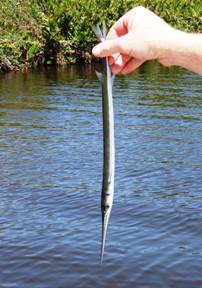
ATLANTIC NEEDLEFISH
Atlantic Needlefish [Stronylura marina] they range in size 1.2 inches to 37 inches, they are silvery in color with Pale Green Iridescent hue to the back and they will congregate in small school and will feed on shrimp and small minnows.
They have long slender bills with the upper and lower beaks that are full of sharp little teeth. They can be found in shore line and coastal rivers, bays, estuaries and will even move up brackish rivers and live three to six years.
Tarpon, Strippers, Bluefish, Larger Jack’s and Sea Trout feed on needlefish. The fly angler often catches needlefish as they will hit anything that they think they can eat.
Now I will cover the patterns that I use to imitate these baitfish now let me explain these are just the patterns that I use and there are thousands of patterns out there that are effective besides the one that I use.
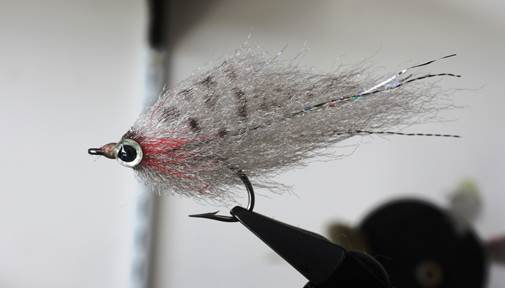
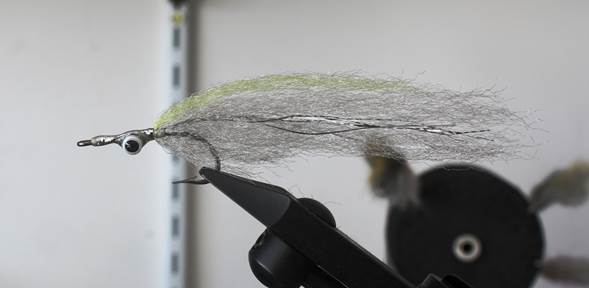
Atlantic Menhaden Minnow
- Hook: Mustad 34007 Sizes: 4/0-4
- Thread: Light Dun 6/0
- Eyes: 3D-Silver with Black centers, applied with epoxy
- Wing/Body: Silver/Grey EP Fibers with six strands of Silver Holographic Flash and three strands of Black Krystal Flash with another bunch of Silver/Grey EP Fibers on top, once the fly is completed and combed out and trimmed then add fine black dots to the upper half of the body using a black fine point Sharpie marker
- Gills: Two small bunches of Red EP Fibers tied on either side as gills, remember to make them short and thin
- Belly: Silver/Grey EP Fibers, layered up the bottom of the hook
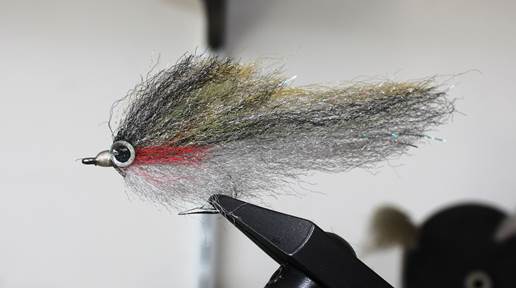
Atlantic Needlefish Minnow
- Hook: Mustad 34007
- Sizes: 4/0-4
- Thread: Light Dun 6/0
- Eyes: Dumb-bell types, Painted white with black centers, tied at the rear of the hook, the imitation will be tied with a long nose
- Body/Wing: Silver/Grey EP Fibers topped with Silver Flash-A-Bou four or five strands and two strands of Black Krystal Flash followed by another thin bunch of Silver Grey EP Fiber and topped with a thin bunch of Pale Chartreuse EP Fibers.
- Belly: Silver/Grey EP Fibers
- Nose: Silver Flash-A-Bou wrapped and coated with epoxy
Mullet Minnow Streamer
- Hook: Mustad 34007
- Sizes: 6/0-4
- Thread: White A
- Eyes: 3D-Silver with Black Center, applied with epoxy
- Wing/Body: Thin bunch of Silver/Grey EP Fibers, topped with Grey EP Fibers, followed by four to six strands of Silver Holographic Flash which is follow by Mullet EP Fibers.
- Gills: Small, short & thin bunches of Red EP Fibers tied on either side
- Belly: Silver/Grey EP Fibers
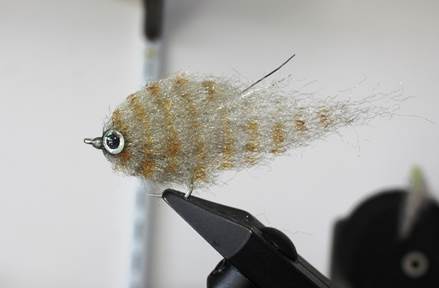
Pinfish Minnow
- Hook: Mustad 3407
- Sizes: 3/0-4
- Thread: Lite Dun 6/0
- Eyes: 3D-Silver with Black Centers applied with epoxy
- Wing/Body: EP Minnow Fibers, with 3 strands of Silver Flash-A-Bou followed by EP Minnow fibers, combed and trimmed to shape and faint black barring follow by golden barring made with Sharpie markers. With a Gray spot on either side of the upper body back a little bit from the eyes
- Belly: EP Minnow Fibers short and layered
These patterns almost never work, but you must admit that they sure are cute!
Enjoy & Good Fishin’
| Sysadmin Note |
|---|
| Sysadmin Note |
|---|
BAITS PART FOUR, MINNOWS CONTINUED:
This column will be the final part of the bait minnows that have major importance to the saltwater fly angler. The minnows that I will be covering are Silversides, Anchovies, Sardines and Ballyhoo and the Glass Minnow.
Glass Minnow imitations are used to imitate the first three minnows we will be discussing. The Ballyhoo was added just to confuse you and make thing difficult because at times I just enjoy being contrary.
A friend of mine was preparing to visit me in Florida and was tying up the patterns that I had suggested since this was to be his first trip to the saltwater and he was trying to become educated on what to expect. In the course of our discussions he asked me what is a Glass Minnow and what does it represent?
He told me that he had went on the Internet and using the search engine Bing he found some 59,600 sites dealing with Glass Minnows and was a little confused to say the least. I laughed and commented that sometime saltwater fly fishing can be as confusing as trout fishing with all the various insects and fly names.
In truth, the Glass Minnow is a generic term for small silvery minnows of ¾ of inch to 2½ inches in length and is used to imitate Anchovies and Silverside Minnows, though in all reality they have come represent any small silvery minnow that is being eaten. However I can see and understand my friend being overwhelmed by the information available on line, as I use the Internet very often myself while doing research on the various subjects that I write about. I have come to realize that you cruise several sites, obtain the information, which I do by jotting down notes, and then I verify the information I have obtained with my own research library and the advice of others whom are respected authorizes on the subject I am researching. You need to stay focused on the information you are seeking. Few would have the time or the desire to go through 59,600 sites. However the Internet is a fine source to gather information and to become familiar with the area you are going to fish, just don’t allow yourself to be overwhelmed by the number of sites you can encounter on any destination or subject.
The Atlantic Silverside [Menidia menidia] are minnows that range from ½ to 5½ inches long and are a translucent grey green on the back with a pale creamish color on the belly with dark brown speckles along the distinct silver bands on either side of the body, and with a thin black stripe down the center line of the body. They are also known as Green Smelt, Sand Smelt, whitebait, Capelin, Sperling and Shiners. These minnows are schooling fish and can be found along gravel or sandy shores, brackish estuaries, saltwater rivers, especially in the area of the inlets, and on the grass flat. These minnow begin to appear in mid to late march and are found in shallow water during the warmer months of the year, but as the water temperatures cool they will move into deeper water. They have a life span of 1½ to 2 years and the first spawning cycle will take place in April, however they can spawn several times in a season and do so in the shallow water.
Silversides feed on zooplankton, shrimp, amphipods, young squids, insects, worms and algae making them omnivorous feeders and in turn everything in the saltwater feeds on the Silversides and I mean everything. You encounter mixed schools of Atlantic Silverside and Inland Silverside [Menidia beryina] in the same area and they are similar in appearance.
As a point of information the Inland Silverside is used in EPA acute and chronic toxicity testing for saltwater research. The Silverside are an important minnow as they in great number and during the warm weather months the gamefish are always aware of them and preying on the bounty that nature has provided. During the months of winter this minnow is seldom seen and is of little use to the fly angler.
The next species of baitfish minnow that is often imitated with Glass Minnow imitations is the Sardines. In Florida there are four species of Sardines they are; Orange Spot Sardine [Sardinella brasiliensis] which is found in the Gulf and throughout the Keys, Redear [Harengula humeralic] which is found in the Gulf and Southeast Florida. The Scaled Sardine [Harengula jaguana] this is one of the most important of the Florida baitfish and the final species of Sardine found in Florida is the Spanish Sardine [Sardinella aurita] and this species is common along much of the east coast of Florida.
Sardines are a very popular minnow and almost all of the saltwater gamefish will actively feed on them. They are found both inshore in shallow waters and in the open ocean and they can grow to 8 inches in length and are harvested for human consumption. They have a life span of three to four years and are also referred to as Pilchards in some areas of the fishing world. This is also a schooling fish and can be found in the inlets and river mouths of saltwater rivers and out to the edge of the shelf in the open ocean. The sardines are migratory in nature and mostly spawn in the spring and summer.
The individual species have some color differences by share the same shape and general coloration. In the shallow water Sardines are often found over the edges of the grass flats around the docks and piers and hanging around the weather or channel marker buoys in small schools. Sardines feed on zooplankton, copepods and phytoplankton and they prefer water that are 75 degrees and above. With the arrival of cooler water they move south and out in a little deeper water looking for their comfort zone. In my area they show up mid to late April and begin to disappear in October, depending on the yearly weather cycle.
One of the most popular and wide spread of the baitfish in found in Florida waters is the Bay Anchovy. They are also known as bigmouth fry, fry fish, shiners and glass minnows. They range from 2 to 4 inches and have a two year life span and also feed on Plankton, copepod, isopods and small worms and fish eggs.
There are three other species of Anchovies found in Florida waters but the Bay Anchovies [Anchoa mitchilli] occur through the IRL System (Indian River System). They are like the Sardines and harvested for human consumption. Bay Anchovies are small greenish fish with a blueish hue on the back and silver stripe that runs the length of the body. They have a mouth that is blunt and it is filled with tiny sharp teeth.
One time I was with some friends who were using live bait as I was using flies and upon running out of bait we were throwing a cast net to restock their supply. After a throw and drawing the net to the deck I notice that we had picked up several Bay Anchovies, one of the anglers knelt down and pick up a few claiming he had never seen any live Bay Anchovies but as he began to examine them he suddenly flung them overboard. We all looked at him like he was crazy then he stuck out his hand and said “they bit me, I can’t believe that they bit me.” We in turn rolled with laughter and none present will soon forget the event. Often it is these small moments of laughter and strange events that are remembered long after the memory of the fish we caught has faded into the mist of time.
The spawning will vary according location and they do so out in the open ocean far from shore. They can be found in the coastal rivers, along the shoreline, and in brackish water and in the open ocean and they have an extremely tolerant range temperature range and can tolerant a wide range of salinities. The Bay Anchovy and its cousins are the final minnows that the many variations of the Glass Minnow is used to imitate.
Ballyhoo [Hemiramphus brasiliensis] can reach a length of sixteen inches and is very noticeable due to its long lower jaw which is 20% of the length of the body. Ballyhoo is also known as Hoo, Bally and Halfbeaks and these minnows feed on algae, sea grass, Plankton, crustaceans and small fish.
It is generally thought that Ballyhoo are found in the open ocean near the surface of the water, however ballyhoo in the three to seven inch range are often found along the shoreline and in the inlets and mouths of the costal saltwater rivers. Ballyhoo have a silver body with green and black hues on the back and it has dark fins and the Caudal Fin is orange to reddish color and the dorsal fin is set back almost to the base of the tail. They spawn during the spring and early summer and are a schooling fish with a life span of three to four years and I am told that they are edible though I admit that I have yet to try them.
Ballyhoo are taken by Tarpon, Spanish Mackerel, Dolphin, Sailfish plus many of the other saltwater gamefish will feed on Ballyhoo. For those of you who are familiar with Joe Bates volume of Streamers & Bucktails - the Big Fish Flies, then you will be able to find some of the early Halfbeak patterns.
In the future there will be one more installment dealing with baits however I am concluding the coverage of the various popular baits.
Please understand that there are a great many baits that I have not covered, as the total number of baits would really need a major volume to cover all that is available to the gamefish. Many of the smaller gamefish become prey for the larger gamefish and the saltwater is a complex predator - prey environment. In the upcoming installments I will begin to cover some of the most popular gamefish found in the area of Sebastian Inlet. With the next installment I will be covering the Glass Minnow and the history and development of this effective saltwater fly patterns and how it changed and been modified by fly tiers with different materials and new ideas.
Now we will move to the patterns that I use imitate the various minnows that I have covered in this installment.
I will make one point before I move on to the recipes and that is that the flies should be slender and can be tied in smaller sizes.
Little Silvery White Minnow
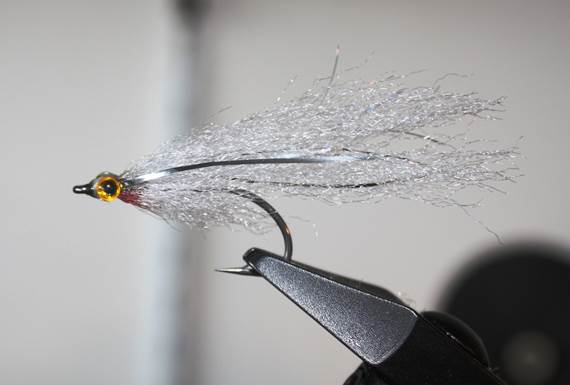
- Hook: Dai-Riki 930 Sizes: 2-8
- Thread: White 6/0
- Wing/Body: White EP Fibers with 8 strands of Silver Holographic Flash, topped with another Bunch of White EP Fibers, then place on either side a strip of wide Silver Flash-A-Bou
- Belly: White EP Fibers
- Gills: Red slash on the belly made with a Red Sharpie marker
- Eyes: 3-D Red with Black centers applied with epoxy
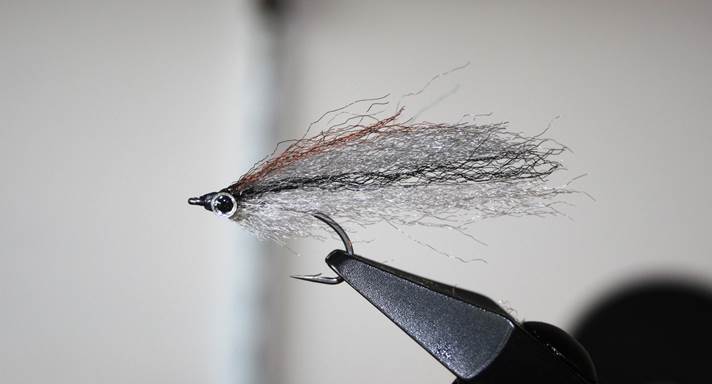
Anchovy Minnow
- Hook: Dai-Riki 930 Sizes: 2-8
- Thread: Light Dun 6/0
- Wing/Body: Silver/Grey EP Fibers with two strands of Silver Holographic Flash follow a very thin bunch of Black EP Fiber and then Gray EP Fibers and top with another thin bunch of 3D Brown EP Fibers
- Belly: White EP Fibers
- Eyes: 3D Silver with Black centers applied with epoxy
Silversides Minnow
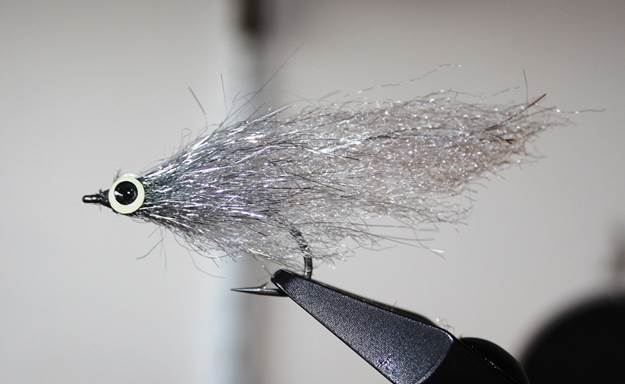
- Hook: Dai-Riki 930 Sizes: 2-8
- Thread: Light Dun 6/0
- Wing/Body: Silver/Grey EP Fibers with two strands of Silver Flash-A-Bou topped with a thin bunch of Bronze EP Fibers and then another Bunch of Silver/Grey EP Fibers
- Belly: Silver/Grey EP Fibers
- Head: Silver Dubbing Brush
- Eyes: 3D-White with Black centers applied with epoxy
These patterns have worked for me, give them a try!
Enjoy & Good Fishin’
| Sysadmin Note |
|---|
| Sysadmin Note |
|---|
The Glass Minnows
A Look at the History, Patterns and Uses of the Pattern Style
For me, looking into the history of the Glass Minnow has been interesting and highly informative and a little bit confusing. If you Google Glass Minnow Fly Patterns you will see that there are 67,200 sites to visit and by visiting just a few of them you still might be wonder what the first Glass Minnow looked like and depending the sites visited you might not even know who originated this outstanding pattern.
Carl O. Hansen (1914 to 1998) of St. Petersburg, Florida is the originator of the Glass Minnow. Carl moved to Florida in 1950 and he was trying to imitate the local “Rain Bait” that was being created by the Bay Anchovy schooling at the surface and being heavily preyed on by various gamefish. Carl’s creation was pure simplicity with a body of wrapped monofilament, a simple bucktail wing and small painted eyes. Carl felt that the key to the success of the pattern was the transparent body, the sparseness and small slim profile.
The success of the pattern speaks for itself as it is still in use today and it copying is a form of flattery then Carl might have felt very good about his creation for it has been copied and modified many times over the years.
As a side note, Carl conducted fly tying and fly casting clinics from his home in St. Petersburg until his death in 1998, he was always willing to share his knowledge with all who wanted to learn. All who learned from Carl considered him a fly fishing philosopher and after his death a friend said “Carl came to earth fly fishing, tying his flies and he would preach finesse and conservation”.
Lefty Kreh was very impressed with the Glass Minnow and modified the pattern by adding a silver wrapped Mylar body under the monofilament body.
Chico Fernandez is attributed with popularizing the Glass Minnow from his home base in Florida; he also modified the pattern and has his own variation of the Glass Minnow. Chico ties the Glass Minnows in many different color variations to cover a wide range of small transparent minnows four in the saltwater. I would also mention that is pattern works well in the freshwater on several different species.
The Glass Minnow is a pattern I learned about on my first saltwater trip many years ago and it is a pattern that I am never without. I also tied it in several different color variations to imitate Anchovies, Sardines, Silversides and any other small transparent minnows that I may encounter.
There seems to be hundreds of Glass Minnow patterns for the angler to choose from and I have tried and play with many different patterns; however the simple original style is still as effective today as I was when Carl Hansen first created therefore I will give you the pattern for the original style and Chico variation which is also very effective. Remember the regardless of what pattern you choose it should be 1½ to 2½ inches in length, transparent, and sparse as possible to offer a slim profile.
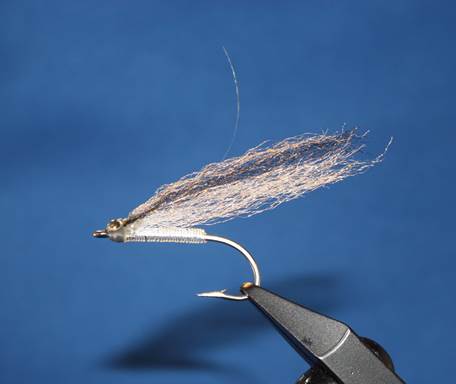
GLASS MINNOW, ORIGINAL
- Hook: Mustad 34007
Sizes: 2-6 - Thread: Black 6/0
- Body: 15 pound monofilament, wrapped
- Wing: White Bucktail with Black Bucktail on the top
- Head: Black thread
- Eyes: Painted, Yellow with Black Centers
CHICO’S GLASS MINNOW
- Hook: Mustad 34007 Sizes: 2-6
- Thread: Black 6/0
- Underbody: Silver Tinsel
- Overbody: 15 to 20 pound monofilament, wrapped
- Wing: Bucktail in two layers with Olive or White with three strands of Silver Flash-A-Bou on either side
- Eyes: Painted Yellow with Black Centers
This pattern is also tied using Calftail Fibers for the wings and can be constructed in many different color combinations.
One of the Glass Minnow imitations that I use is tied with EP Fibers.
GLASS MINNOW VARIATION
- Hook: Mustad 34007 Sizes: 2-6
- Thread: 6/0 Light Dun
- Underbody: Silver Tinsel, wrapped
- Overbody: 12 to 20 monofilament, wrapped
- Wing: White EP Fibers, with 3 strands of Silver Holographic Tinsel, followed by a very thin bunch of Black EP Fibers with a topping of Gray EP Fibers.
- Head: Thread
- Eyes: 3D Eyes, Silver with Black center, applied with epoxy
Make sure that you have a supply of Glass Minnows for your next trip to the salt.
Enjoy & Good Fishin’
| Sysadmin Note |
|---|
| Sysadmin Note |
|---|
Saltwater Gamefish of the Sebastian Area
Now we will delve into the variety of Saltwater Gamefish found in the Sebastian area; this would include Sebastian Inlet, the Indian River and the St Sebastian River. There are simply a lot of gamefish for the saltwater fly angler to catch and from my perspective this abundance and variety is the perfect setting for the saltwater angler to learn the area and to become familiar and comfortable with saltwater fly fishing. If the angler is new to the sport they can find that a day on the water can be filled with many different experiences to be enjoyed besides the catching of the fish.
In this column we will start out with Jack’s and Sailcats and I will cover the fish and the patterns that I have had success with along with tackle tips for the different times of the season.
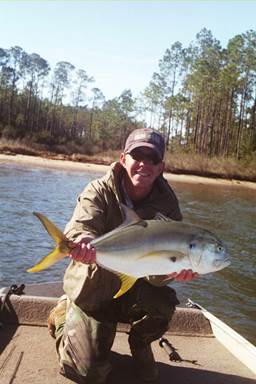
One of first fish I will discuss is the Jack Crevalle [Caranx hippos] they have a body shape similar to that of a Permit and are a powerful predatory fish eating a variety of small fish along with shrimp and crabs. They have a reputation for being an extremely strong and powerful fighter which is well deserved; as anyone who caught one will tell you.
They can live up to seventeen years and can attain forty inches in length and weight fifty five pounds and are found both inshore and offshore. They spawn offshore from March to September and the young fish head inshore upon hatching. They are found in lagoons, brackish water, over reefs and in saltwater river and all but the largest individuals will school.
You can often find schools of one to three pound Jacks and they will often take surface flies which endear them to me. Larger ones will also take poppers and sliders on the surface. As for tackle I always have a eight weight with a floating line and small popper rigged up and another rod with a type three sink tip rigged up with a minnow or shrimp imitation. The tackle that you choose will depend on the depth of the water you are fishing, the time of year and the water temperature. Over the years I have caught Jacks from one to thirty pounds and have never been disappointed by the fight or the excitement they offer.
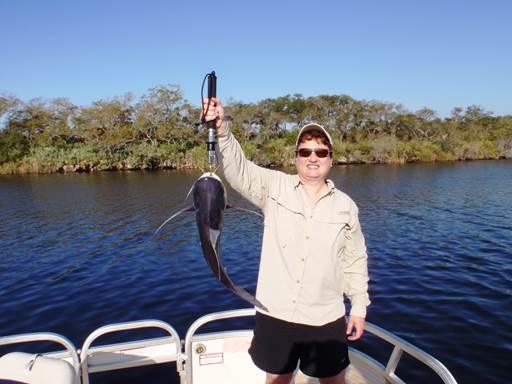
The next fish that I would to discuss is Gafftopsail Catfish [Bagre marinus] which are commonly called “Sailcats” these fish are seldom written about and are largely considered a nuisance fish. However I am here to tell you that Sailcat will give you all the fight that you can handle. The research books will tell you that they can reach ten pounds but the average is two to three pounds, well the St. Sebastian River and the Indian River around Sebastian Inlet must be above average as we often catch six to eight pound Sailcats and have taken them as large as eleven and half pound. These are among the hardest and most tenacious fighters in the saltwater.
A Sailcats lifespan is between six and eight years and can exceed ten pounds in weight. They have long venomous spines which can cause a painful wound to the careless angler. They spawn from May to August over inshore mud flats, the males fertilizes the eggs of the female and then broods the eggs in his mouth until they hatch. During this period the males does not eat however the females are very hungry after spawning. Both young and adult Sailcats will school and a school of adults will flat wear out the angler.
These strong fighters feed throughout the water column and are common in lagoons, brackish water, flats, and mangroves and around piers where they feed on shrimp, crabs and smaller fish.
My first encounter with Sailcats took place on the St. Sebastian River many years ago in December on a fishing trip with my son Ryan.
The day was overcast with a light steady rain and the fishing during the morning was outstanding for Jacks, Ladyfish, small Tarpon and the occasional Spec all morning and into the early afternoon we had fished with floating lines and sink tips. During the later afternoon the fishing began to slow down and we switch to fishing type four full sinking lines and began to once again catch fish. Suddenly I hooked up with a powerful fish that just wouldn’t give up and when I finally land the fish we had to grab to fish guide to figure out just what I had caught. At the time my son made the observation that this fish is all mouth. We later learned that a local name for this fish was Bigmouth Catfish. The odd part of this story is I then proceeded to hook and land six more of these Sailcats and my son was using the same type of fly line and fly could not seem to find them, all of the fish I had hook were between six and eight pound with one pushing nine and half pounds. Finally I hooked another and hand him the rod, as I was beat down and tired from fighting these bulldog fighter.
Sailcats may not be as glamorous as other speices but they will give you all the fight you want and as we found out they are pretty eating to boot.
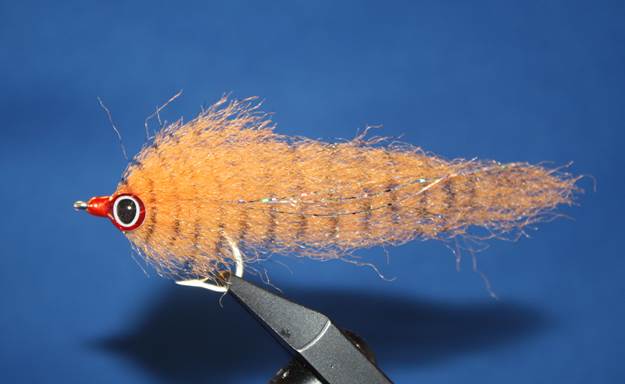
Orange Barred Sailcat Special
- Hook: Mustad 3407
- Sizes: 4/0 to 6
- Thread: Orange A
- Wing/Body: Orange EP Fibers with four strands of Silver Holographic Flash placed in the middle of the wing
- Belly: Orange EP Fibers
- Eyes: 3D-Red with white ring and Black centers, applied with epoxy
Once the pattern is complete comb it out and trim to shape and then mark the entire wing/body and belly with black barring using a Sharpie marker.
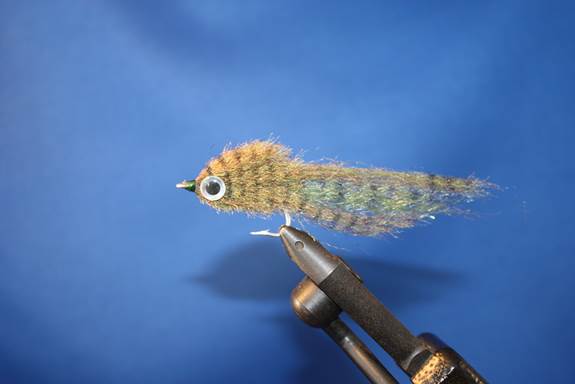
Olive Barred Sailcat Special
- Hook: Mustad 3407
- Sizes: 4/0 to 6
- Thread: Olive A
- Wing/Body: Olive EP 3D Fibers with four stands of Silver Holographic Flash placed in the center of the wing
- Belly: Olive EP 3D Fibers
- Eyes: 3D Silver with Black centers, applied with epoxy
As stated before, comb out, trim and make the barring with a black Sharpie marker.
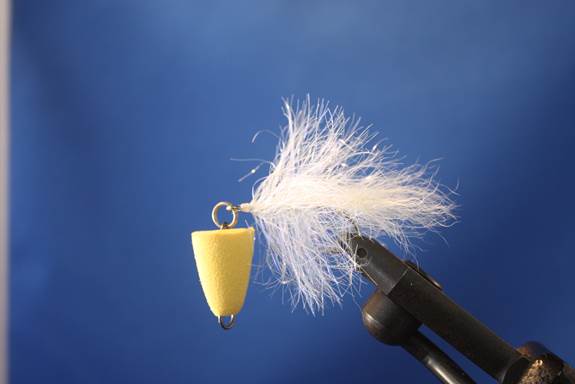
Yellow & White Jointed Popper
- Hook: Mustad 34007
- Sizes: 4/0 to 6
- Thread: White A
- Popper Head: Yellow Cone Foam type, placed on a Black Barrel Swivel, you attach the barrel swivel to the hook using a spilt ring. Also there are many colors and styles of Popper, Slider and Fluted Chugger style heads that will work the choice is yours. Eyes are optional and 3D type eyes can be applied with epoxy.
- Tails: White Calf tail
- Body: White Trilobal Hackle wrapped.
Note: These jointed poppers are easy to construct and can be tied in a variety of colors and they work on a lot of saltwater and freshwater species.
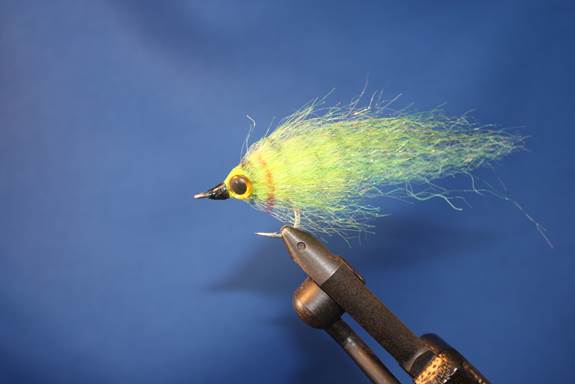
Jack C Special Streamer
- Hook: Tiemco 800S
- Sizes: 3/0 to 6
- Thread: Green A
- Wing/Body/Belly: Chartreuse Farrar’s SF Flash Blend
- Eyes: 3D Yellow with Black centers applied with epoxy
All of the patterns listed in this installment are effective on many different speices in the saltwater.
Enjoy & Good Fishin’
| Sysadmin Note |
|---|
| Sysadmin Note |
|---|
In this selection we will be covering Sea Bass and one of the most common and fun fish found in the saltwater the Ladyfish. Often we get so caught up in the glory fish species that we forget to enjoy some of the other species that are available to us.
I have spent hours casting to rolling Tarpon and end up with nothing but casting practice however by switching focus, tackle and flies soon I can be hooked up with leaping, skittering Ladyfish and laughing over their antics. As a friend of mine once said, “If you can’t catch the one you love, then love the one you are catching.”
But let us begin with the Sea Bass [Centropristis striata] This specie is also known as Black Sea Bass or Rock Bass. They live for twenty years and can reach six pounds and twenty four inches in length with the recorded being a ten pound plus fish.
It is a bottom dweller living around reefs, open shelf and shelf-edge water, in water depths of ten to one hundred feet, however the spawning occurs off shore between January through March. Upon hatching the young bass migrate inshore where they inhabit the area around oyster beds, piers and rocky bottom structure.
Sea Bass are opportunistic bottom feeders during the hours of daylight eating shrimp, crabs, clams, worms, squid and small fish. Though they are sometimes called Black Sea Bass the colors will often vary depending on the age of the bass and the habitat where they are living.
The Seas Bass is closely monitored and the season can be closed at any time to avoid over-harvesting, so always check the regulations if you desire to keep some for the table. I have gone weeks without catching any Sea Bass and then I have caught several in a single day. This depends on where you are fishing.
Many of the flies that imitate shrimp, crabs, worms and minnows will be effective on Sea Bass, however on checking my notes I have found that the only times that I have taken Sea Bass was when I using Sink Tip Lines or Full Sinking Lines.
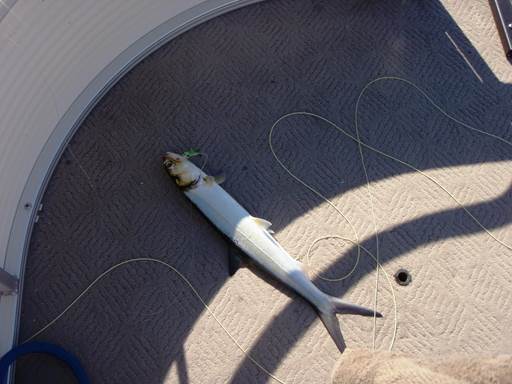
Ladyfish
Now to one of my favorite saltwater specie the Ladyfish [Elops saurus Linnaeus] they are also called Lady’s, Silver Fish, Long John, Big eyed Herring and Poor Man’s Tarpon. Ladyfish are coastal fish though the spawning takes place at sea in the fall. Upon hatching the larvae will migrate to the coast entering the lagoons, saltwater rivers, brackish water rivers and creeks.
Ladyfish feed on smaller fish, shrimp, small crabs, worms and the like and will form large schools and are preyed on by other predator species. They are herring like in general appearance and are silver in color and they will leap and skitter across the surface when hooked. They live for six years and can reach three feet in length and weight as much as fifteen pounds.
Ladyfish have rough sandpaper like mouth and is one of few saltwater fish that doesn’t bite the angler. However, repeat catches means that the angler should constantly be retying the imitation as they destroy tippets with their rough sandpaper like mouths.
They feed throughout the water column and will even take surface flies and anything that will take off the surface always holds a special place in my esteem. Besides, they are fun to catch and on days when other species seem to taking the day off the Ladyfish will be active and aggressive.
The following are some of my favorite patterns for these species; however please remember that these patterns are effective on many different denizens of the saltwater.
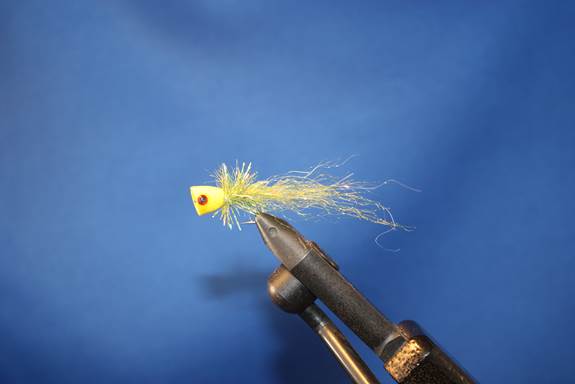
Yellow Flash Popper
- Hook: Mustad 34007 Sizes: 1/0 to 8
- Thread: Yellow A or 6/0
- Popper Head: Yellow dished faced foam popper, super glued in place over a bed of thread,
- 3D Eyes: Red with Black Centers, applied with epoxy
- Tails: Farrar’s Yellow Flash Blend Fibers
- Collar: Short Trilobal Olive Hackle
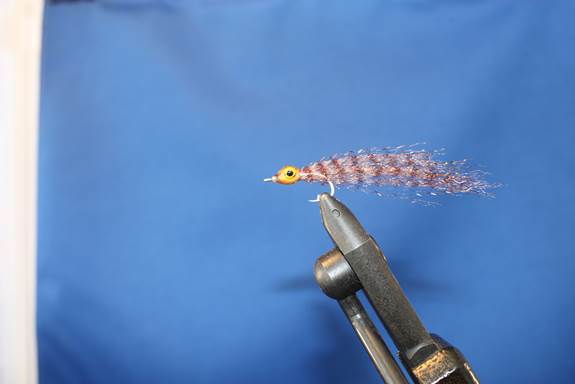
Super Hair Clouser’s Style Shrimp
- Hook: Mustad 34007
- Sizes: 1/0 to 8
- Thread: Clear Ultra Thread
- Eyes: Dumb-bell type, painted Yellow with black centers placed on the top of the hook shank so the hook will invert and ride hook point up in the water
- Belly: Tan Ultra Hair
- Wing: Tan Ultra Hair
Once the pattern is completed the Tan Ultra Hair is banded using a brown Sharpie marker and then the head and eye area is coated with epoxy.
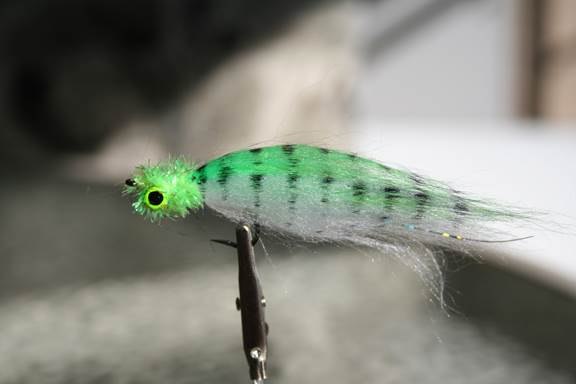
CF Chartreuse & White Streamer
- Hook: Dai-Riki 930; Tiemco 800S
- Sizes: 3/0 to 4
- Thread: White A
- Eyes: Dumb-bell types eyes, Painted Chartreuse with black centers, placed on the bottom of the hook shank so the hook will track in its normal position.
- Wing: White Craft Fur topped with six strands of Silver Holographic Flash, follow by Chartreuse Craft Fur which is banded with a black Sharpie marker
- Head: Chartreuse Estaz
This is one of my “Go to flies in the saltwater” and it has been responsible for many different species including Tarpon, Snook and Spec’s. I always have an ample supply of these flies whenever and wherever I am fishing in the salt.
Enjoy & Good Fishin’
| Sysadmin Note |
|---|
| Sysadmin Note |
|---|
Saltwater Gamefish of the Sebastian Area:
In this installment I will cover one of the most popular and sought after gamefish found in Florida and that is the tarpon or Silver King as it is often called.
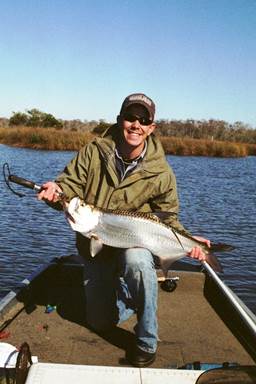
Tarpon always bring a smile
Atlantic Tarpon [Megalops atlanticus] can grow to over eight feet in length and weigh over three hundred and fifty pounds, the males can live up to 35 years and the females can live to an age of 50 years. The tarpon are one of the most sought after fish is the southern coastal waters.
The Silver King got its name from its brilliant silver color, spectacular aerial leaps and hard fight they are classed as a mid-water predator mostly feeding on mullet, pinfish, ladyfish, marine catfish, Atlantic needle fish, sardines, shrimp and crab. They will feed both during the hours of daylight and darkness and the sallow their prey whole. Even though I have listed several of the tarpon’s favorite meals I will tell you that they are opportunistic feeder and will feed on a great many marine minnows and small fish given the chance and will take flies off the surface.
Many fish prey on the smaller tarpon and the larger tarpon are preyed on by bull sharks, hammerhead sharks and alligators.
The tarpon reach sexually maturity during the sixth or seventh year at about four feet in length; they spawn offshore during May to July where the currents will carry the hatching larvae inshore to the nurseries of the lagoons, grass flat, saltwater and brackish water rivers.
When they first hatch the tarpon larvae resemble small eels rather than the familiar tarpon shape which is known to the anglers. The larvae grow through three stages and at the end of a six month period they now resemble the tarpon all anglers know and seek.
In the United States tarpon are not considered to be a food fish and in Florida you must obtain a special permit to kill a tarpon, however in Panama, Africa and the West Indies the tarpon is considered a delicacy. But the tarpon are not in danger and the world population multiplies 4.5 times every five years.
Tarpon are not dangerous to humans unless you try to land a green (fresh) hooked fish without properly fighting and getting the edge off its strength. Then you can have the tarpon in the boat or even in your lap which is generally bad for the angler, the boat and the equipment.
Before you try to land a tarpon make sure that the fish is properly tired out before bringing it alongside the boat. Now that you have landed your tarpon, taped it, and taken photographs you must make sure the fish is fully resuscitated before you release it. A tarpon this is released to soon can die of oxygen deprivation or may easily fall prey to sharks or gators and the Silver King is to valuable a trophy to waste.
Tarpon are found all along the coast including lagoons, saltwater and brackish water rivers and although most anglers seem to desire tarpon over eighty pounds I prefer the ten to sixty pound tarpon. The Sebastian Inlet area has plenty of large tarpon and the St Sebastian River is loaded with smaller tarpon during the winter months. Tarpon have a unique swim bladder which also functions as a practical respiratory organ (lung) which allows them to breathe and survive in water with low oxygen content.
As for those who wish to seriously pursue tarpon I suggest that you read A Passion For Tarpon, by Andy Mills. Andy will take you through the history of tarpon fishing with a fly rod and give you full understanding of the methods, tackle and flies that should be used to successfully hook this beautiful silvery fish.
Depending on the size of the tarpon being targeted an eight, ten or twelve weight rod and reel system will be required. Here in the Sebastian Inlet area during the winter months I am often using an eight weight and have landed tarpon up to ninety pounds with this system. Now if I see larger tarpon rolling I would switch to a heavier rod, however when you are catching a variety of species and you happen to hook a tarpon which you never saw coming it is kind of hard to switch to a heavier rod in the middle of the fight.
As for not seeing the tarpon if it is windy on the Indian River the water becomes churned up and discolored and you may not see the tarpon and on the St. Sebastian River the water is tea colored and you seldom see the tarpon that eats your offering.
In the Sebastian Inlet area the fly lines that I select will depend on the water depth that I am fishing in, but I always have a floating line, sink tip line, full sinking line and shooting heads rigged up for both my eight and ten weight system and I have caught tarpon on all of the lines that I have listed.
As for the flies, I will share a couple of my favorite tarpon patterns with you; however the number of different patterns that I have caught tarpon on is simply amazing. However I try to match my patterns with the current bait found in the water that I am fishing.
Mullet Minnow Streamer
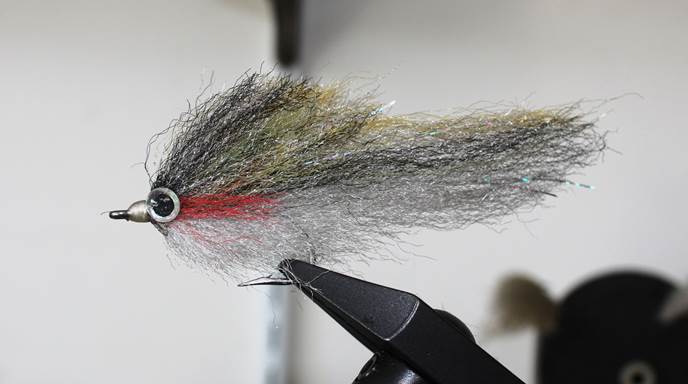
- Hook: Mustad 34007 Sizes: 6/0-4
- Thread: White A
- Eyes: 3D-Silver with Black Center, applied with epoxy
- Wing/Body: Thin bunch of Silver/Grey EP Fibers, topped with Grey EP Fibers, followed by four to six strands of Silver Holographic Flash which is follow by Mullet EP Fibers.
- Gills: Small, short & thin bunches of Red EP Fibers tied on either side
- Belly: Silver/Grey EP Fibers
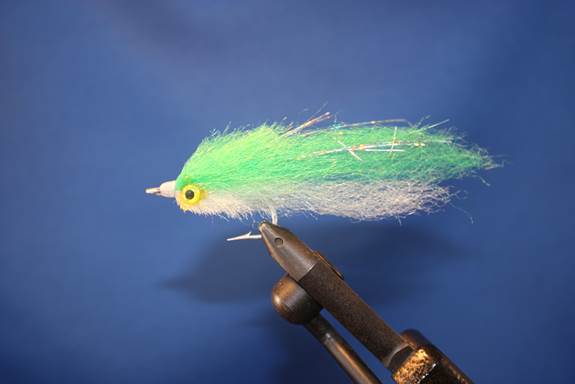
Chartreuse & White Tarpon Streamer
- Hook: Mustad 34007 Sizes: 5/0 to 4
- Thread: White A
- Wing/Body: White EP Fibers topped with Chartreuse EP Fiber and Silver Holographic Flash layered up the hook shank
- Belly: White EP Fibers layered up the bottom of the hook shank
- Eyes: 3D Yellow with black centers, applied with epoxy
Notes: Once the pattern is complete comb it out and trim to shape.
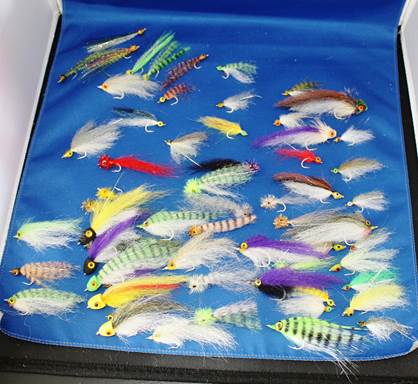
The Tarpon Toad created by Cary Merriman or Jack Gartside’s Tarpon Bunny are two more popular flies for this exciting and highly sought after fish, but there are hundreds of effective tarpon flies all you have to do is chose your favorites.
Enjoy & Good Fishin’
| Sysadmin Note |
|---|
| Sysadmin Note |
|---|
Snook:
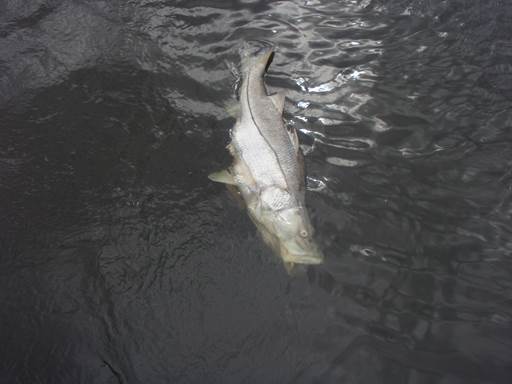
Common Snook [Centropomus undecimalis], this specie is native to the coastal waters of Florida (and many other places) they can reach 4.6 feet in length and weigh 53 plus pounds and may live up to twenty years. Furthermore their spectacular aerial displays endear them to the angler and this is one of the very few saltwater species that you can “Lip” without endangering your fingers!
Depending on the exact location the snook spawning occurs from April to October in near-shore waters, inlet passes and along the beaches close to the inlets. The young snook move to the lagoons, estuaries, brackish and saltwater rivers. The young snook prefer sloping banks with over hanging vegetation. The young snook feed on bay anchovy, pinfish, grass shrimp, mosquito fish, and insects whereas the adults primarily feed on menhaden, mllet, pinfish, anchovies, pigfish, shrimp and crabs. However they are very much opportunistic feeders which endear them to the anglers.
Snook are often found in shallow water but can be found in water up to 70 feet in depth and during the late spring and throughout the summer you can find snook in schools of twelve to forty or so cruising along the beaches looking for schools of baitfish.
Due to their willingness to take both subsurface and surface flies coupled with the excitement of the strike makes the snook one of the most sought after gamefish in Florida. Because of their legendary status as excellent table fare (meaning that they are very tasty) the seasons and limits of snook are closely monitored by the State of Florida.
In Florida there is no commercial snook fishing only recreational fishing is allowed, however before you gear up to put a couple of them on the table make sure that you check the regulations to ensure that the season is open and check your license to make sure that you have a snook stamp!
Snook in the Sebastian area are legendary and especially larger snook at night. Many of the expert bait and lure anglers I have spoken to claim that the snook in the Sebastian area are of the quantity and quality to make the area one of the best in the State of Florida.
Many years ago I witnessed the number of boats at the Inlet Pass during the height of snook season in the fall and was astonished and wondered how they all kept from running into each other or tangling lines with other anglers. But they all seem to fish with very few mishaps, however I will caution you that the Sebastian Inlet Pass is nothing to treat lightly, as the currents are strong and without acute observation you can find yourself in trouble. However, I avoid the crowds at the pass and fish along the lighted docks and shorelines of the Indian and St. Sebastian River or on the Grass Flat just inside the Inlet Pass. Furthermore these areas are easier for the fly angler to cover and are very productive. If you are out at night in a boat make sure that your running lights are in working order and that you have all the required safety equipment.
Now I know that you readers are like I am, a fly angler but I have found time and time again that by talking to the bait anglers, lure fishermen and bait shops operators that you can learn a tremendous amount about the fishing in a specific area. Then you can translate that information into fly fishing terms.
I have found over the years that the fly angler can learn much from the disciples of angling coupled with knowledge gleaned from books, other fly anglers, the Internet and personal observations. This has allowed me to quickly get the feel of an area and a particular specie.
Another bonus about learning about both the young and adult snook in the Sebastian Inlet area is, that regardless of how slow the general fishing might be that I can always slide up the mangrove covered shores of the St Sebastian River and always pick up a few smaller snook on poppers or small minnow imitations unless it is during the winter months and the water temperatures are to cool.
One important point to remember when targeting snook is that they are very water temperature sensitive. In cooler water temperatures slow down your retrieve speed as the snook become very lazy and sluggish in cooler waters. They prefer water temperatures of 68 to 78 degrees. During a cool winter there are very few snook caught from late December to early March, but remember this is all tied to water temperature therefore knowing the water temperature in the water you are fishing is critical during the winter months.
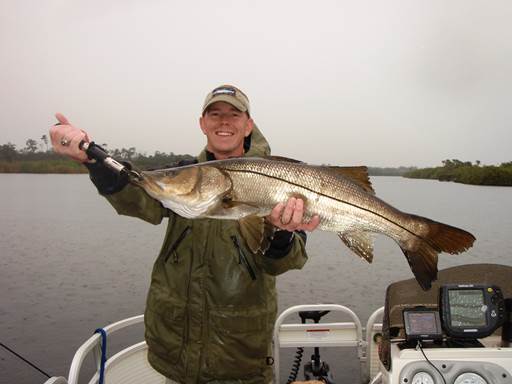
I have covered how some of the largest snook are taken at night but there is nothing wrong with fishing for snook during the daylight hours where you can enjoy the sights and sounds of the day. Snook are the perfect fly rod fish willing to freely move and feed at any time of the day or night. I have caught my largest snook during overcast days just prior to a major storm front moving into the area as is demonstrated by the photo of my son Ryan with a monster snook taken on January 1st at 10:30 A.M. That’s not a bad way to start the fishing year, huh!
For those anglers who are unfamiliar with snook fishing with a fly but wish to get stated then I strongly recommend getting a copy of Norm Zeigler’s Snook on A Fly published in 2007 by Stackpole Books. I consider this volume a must for the serious fly rod snook angler.
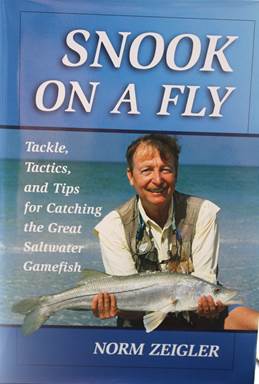
Snook on A Fly is an excellent guide for both the beginner and the advanced angler. The book explains the snook, how to fish from the beach, from boats, and flats, along with excellent fishing advice and tips on tactics and covering the tackle that Norm recommends. Also this volume contains excellent photographs which are so important to understanding the snook, flies and tactics.
I use an eight weight system when fishing for snook. Now I know that often I could successfully use a six weight system but every time I use a six weight while catching smaller snook or ladyfish I end up hooking a larger fish where I wished I was using a heavier rod. Now I will share a couple of my favorite snook flies with you.
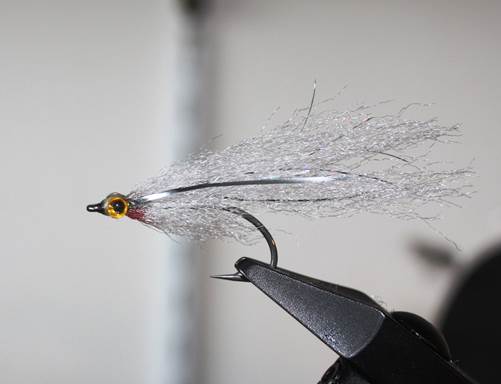
Little Silvery White Minnow
- Hook: Dai-Riki 930 Sizes: 2-8
- Thread: White 6/0
- Wing/Body: White EP Fibers with 8 strands of Silver Holographic Flash, topped with another Bunch of White EP Fibers, then place on either side a strip of wide Silver Flash-A-Bou
- Belly: White EP Fibers
- Gills: Red slash on the belly made with a Red Sharpie marker
- Eyes: 3-D Red with Black centers applied with epoxy
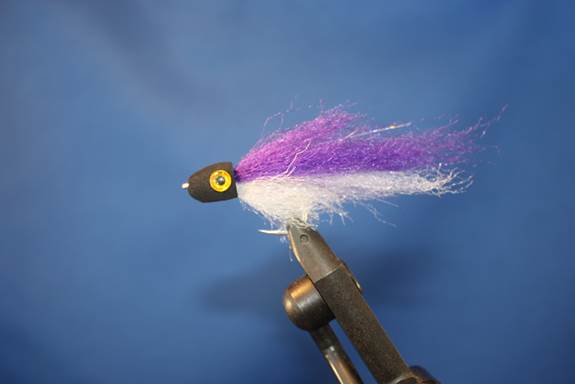
Black & Purple Snook Popper
- Hook: Mustad 34007 Sizes: 1/0-6
- Thread: White 6/0
- Popper: Black Foam Popper head with 3D Yellow Eyes with Black centers and are applied with epoxy, the style of popper head is left to the choice of the angler and what is to be accomplished with the popper
- Wing/Body: White EP Fibers with three or four strands of Silver Holographic flash on top followed by Purple EP Fibers
- Belly: White EP Fibers
Note: Once the imitation is complete, comb out and trim to desired shape
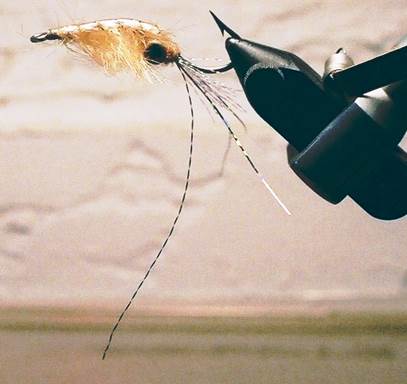
Salty Root Beer Shrimp
- Hook: Mustad 34007 Sizes: 1 to 8
- Thread: Hot red, 6/0
- Tails: Thin tapered point of clear plastic, several strands, pearl Krystal flash, then Pearl Krystal flash, then two strands of silver motion Mylar, slightly longer than the tail
- Antennae: Two strands of black Krystal flash 1½ times the length of the hook
- Eyes: Lead, painted red with black centers, tied on the bottom of the hook at the back of the hook
- Head: Dubbed Scintilla #58 Garden Hackle
- Shellback: Clear heavy plastic strips
- Rib: Dark fine Ultra thread
- Body: Root beer Holographic and Tri-lobal Hackle, wrapped tightly
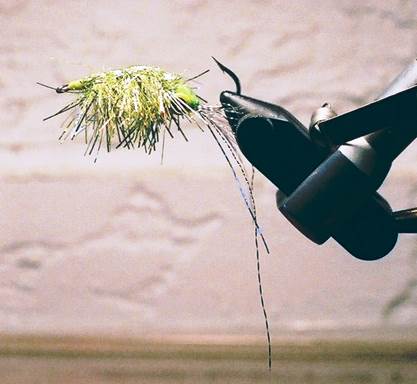
Salty Chartreuse/Green Shrimp
- Hook: Mustad 34007 or 34011 Sizes: 1 to 8
- Thread: Hot Chartreuse 6/0
- Tails: Clear Plastic Point
- Antennae: Several strands of Pearl Krystal Flash, two strands of silver motion Mylar, slightly longer than the pearl K-flash. Plus two strands of black Krystal flash which is one and one half times the length of the hook.
- Eyes: Lead, painted hot Chartreuse with a black center, tied at the rear of the hook on the bottom of the hook shank, so the imitation will ride hook point up.
- Head: Dubbed, Scintilla #57 bright lime
- Shellback: Clear heavy plastic strip
- Rib: Dark fine ultra-thread
- Body: Chartreuse Holographic and tri-lobal hackle 1-/4 wrapped tightly.
Enjoy & Good Fishin’
| Sysadmin Note |
|---|
| Sysadmin Note |
|---|
Redfish
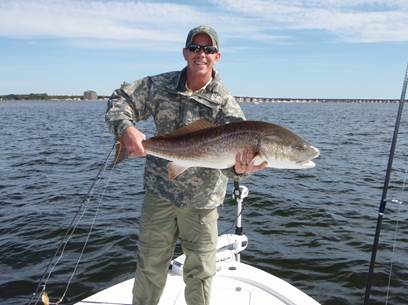
Redfish [Sciaenops ocellatus] are a member of the Drum family and are close cousins to black drum and Atlantic croakers. They are found all along the coastal waters of Florida and depending on the location you may hear redfish referred to as red drum, reds, bull reds, spot tail bass, puppy drum and channel bass.
They are well known for the spot on their tail and some will have multiple spots on the tail and body, they can reach weights of ninety five pounds and reach sixty one inches in length and they can also live for sixty years.
Redfish will vary from deep copper to an almost silver color and, unlike their cousins the black drum; they have no barbels under their mouth. They can also tolerate a wide range of water temperatures ranging from 39 degrees to 95 degrees. Furthermore they can live in a wide range of salinity and can be found far up brackish water rivers. Redfish can be found as individuals or in schools and will mix into the schools of black drum and tarpon.
Redfish, due to their wide range of tolerances, are found all along the coastal waters, lagoons, estuaries, brackish water and saltwater rivers along the coast of Florida and are among the most sought after game fish in the state.
Redfish reach sexually maturity during their fourth year and the spawning usually takes place from mid-August to mid-October along the shorelines around the inlets and river mouths where the eggs will hatch within 28 to 30 hours after being fertilized and then the currents will move the newly hatched fry to the estuaries where they remain until they mature.
Redfish are famous for their tailing when feeding along the bottom on crabs, shrimp, sand dollars, marine worms and minnows. Thus some anglers believe that they only feed on the bottom and this is just not true. They feed throughout the water column and I have even taken them with floating minnow imitations and other surface popper type imitations. The adults will feed on crabs, shrimp, marine worms, sand dollars, menhaden, mullet, pinfish, lizardfish, flounder, Atlantic croakers, bay anchovies and sardines.
Redfish are found over a wide spectrum of habitats including estuaries, river mouths, bays, grass flats, sandy bottoms, around oyster beds, mud flats, rocky out cropping, bridges, priers, jetties, shoreline and along the continental shelf.
Redfish have always been popular as table fare with recipes dating back to the 1890’s and then in the 1980’s Chef Paul Prudhomme introduced Cajun-style blackened redfish which increased the popularity of redfish as table fare. On October 20th 2007 President George W. Bush issued Executive Order 13449 which designated the redfish as a protected gamefish in Federal water and encouraging the states to take similar action. Thus today there is no commercial fishing operations for redfish and Florida has a slot limit on redfish, the angler is allowed to harvest one per day between 18 and 27 inches, all others must be released. I might mention that there are farm raised redfish available for commercial use.
Tips on Tackle and Tactics
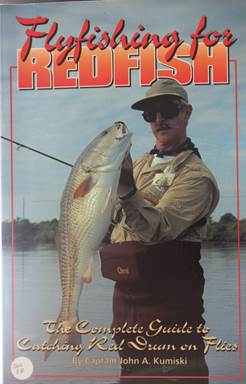
I will start this section by recommending that the fly angler who is interested in fly fishing for redfish should obtain a copy of Fly Fishing for Redfish by Captain John A. Kumiski which was published in 1997 by Argonaut Publishing Company. This is an excellent and informative book for the angler wishing to pursue redfish. I have met and talked with John several times over the year at Southeast Council FFF events and take it from me John truly is an expert on saltwater fly fishing in Florida.
Now as for tackle; I prefer to use a nine foot rod for an eight weight line as to the type of rod, well I won’t even go there, if you have a favorite brand than by all means have at it.
I will make two comments on rod, first always carry a spare rod if you only have one rod and you break and the fishing is good well then you are out of luck. My second comment on fly rod is that the fish really don’t care about which brand you are using. Now 90% of the redfish that I catch are in shallow water therefore the two lines I use for reds are weight forward floating lines and type II sink tip lines along with adequate reels that will hold 100 to 150 yards of backing. Redfish don’t make long hard runs but you can hook other species where you might need that extra backing. I use heavy hand tied tapered leaders that are designed to turn over the imitations and allows me to fight the redfish hard and fast. I will discuss my leader formula in another selection of the chronicles.
I have learned that the waters of the Indian River Lagoon are unique as it pertains to redfish because as they attain maturity and reach twenty pounds or so they generally move to coastal shoreline of the Atlantic Ocean and inlet passes. However the large redfish of the Indian River Lagoon remain in the shallower waters of the lagoon.
As a general rule redfish will move with the tides moving into the desirable shallow water feeding areas with the incoming tide bringing with it organisms which the redfish feed on to include crabs, shrimp and various minnows. When the tide moves out the redfish will slide out into the deeper edges of the channels. But remember in any local area there will be places that the fish feed better at low tides and other areas where the best fishing is on an incoming high tide and that is why local knowledge is so important.
Redfish in shallow clear water are very wary and are easily spooked by the clumsy angler therefore when you approach tailing redfish in a boat you should be carefully poling the boat and if you are wading you should approach slowly and carefully send out no bow wave and be very quite in the boat or wading as a dropped rod, clunky noise or a misstep by the wading angler can spook the fish. Therefore with tailing redfish you are trying to position yourself so you can drop your cast a couple of feet beyond the tailing fish and make your cast without lining the them.
If the redfish are cruising, once again the cast angle is critical and you need to be far enough ahead to fish so as not to spook them with the cast but in the cruising zone of the fish. Remember that each and every fishing situation is different and you must observe the situation and act accordingly. But there is one fact that is undeniable and that is if you want to try for redfish the Indian River Lagoon it is a good bet as they are plentiful. Redfish are opportunistic feeders and are seldom super picky, at least in my experience. I will tell you that Clouser minnows are effective on redfish however the Clouser is effective on a great many saltwater species. Now I will share a couple of my favorite redfish imitations that you may not be familiar with.
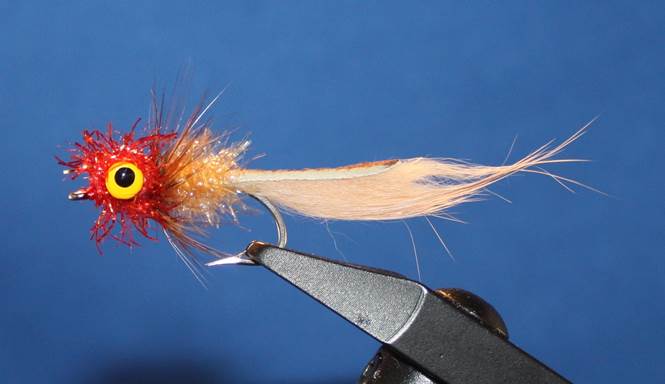
Anclote Key Red Headed Tan Shrimp
-Original pattern designed by Rod Walinchus
- Hook: Mustad 34007 Sizes: 1/0 to 6
- Thread: Red 6/0
- Tails: Tan Rabbit Strip, tied hair side down with two strands of Root Beer Krystal tied in side of the Rabbit Strip
- Body: Tan Crystal Chenille
- Collar: Brown Hackle
- Eyes: Dumb-bell type, painted yellow with black centers and coated with Sally Hansen’s Hard As Nails for durability and tie the eyes on the top of the hook shank so the fly travels hook point up in the water.
- Head: Red Estaz
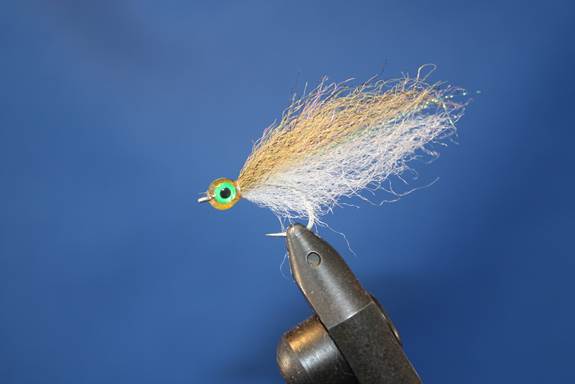
Backcountry Bullet Baitfish
- Hook: Mustad 34007 Sizes: 1/0 to 6
- Thread: Light Dun 6/0
- Wing/Body: White EP Fibers with six strands of Pearl Krystal Flash, topped off with EP Backcountry Fibers
- Head: Backcountry EP Fiber on top and White EP Fibers on the bottom, tied bullet style
- Eyes: 3D Green with Black centers, applied with epoxy where the entire head area and eyes are coated
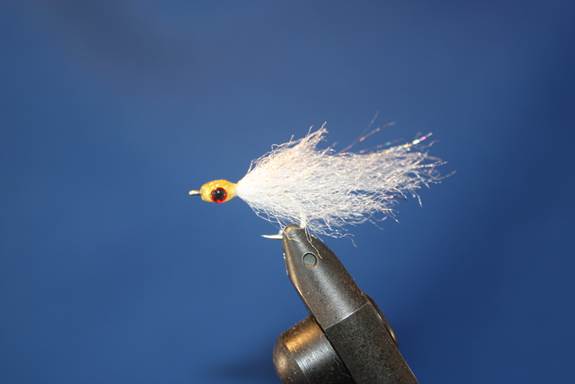
White Bullet Baitfish
- Hook: Mustad 34007
Sizes: 1/0 to 6 - Thread: White 6/0
- Wing/Body: White EP Fibers, with four strands of Silver Holographic Flash topped with more White EP Fibers
- Head: White EP Fibers top and bottom
- Eyes: 3D Red with Black centers, applied with epoxy where the entire head area and eyes are coated
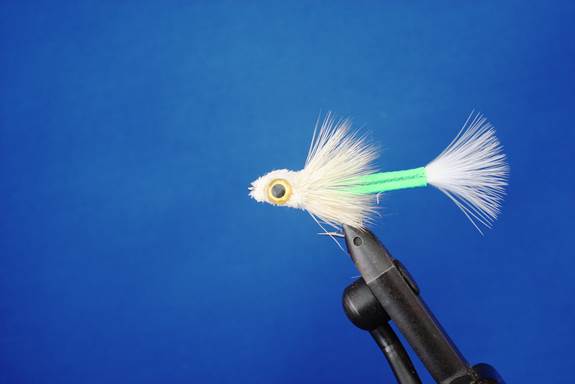
White & Chartreuse Pop-Ups Minnow
- Hook: Mustad 34007 or 3407 Sizes: 2/0 to 6
- Thread: A White or to match head Color
- Body & Tails: White Marabou pulled through a section of Chartreuse E-Z
body material - Collar: White Deer Hair, Flared
- Head: White Deer Hair, Flared, packed, stacked and trimmed to shape
- Eyes: 3-D Yellow with black centers, applied with epoxy
This pattern can be used with a Sink Tip as described in Pop-Ups published by Fly Angler’s On Line as the second installment of the Saltwater Chronicles. This pattern is also effective when used on the surface with a floating line.
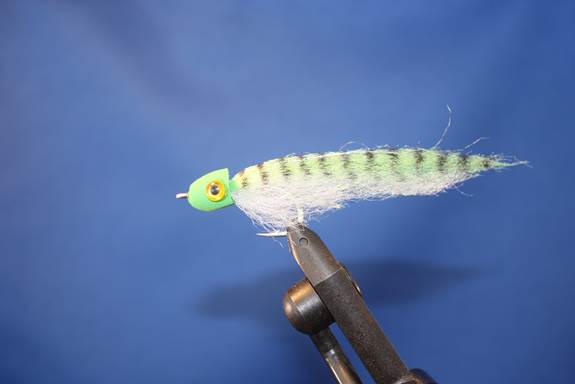
Simple Chartreuse & White Popper
- Hook: 34007 Mustad Sizes: 2/0-6
- Thread: White A
- Popper: Chartreuse Foam Popper, with 3D eyes Yellow with Black centers, applied with epoxy. There are many different popper styles that you can use. The choice is yours.
- Wing/Body: White EP Fibers with six strands of Silver Holographic Flash with Chartreuse EP Fibers on top. The Chartreuse EP Fibers are banded with a Black Sharpie marker
- Belly: White EP Fibers
There are many patterns that are effective; however these are the ones that I use.
Enjoy & Good Fishin’
| Sysadmin Note |
|---|
| Sysadmin Note |
|---|
Taking A Break with Largemouth Bass
There is no doubt that Florida offers some of the greatest saltwater fly fishing found anywhere in the world. The saltwater fishing can be so overwhelming that it is easy to forget that Florida also has excellent fishing for largemouth bass. In 1975 the largemouth bass became the freshwater fish of the State of Florida. I know anglers that never fish the saltwater here in Florida because they are consumed with the excitement of fly fishing for largemouth bass. Besides there are days when the wind can drive you from the salt flats and the fishing for the other freshwater species of gamefish can offer a pleasant change of pace and it fun and exciting in its own right.
Largemouth Bass [Micropterus salmoides floridanus] (Florida Sub-Species) has several common names which includes bass, American black bass, bayou bass, bigmouth bass, marsh bass and there are several others to describe this eating machine with fins and gills. Largemouth bass are one of the most widely distributed fish species in the world. In many places where they were not native, they were imported due to their popularity as a sport fish. The original range was the eastern half of the United States, the spread of the largemouth bass is a testament to its ability to adapt to a variety of habitats.
The following is some basic information on the habits of bass. They live in all types of water including swamps, ponds, lakes, reservoirs, creeks and large rivers and can even be found in estuaries. They prefer weedy environments and are seldom found in water over twenty feet. In the spring of the year bass migrate to shallow water that warms earlier than the deeper water to feed and select a nesting site. The spawning in Florida goes on between February and March depending on the weather cycles as it effect the water temperature as they prefer 64 to 70 degrees.
The males choose the nesting sites and then they attract the females. Shortly after the eggs are deposited the females leave for the casinos and shopping malls and the males defend the nest, during this period the males are fasting and this period last from three to seven days. Upon hatching the fry are transparent and are around 3mm in length. At first they will hang around the nest absorbing the yoke and then they rise in schools to feed on zooplankton. When they are 6 to 6.5mm long they change color to pale green with black lateral line markings. The young will continue to school as they grow and they are both prey and predator and will basically feed on anything that doesn’t eat them.
As they grow larger the schools begin to drift apart and during the day they cruise under the lily pads, through the weedbeds and around the structures seeking to ambush their prey. During the hours of darkness they move to deeper water often laying on the bottom resting and logs, trees and brush piles.
In an historical sense the most noted American author to chronicle the life history and fishing methods for Bass was James A. Henshall who published Book of Black Bass in 1881 andMore**About Black Bassin 1889. Henshall is often referred to as the Father of American Bass Fishing, he embraced all methodd which included fly fishing and also had Mary Orvis Marbury tie some of his bass flies. It is interesting to note that 43% off all freshwater anglers in America are fishing for largemouth bass!
Florida has long been known for its great largemouth bass fishing and places like the world famous Lake Okeechobee are famous for their excellent bass fishing. As a side note, did you know the Lake Okeechobee is the 7th largest fresh water lake within the lower forty eight States?
To be a successful in your endeavors to fly fish for bass the beginning angler must first understand a little bit about the Largemouth Bass and how it feeds, when it feeds and what it feeds on.
Regardless of the water you have chosen to fish, if it holds largemouth bass the local bait shop will be able to tell you what the bass are likely going to be eating. This, coupled with your own observations, should allow you to come up with suitable flies.
If you have little or no knowledge on fly fishing for largemouth bass and wish to do a little homework then I recommend reading Largemouth Bass Fly-Fishing, Beyond the Basics by Terry and Roxanne Wilson published in 2001. The Fly Fisher’s Guide to Warmwater Lakes by Cliff Hauptman published in 1995 and Fly Fishing Bass Basics by C. Boyd Pfeiffer published in 1997. All three of these small books will offer excellent insight into the world of fly fishing for Largemouth Bas
I will now offer a few important tips on the tackle used for fly fishing for bass that I have learned over the years. I believe in using fly rods that are suitable for the intend task, therefore my basic fly rod for bass is a nine foot rod for an eight weight line. The two fly lines that I use the most are a floating weight forward line and a ten foot type III sink tip fly line. I also carry a type III full sinking line for fishing in deep water during cooler water temperatures.
I have taken largemouth bass on six and even four weight rods when fishing for bluegill or other smaller warmwater species but when I am targeting largemouth bass I use an eight weight system and I will have both a nine weight and ten weight rod available to throw the largest of the deer hair or popper style surface patterns which are very air resistant.
Another point that I would like to emphasize is that long casts beyond forty feetis of little use, as you are working around weed beds, lily pads, brush piles, down timber and the like, so short accurate cast are much more productive. Furthermore, trying to throw long cast with air resistant flies is something I do not care to do!
The leaders you choose are also important as they should be designed to turn over the patterns you are using and an undersized leader will not allow you to be accurate. My leaders for floating fly lines are nine foot in length with tippets of 10, 12, or 15 pound test. Remember you will be fishing around weed beds, lily pads and the other structures already mentioned and you will need these heavier tippets to stand the strain of fighting these dynamic and exciting fish. When using the sink tip fly lines the leader I use are generally around six feet in length unless I am using the Pop- Up Method as describe in an earlier article published here.
Largemouth Bass are a known freshwater species but often I have caught them in the upper reaches of the St. Sebastian River in the brackish water. On one outing we caught several largemouth bass, small snook and Mangrove snapper along the banks of a channel, you never can tell where a largemouth bass will show up.
Now I will share a few of my favorite largemouth bass patterns with you, but realize there are thousands of effective bass flies out there and many of them are also used for trout or in the saltwater.
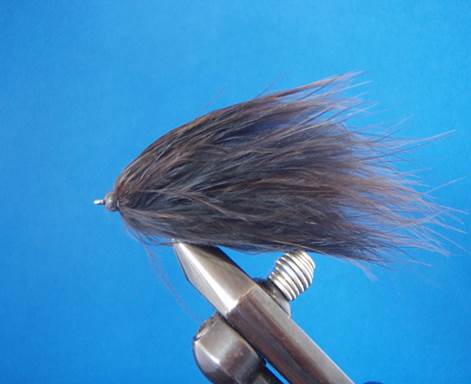
BH B & B Marabou Leech
- Hook: Dai Riki #810
- Size: 1/0-6
- Thread: Dark Brown or Black 6/0 or A
- Bead: Black Tungsten 5/32 for size 6, or sized to hook
- Tails: Black and Dark Brown Marabou Mixed
- Body: Black Marabou, Brown Marabou, wrapped
I also tie this pattern in Brown and Dark Olive & Brown. This pattern is easy to construct and very effective on many warm water species. I also tie some smaller sizes for Panfish on Tiemco 105, Sizes 4-8.
Barred Olive CF Tube Streamer
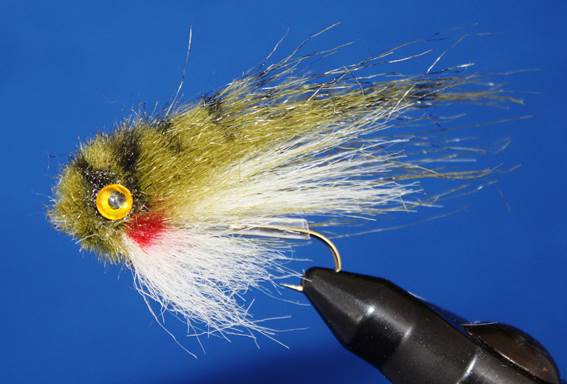
- Hook Only Flies: Dai-Riki 930 Sizes: 3/0 to 8
- Tube: Clear, 3/32 Diameter
- Hook: Dai-Riki 155 Size: 8 or 10
Note: For larger diameter tubes, use larger hooks. However, I strongly suggest staying with wide gape short shank hooks.
If you desire to tie this pattern straight to a hook, then I suggest Dai-Riki 930 Size: 3/0 to 8 or Dai-Riki 810 Size: 3/0 to 6 depending on the size of the imitation you desire. - Thread: White A or Olive A
- Body/Wing: On the bottom of the tube place a small amount of Cream Craft Fur. Then on the top of the tube place another bundle of Cream Craft Fur. If desired, place any Krystal Flash or Flash-A-Bou on top of the Cream Craft Fur. Then place a larger bundle of Olive Craft Fur on the top.
- Gills: Take a Red Sharpie marker and color in gill at the base of the throat area.
Important tying note: Craft Fur is much like deer hair; when you cut off bundle from the hide, comb out the under-fur so to speak. Save the combed out material as it is use forming the head and can also be used as dubbing. - Head: Formed by stacking and packing the shorter fibers of the Olive Craft Fur that you combed out. Once the head is complete, whip finish and trim into the desire shape with scissors.
- Eyes: Mix up some 5 Minute Epoxy and take a toothpick and work the epoxy into the area where you want the eyes to go. Place the Yellow with Black Center 3-D Eyes on either side in the appropriate position and squeeze. If you get a little epoxy on your fingers, just clean them off with a little alcohol. Once the epoxy begin to set up, give the eyes one more squeeze.
- Barring: Using a Black Sharpie Marker, bar the head and the olive part of the Body/Wing.
Note: If I want an imitation that goes deeper on its own, I will use painted lead (or other) Dumb-Bell Eyes; thus foregoing the use of epoxy.
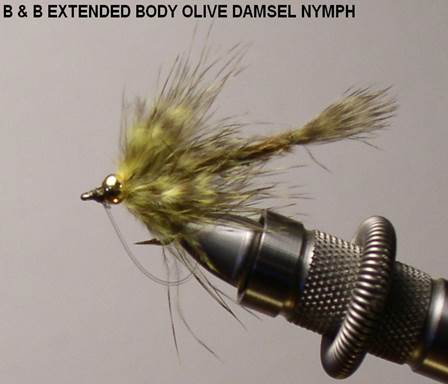
B&B EXTENDED BODY OLIVE DAMSEL NYMPH
- Hook: Tiemco 105 Sizes: 6-10
- Thread: Olive dun, 8/0
- Weed guard: Two loos of 0x mono [optional]
- Bead: Metal – gold or copper as desired
- Body Extension: Body extension is tied on a length of 0x tippet material strung between two vises.
- Tails: Yellow/olive grizzly Marabou tips
- Body: Barred chartreuse Marabou fibers tied in by the tip and twisted with thread and wrapped forward. [Several bodies can be done at one time] After you finish spiraling the thread touch it and the mono with a drop of Super Glue and begin you next body. They can be cut apart and attached to the hook.
- Thorax and legs: Wrapped, two or three yellow/olive grizzly Marabou feathers to the base of the bead.
NOTES: This pattern is durable and has a great life-like swimming motion. It can be tied in many different color combinations to match the color of the naturals in your area.
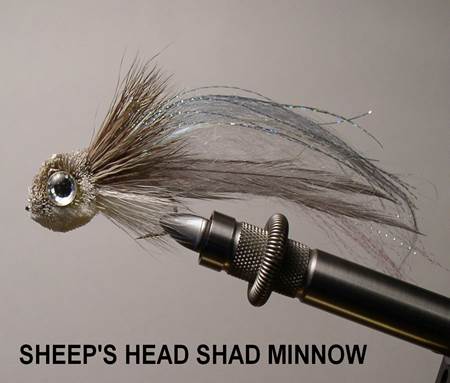
SHEEP’S HEAD SHAD MINNOW - Dave Whitlock Pattern
- Hook: Tiemco 8089 OR 8089NP Sizes: 2-6-10-12
- Thread: White or Gray, 8/0 and ‘A’
Tying Note: 8/0 thread can be used to tie the body, however, A thread should be used for the collar and head – the hook shank should be roughened and then use zap-a-gap and then thread should be applied as a tying base. - Body Foundation: Mono equal to the diameter of the hook wire and should be tied down on either side of the hook shank and the body should begin even with the hook point
- Body/Tail: Ten strands of pearl Krystal flash and white Icelandic sheep hair tied on both the top and bottom of the hook shank
Ten strands of silver motion Mylar, a strip of wide pearl tinsel tied down on either side of the body. Two lite dun hackle feathers, one per side. - Gills: Dubbed, Scintilla #32 vivid red
- Topping: Ten strands of peacock Krystal flash
- Collar and Head: Deer hair – white on top and gray on the bottom. Use the natural tips for the collar and then flare the hair to finish the head. When trimming the head remember to make it narrow.
- Eyes: Black and white doll eyes place with epoxy. 3-D black with silver prism background also works well
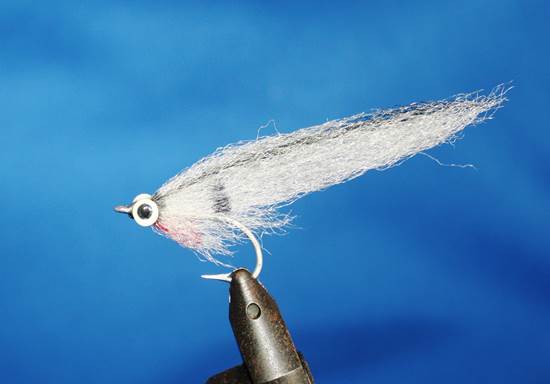
Shad Minnow
- Hook: Mustad 3407
Sizes: 1/0-6 - Thread: Light Dun 6/0
- Wing/Body: Silver/Grey EP Fibers, with six to eight strands of Silver Flash-A-Bou, with another thin Bunch of Silver/ Grey Fibers on top and the add two strand of Pearl Flash-A-Bou topped with a thin bunch of Mullet EP fibers and finished off with another small bunch of Silver/Grey EP Fibers. The body should be marked with a black bar about one inch behind the head with a Black Sharpie marker.
- Belly: Silver/Grey EP Fibers, marked with red slashes on either side of the throat area using a red Sharpie marker
- Eyes: Pearl White with Black centers 3D eyes, applied on either side of the head with five minute epoxy
This is a pattern of my own design which has work well for a number of years. In any water that hold shad the Bass will find them and feed on them. With any of the warm-water patterns a weedguard can be added as explained in other patterns.
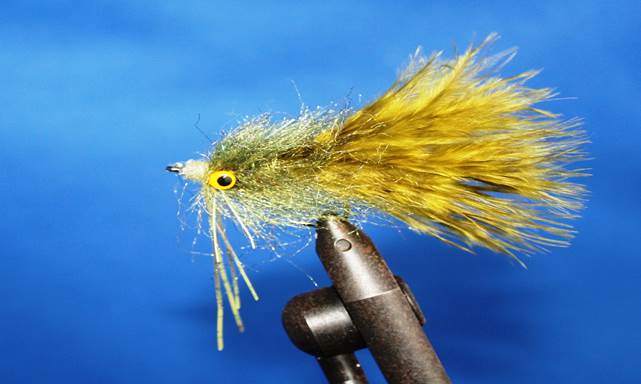
Mottled Olive Bushy Bug
- Hook: Dai-Riki 810 Sizes: 2/0-6
- Thread: Olive Dun 6/0
- Weedguard: 20 Pound Mason Hard Monofilament
- Eyes: Dumb-bell Type, Yellow with Black Center
- Tails: Olive Marabou, Barred with a Black Sharpie
- Body: EP Olive Dubbing Brush with legs, wrapped
- Legs: Four Olive Sili-Legs with Black Flecks
- Head: Dubbed, UV Light Olive
This is my favorite crayfish imitation and I also tie this pattern in tan with brown mottled markings.
Bluegill Minnow
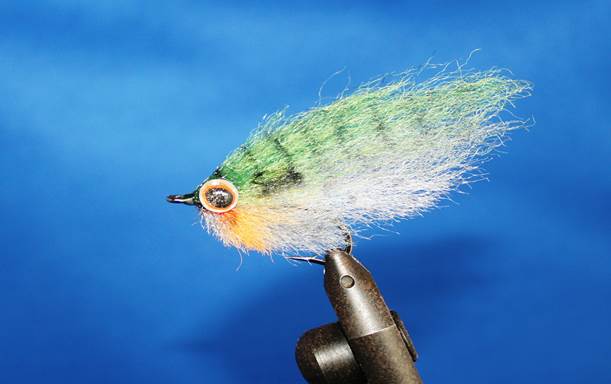
- Hook: Dai-Riki 810 Sizes: 3/0-6
- Thread: Grey 6/0-8/0
- Weedguard: 20 Pound Mason Hard Monofilament, Optional
- Wing/Body: Silver Gray EP Fibers with Gray EP Fibers on top and two bunches of Olive EP Fibers
- Belly: Gray EP Fibers follow by Orange EP Fibers followed by another bunch of Gray EP Fibers
- Eyes: 3D Orange with Black Center, applied with Epoxy.
Gills & Body Marking: Using Sharpie Markers, Red Gill Slashes on either side at the base of the Gray and Orange, Faint blue shading on the Grey EP Fibers, Black Barring on the Olive EP Fibers and a large back dot behind the eye on either side of the body.
Once all the EP Fibers are applied to the hook, comb out the imitation and trim to shape.
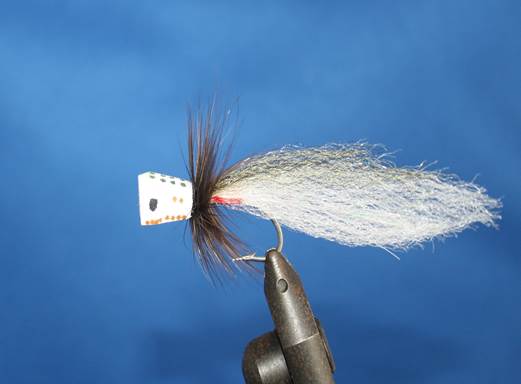
Foam Popper White Barred
- Hook: Mustad 34007 Sizes: 2/0-6
- Thread: White A
- Weedguard: Optional 20 Pound Mason Hard Monofilament
- Wing: White EP Fibers, topped with a small bunch of Mullet EP Fibers with a red Slash on the bottom of the white wing at the base of the hackle
- Hackle: Two dark dun hackles, wrapped
- Head: White Foam, styled and colored as desired
Notes: The are many different popper and slider styles of dry cell foam popper heads and they come in a variety of colors and all of them work at one time or another.
Tan Bass Worm
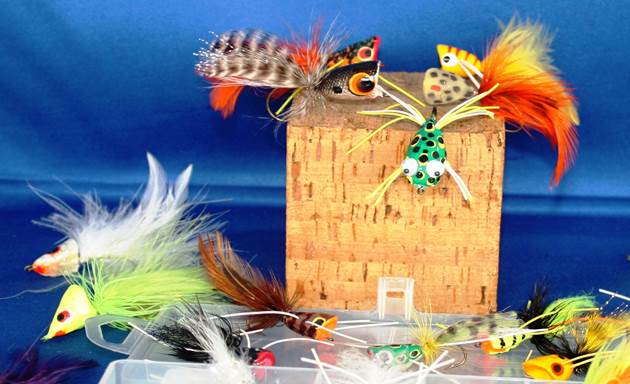
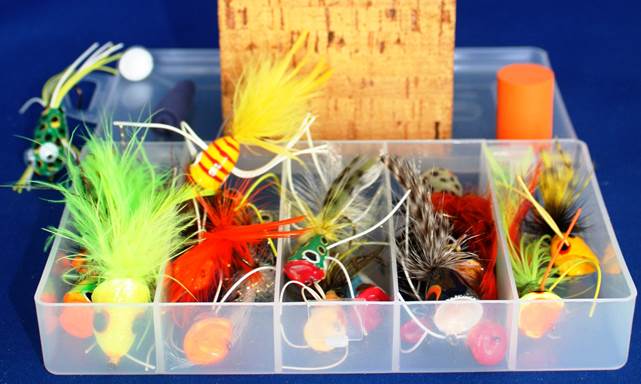
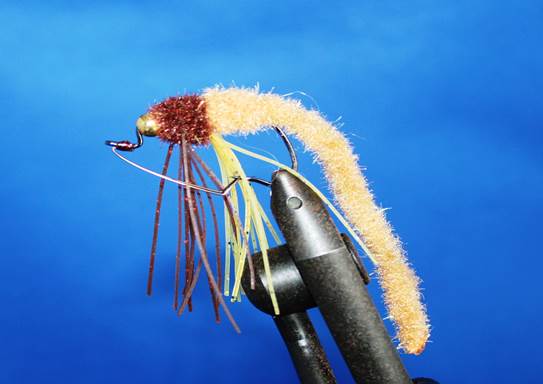
- Hook: Gamakatsu G-Lock Worm Hook Sizes: 4/0-2
- Thread: Tan 6/0
- Bead: Gold Metal
- Body: Tan Antron Chenille, melt the tip
- 1st Set of Legs: Chartreuse Sili Legs Six to Eight
- Thorax: Brown Antron Chenille
- 2nd Set of Legs: Pumpkin Sili Legs Six to Eight
- Weed Guard: 30 lb mono or 25 lb steel wire formed with pliers
I also tie the worm in Brown, Light Brown, Black, Purple and Chartreuse.
Enjoy & Good Fishin’
| Sysadmin Note |
|---|
| Sysadmin Note |
|---|
Saltwater Game fish of the Florida
In this installment we will be covering spec’s (Spotted Sea Trout), bluefish and Spanish mackerel these three are also very popular sport fish in the waters of Florida. All three of these species are highly popular with the fly fishing saltwater angler and all three are taken for table at times.
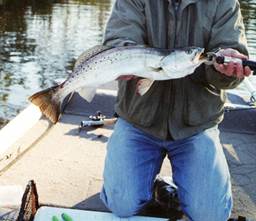
Spotted Sea Trout
Spotted Sea Trout [Cynoscion nebulosus] and the common names include spotted sea trout, spotted trout, spotted weakfish or just spec’s, the larger ones are also called “Gator Trout”. As a point of information the Indian River and the Sebastian Inlet area is noted for its large spotted sea trout called “Gator Trout”. To be classed as a gator trout the fish generally exceeds six pounds.
The specs are often found in both brackish water and in coastal rivers along with saltwater estuaries and are found on sandy on sandy bottoms with Sea Grass and are often found around other structure such as docks. They will move to deeper water during the cooler months but rarely leave the estuaries where they were spawned.
Specs can attain thirty nine inches and a weight of eighteen pounds and can live up to fifteen years. They feed on shrimp and any minnows they can catch, the adults are generally solitary individuals but they also gather in small schools and feed in the shallows on the incoming tides. They are ambush predators who make swift short lunges to grab their prey with their front canine teeth prior to swallowing the prey whole.
The prefer water temperatures from the low 60’s to the mid-80’s degree and the spawning goes on from late March to September with the peak activity occurring during June to August. The spawning takes place at night and the fry hatch within eighteen hour of fertilization and hide in the bottom rubble for about six weeks when they move to the sea grass beds.
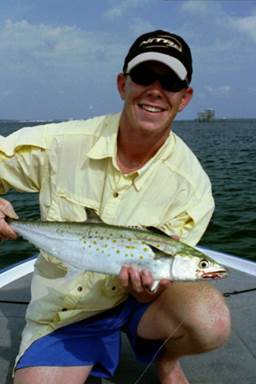
Atlantic Spanish mackerel
Spanish mackerel [Scomberomrus maculatus], and are also referred to as Spanish or macks. This toothy predator is found both inshore along the beaches in the inlets and estuaries and close off-shore.
They are a species that migrate in schools as the water temperatures rise beginning in South Florida in February and during the summer they move all the way up the coast to Cape Cod. The females can reach eleven pounds and can live for twelve years and the males live for about six years and seldom exceed twenty inches in length. They appear in large school and savage schools of baitfish.
The spawning in Florida occurs from July to September and the young often use the estuaries as nursery sites. In the saltwater almost everything is both prey and predator and the Spanish mackerel are both. They prefer water temperatures from 72 to 82 degrees and when the temperatures drop below 68 degrees they move to deeper water or move off-shore to warmer waters.
The Spanish mackerel is also a much sought after baitfish for a variety of big game sport fish species. But there sure are a fun fish with plenty of fight for the fly rod angler.
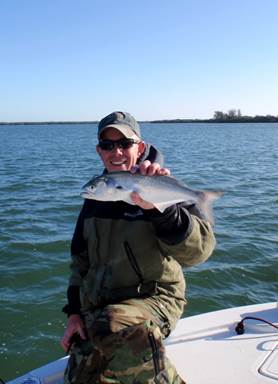
Bluefish
Bluefish [Pomatomus saltatrix] and also referred to as blues, snappers, sea wolf, choppers and slammer. The Bluefish is a popular gamefish and is good eating and they are known a various feeders and have a mouthful of knife edge teeth and the stories about their jaw strength and teeth are legendary!
As for feeding habits it is hard to name something they don’t eat as they are known as ravenous feeders and they travel and feed in schools that are formed by fish of the same size as they will feed on smaller blues. Watching a feeding blitz is something to witness and hard to imagine unless you have seen it, they are most active during the hours of daylight. They are a very popular sport fish due to their strong runs and frequent jumps and often will bite off the angler who encounters them while fishing for other species.
They spawn off shore during the spring and fall, in Florida waters this means April and May on the east coast and October and November in the northern waters of the Gulf Coast. The fry hatch within forty eight hours of fertilization and upon hatching they migrate inshore to the estuaries and bays until they reach two to three pounds where they move to join the larger schools. Though they are primarily a saltwater species they can tolerate brackish water. They live an average of nine years and can reach forty pounds.
Along the west coast of Florida they average one to three pounds with some larger fish taken and off the east coast fish in the six to fourteen pound class are taken. Small bluefish are great table fare especially when eaten the same day that they are caught.
Now I will share some of the patterns that I use on these species, however these patterns are not species specific as these patterns will work on a variety of saltwater species and I will show you how one basic effective color scheme can be tied in a number of different styles to fit the conditions you are fishing.
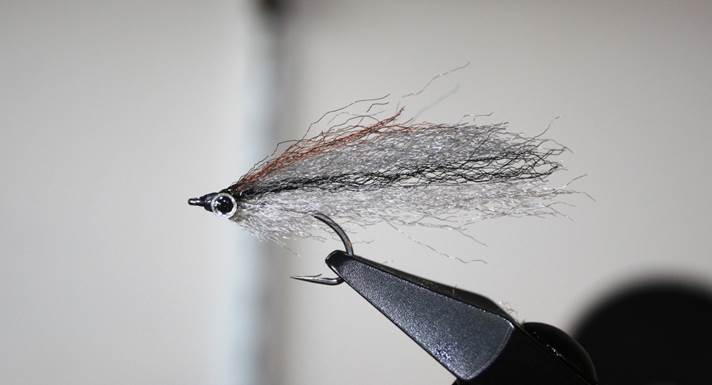
Anchovy Minnow
- Hook: Dai-Riki 930 Sizes: 2-8
- Thread: Light Dun 6/0
- Wing/Body: Silver/Grey EP Fibers with two strands of Silver Holographic Flash follow a very thin bunch of Black EP Fiber and then Gray EP Fibers and top with another thin bunch of 3D Brown EP Fibers
- Belly: White EP Fibers
- Eyes: 3 D Silver with Black centers applied with epoxy
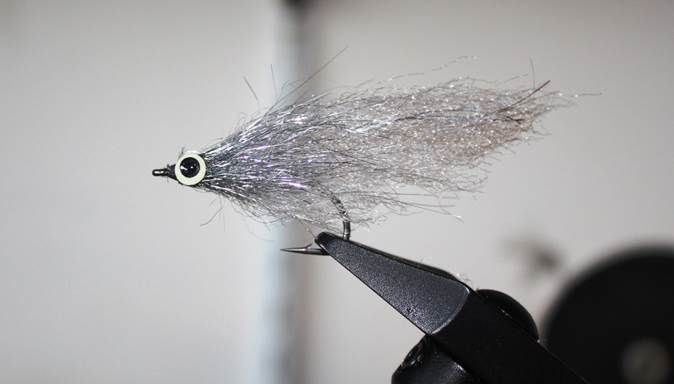
Silversides Minnow
- Hook: Dai-Riki 930 Sizes: 2-8
- Thread: Light Dun 6/0
- Wing/Body: Silver/Grey EP Fibers with two strands of Silver Flash-A-Bou topped with a thin bunch of Bronze EP Fibers and then another Bunch of Silver/Grey EP Fibers
- Belly: Silver/Grey EP Fibers
- Head: Silver Dubbing Brush
- Eyes: 3D-White with Black centers applied with epoxy
Now I will share with you one of the color schemes that I have used to catch all of the species covered in this installment and how by changing the style of the imitation it can be used to cover a variety of situations and species. The color scheme I have selected is the basic Yellow, Red, and Yellow.
Furthermore you can take any effective pattern and adapt it to the method or water type you are fishing here are six different styles using the same color scheme of Yellow-Red-Yellow.
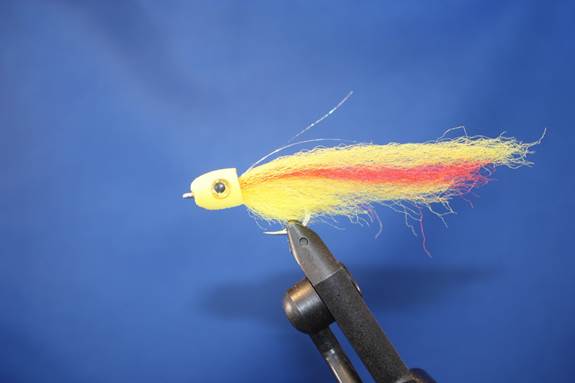
Yellow & Red Popper
- Hook: Mustad 34007
- Sizes: 2/0 to 6
- Thread: Yellow 6/0
- Popper: Yellow Foam with 3D Yellow with Black centers, applied with epoxy. Many styles and shapes will work.
- Wing/Body: Yellow EP Fibers, Red EP Fibers with three to six strands of Silver Holographic with Yellow EP Fibers on top
- Belly: Yellow EP Fibers
This pattern is used on the surface.
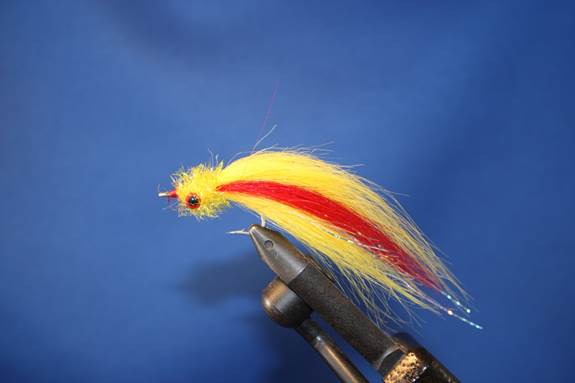
- Hook: Mustad 3407
- Sizes: 2/0 to 4
- Thread: Red 6/0 Tiemco 800S 2/0 to 4
- Wing/Body: Yellow Craft Fur, with six to eight strands of Silver Holographic Flash, with Red Craft Fur and topped with Yellow Craft Fur.
- Eyes: Dumb-bell types, painted Red with black centers, coated with Sally Hansen’s Hard as Nail for durability
- Head: Yellow Estaz
This pattern is used in Deeper Water and I often use it in conjunction with a sink tip fly line.
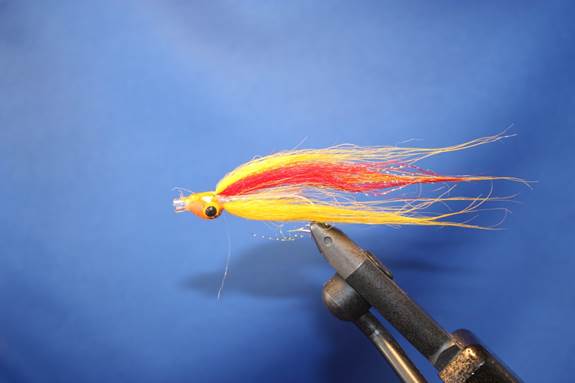
#3 Tube Style Craft Fur Clouser (Yellow-Red-Yellow)
There are several different tubes that could be used, various metal types but I use plastic tube, white or colored plastic tube from Q-tips, Clear Hard Plastic Tube all of which would need a snubber tube of soft plastic to hold the hook in position.
What I prefer is clear soft plastic tube which is found in any pet shop in the form of air line tubing for fish tanks or at any Medical Supply House where soft plastic tubing of various sizes may be obtained.
- Tube Size ¼ inch diameter Hook: Mustad 3407 Sizes: 1/0-2
Tube Size 9/64 inch diameter Hook: Mustad 3407 Sizes: 4,6,8
Tube Size 3/32 inch diameter Hook: Mustad 3407 Sizes: 8 - Eyes: Dumb-bell, painted Yellow with Black Centers, the eyes are tied on the top of the tube.
- Belly: Yellow Craft Fur
Now turn the tube over on the needle so the eyes are now on the bottom of the tube. - Wing: Red Craft Fur with six to eight strands of Rainbow Krystal Flash topped with Yellow Craft Fur
- Head: Coated with epoxy
I use tube flies for all types of imitations, tube flies are especially effective and durable on toothy predators.
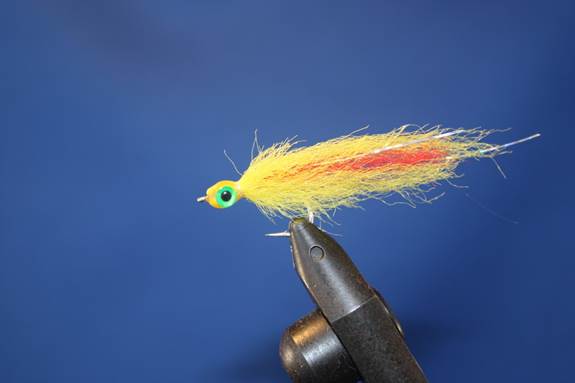
- Hook: Mustad 34007 Sizes: 1/0-6
- Thread: White A
- Wing/Body: Yellow EP Fibers followed by Red EP Fibers with 4 strands Silver Holographic Flash topped with Yellow EP Fibers
- Belly: Yellow EP Fibers
- Head: Yellow EP Fibers-top and bottom, tied bullet style
- Eyes: 3D Green with Black Centers applied with epoxy and also coat the head.
I use this pattern in shallow water on both floating lines and sink tips.
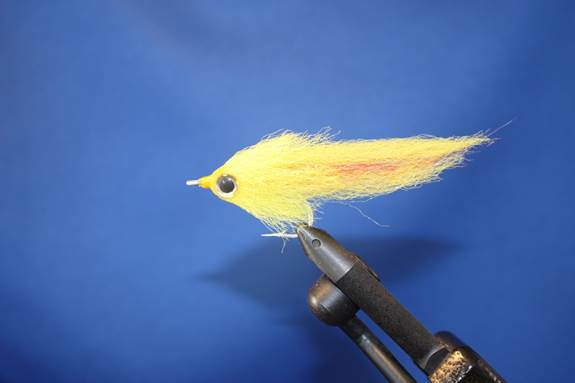
#5 Yellow & Red All Purpose Streamer
- Hook: Mustad 3407 Sizes: 4/0-6
- Thread: Yellow A Tiemco 800S 4/0-8
- Wing/Body: Yellow EP Fibers, Red EP Fibers with four strands of Silver Flash-A-Bou topped with Yellow EP Fibers
- Belly: Yellow EP Fibers
- Eyes: 3D Silver with Black Centers, applied with epoxy
Brush out and trimmed to shape. I use this pattern on larger gamefish on various types of fly lines.
#6 Super Clouser Yellow-Red-Yellow
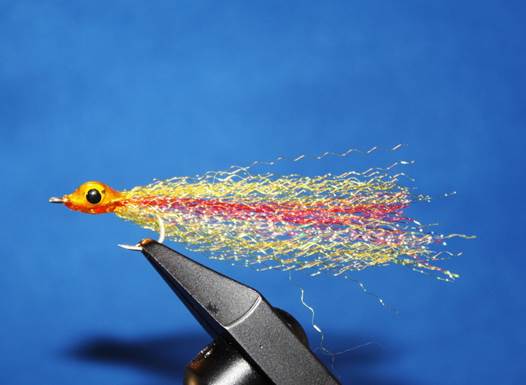
- Hook: Mustad 34007 Sizes: 1/0-8
- Thread: Clear Ultra Fine Mono
- Eyes: Dumb-bell type, painted Yellow with Black centers, tied on the top of the hook shank, this will cause the hook to invert and ride point up is the water
- Belly: Yellow Ultra Hair
- Wing: Red Ultra Hair, with eight to ten strands Rainbow Krystal Flash, topped with Yellow Ultra Hair
The effectiveness of Clouser Minnows is legendary and needs no further explanation.
So as you can see one color scheme can be used in several different patterns styles and all of the styles are effective.
Enjoy & Good Fishin’
| Sysadmin Note |
|---|
| Sysadmin Note |
|---|
“Why bluegill? They are available to fisherman in nearly every state in the Union, their pugnacity is legendary, and their tenacious yanking, diving, twisting battles are unforgettable. They’re fun, anywhere and just about any time.”
Terry & Roxanne Wilson, Bluegill…. 1999
The saltwater fly fishing in Florida is so exciting and addicting that you sometimes forget that there other waters to fish and other species to catch besides the ones that live in the saltwater. In this column I will cover Peacock Bass, Bluegills and Redear Sunfish (Shellcrackers) and Black Crappie.
I will admit that I found the lure of the saltwater so great that I finally had to schedule freshwater fishing days or I fear that I would have had very little experience with warmwater fish in Florida. But I am glad that I started spending time chasing the fresh water species as they have afford me some excellent fishing, fond memories and many thrilling adventures on the water.
Now I will plunge into the subject at hand and begin with one of the most popular of the freshwater gamefish and that is the Bluegill.
Bluegill [Lepomis macrochirus] are also known as bream, brim, copperbelly, sunfish and many others they actually are cousins to the sunfish and they are among the native species of Florida. The bluegill occurs naturally in the United States east of the Rocky Mountains but have been transported across the country and around the world. They live in the shallow waters of lakes, ponds, and slow moving sections of rivers and streams and are school fish that gather in groups of 10 to 20 fish.
During the warm months of summer the bluegill will consume 35% of its own body weight on a weekly bases, they use a suction method when feeding so they approach their prey very closely. They are able to accomplish this as they have the ability to swim and change direction at high speeds. Bluegills are primarily daylight feeders as they feed by sight and have peak feeding periods occurring in the mornings and evenings.
Spawning occurs in the spring with water temperature of 67 to 80 degrees, in the North this mean May to June however in Florida the spawning period occurs from mid-February to April in a normal year. The Males will choose the spawning site and scoop out a depression in the bottom this normally occurs in shallow water around vegetation. Once the eggs laid the females are off to party central while the males defend the bedding area very aggressively and believe me they are aggressive.
Bluegills can live up to eleven years and during the first three years the growth rates are very rapid and then it begin to slow. The can tolerate a salinity of 1.8% and can also be found in the upper stretches of brackish water. Bluegills are found throughout Florida and they are one of the most fun fish that you can catch on a fly rod. Without a doubt the most popular fishing for Bluegills is during the spawning season however they can be caught throughout the year. Bluegills are also cousins of the Redbreast Sunfish Lepomis auritus and the Redear Sunfish Lepomis microlaphus which are also known as “Shellcrackers”. The Shellcrackers can tolerate brackish water better than any of their cousin and are found throughout Florida and have a life span of six years. All have similar spawning times and habits and though the Shellcrackers have a decided liking for clams and other shellfish which have given them their nickname.
Another of the freshwater species that is found throughout Florida in the lakes and pond is the Black Crappie Pomoxis nigromaulatus has a lifespan of 15 years and the largest ever recorded was 19 inches in length and was just under six pounds. They are a schooling fish with the smaller fish feeding on all forms of aquatic life and the adults the actively seek minnows.
Here in Florida the spawning take place in March and April and the black crappie is a much sought after for the table.
The final species that we will discuss is the bright and colorful peacock bass [Cichla ocellaris] which is a non-native fish that was introduced by Florida Fish & Game in 1984 to control the growing population of spotted tilapia which is also non-native.
At first the peacock bass were only found in South Florida but now they are found in several area lakes and ponds in the state along with some of the freshwater canals. This introduction has created a much sought after gamefish due to its aggressive strike and hard fighting capabilities. The preliminary data shows that they live approximately six years and spawn from April through September and grow very quickly and will reach 12 to 14 inches within the first sixteen months and then will add about an inch per year, a seventeen inch peacock bass will weigh about three pounds, the largest Florida peacock bass reported was twelve pounds and twenty five inches in length. Peacock bass are very aggressive and will take both surface and subsurface imitation and they like shady areas.
There is a private lake on which my son owns a piece of property which has all of the freshwater speices including the peacock bass and the fishing for these various species is exciting, fun and the results are at time very tasty!
Normally I am using a four weight rod system during the time period of finding the bluegills on the spawning beds and during the rest of the time I am using a six weight rod system with floating lines, sink tips and type III full sinking fly lines.
Now I will share some of the patterns that I use on these species.
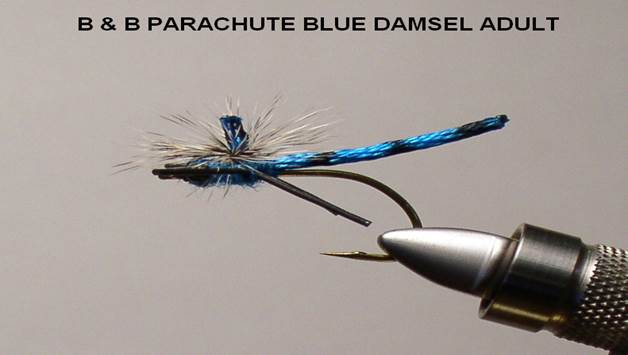
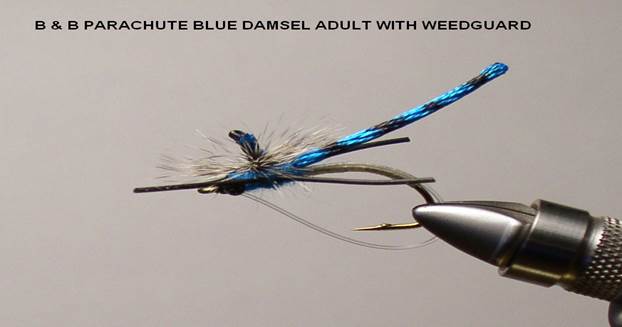
B&B PARACHUTE BLUE DAMSEL ADULT
- Hook: TIEMCO 8089 Sizes: 10 & 12
- Thread: Black 6/0 OR 8/0
- Weed Guard: (Optional) Apply 20 lb OR 25 lb Mason monofilament using 6/0 White Thread
- Body extension and wingpost: 2 mm blue nylon lace, banded with black marker. Both ends of the material need to be seared.
- Eyes: One pair of black mono
- Thorax: Dubbed, scintilla #85 Damsel blue
- Hackle: Grizzly dry fly hackle, tied parachute style
- Legs: Two black round rubber legs per side, tied Madam X style
NOTES: If you are using a weed guard, you will finish the weed guard before you wrap the parachute hackle. If no weed guard is being used, the parachute hackle is the last step in completing the imitation. This pattern may be constructed in several different color variations.
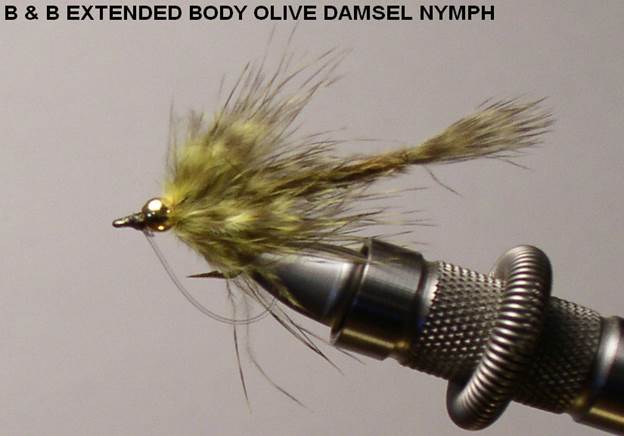
B&B EXTENDED BODY OLIVE DAMSEL NYMPH
- Hook: Tiemco 105 Sizes: 6-10
- Thread: Olive dun 8/0
- Weed guard: Two loos of 0x mono [optional]
- Bead: Metal, gold or copper as desired
- Body extension: The body extension is tied on a length of 0x tippet material strung between two vices.
- Tails: Yellow/olive grizzly marabou tips
- Body: Barred chartreuse marabou fibers, tied in by the tip and twisted with the thread and wrapped forward. Several bodies can be done at one time. After you finish spiraling the thread, touch it and the mono with a drop of super glue and begin your next body. They can then be cut apart and attached to the hook.
- Thorax and legs: Wrapped, two or three yellow/olive grizzly marabou feathers to the base of the bead
NOTES: This pattern is durable and has a great life-like swimming motion. It can be tied in many different color combinations to match the color of the naturals in your area.
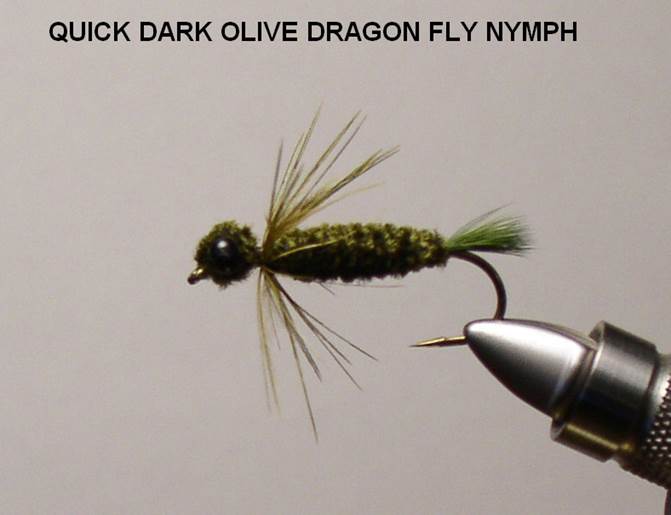
QUICK DARK OLIVE DRAGON FLY NYMPH
- Hook: Tiemco 5262, 5263 or 200R Sizes: 4 to 12
- Thread: Olive dun 6/0 or 8/0
- Tails: Dark Olive marabou tips tied short
- Body: Small dark olive chenille
- Eyes: One pair black mono
- Head: Small dark olive chenille
- Legs: Pheasant rump feather dyed yellow/olive
NOTES: Weighting the body should be done with lead fuse wire. I’ve found that brown, olive or black are the best colors.
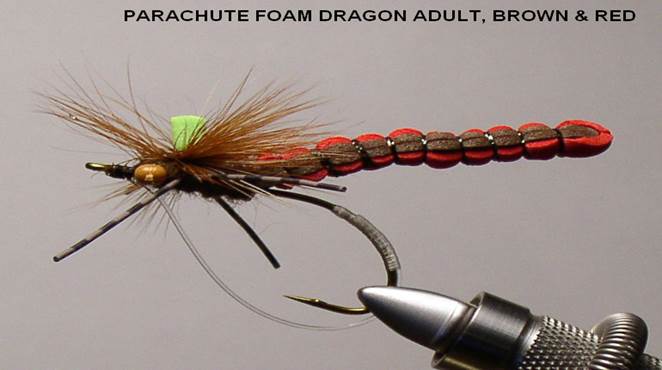
PARACHUTE FOAM DRAGON ADULT, BROWN & RED
- Hook: TMC 8089 Sizes: 2, 6, 10, 12
- Thread: Brown 6/0 or 8/0
- Body extension: The body extension is pre-tied on a long, thin doll needle, using dark fine ultra-thread. The body consists of two lengths of dry cell fly foam, a strip of brown with a thinner strip of red laid on top. This is folded over the needle. As soon as a base is secure tie in two strands of black Krystal flash. This will be twisted and wrapped through the body. The segmented body is made with the ultra-thread and the rib is spiraled through the body. Whip finish, glue and slide off the needle. Attach the body extension to the hook shank at the mid-point on the top of the hook shank. Attach the body with white ‘A’ thread, then switch back to brown 6/0
- Wingpost: 1/8 round bright foam post, yellow, orange or chartreuse as desired
- Eyes: One pair, brown mono
- Thorax: Dubbed, Scintilla #14 dark chocolate
- Hackle: One or two brown hackles, as desired, tied parachute style
- Legs: Two per side, tied X style, brown speckled rubber centipede legs
NOTE: If you desire a weed guard, use mono and white thread.
*More patterns next issue
| Sysadmin Note |
|---|
| Sysadmin Note |
|---|
MM Black Nose Dace
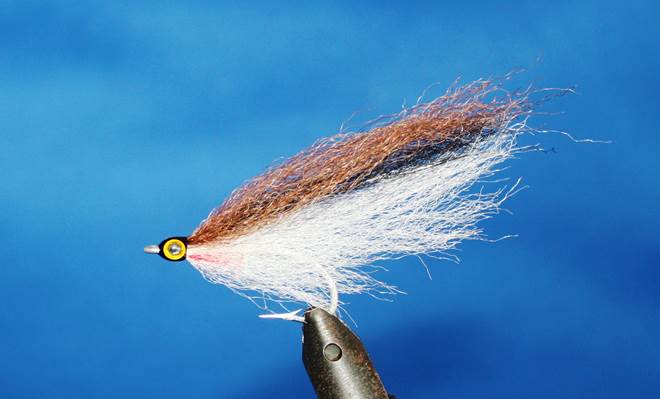
- Hook: Mustad 3407 Sizes: 1/0-6
- Thread: Black 6/0
- Wing/Body: White EP Fibers with six strands of Silver Flash-A-Bou on top, followed by a thin bunch of Black EP Fibers, topped with Brown EP 3D Fibers.
- Belly: White EP Fibers, with red slashes either side of the belly in the area of the throat, made with a Red Sharpie marker
- Eyes: Dumb-bell Eyes Yellow with black centers—Optional for a deep running imitations, or 3D eyes Yellow with black centers and the head is epoxy coated regardless of which type of eyes are used.
The MM stands for modified and modern I use this designation which I using traditional pattern where next materials and different construction methods are being used. The original pattern was developed by Art Flick.
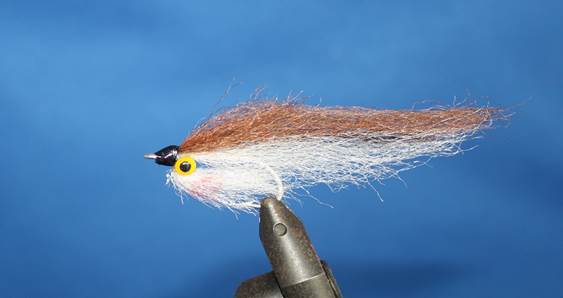
MM Black Nose Dace Deep Variation
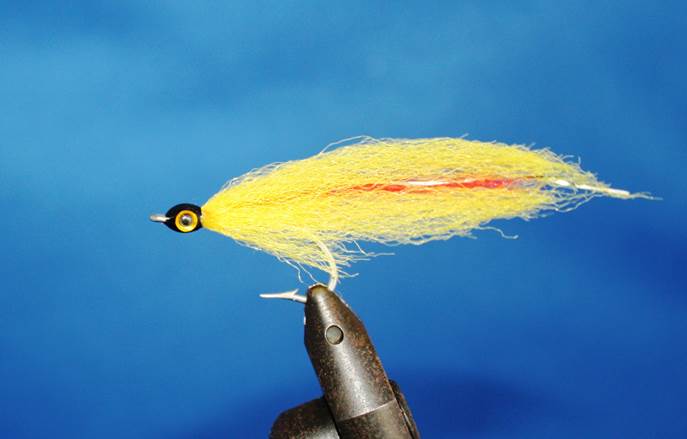
MM Mickey Finn
- Hook: Mustad 3407 Sizes: 1/0-6
- Thread: Black 6/0
- Wing/Body: Yellow EP Fibers with six to eight strands of Silver Flash-A-Bou, with a thin bunch of Red EP Fibers and topped off with Yellow EP Fibers
- Belly: Yellow EP Fibers
- Eyes: 3D Yellow with black centers applied with 5 minute Epoxy
- Head: Black Thread, Epoxy coated
Dumb-bell eyes can be used on this pattern for deep running imitations. The original Mickey Finn was designed by John Alden Knight during the 1930’s and the original pattern was a bucktail.
Many small poppers are very effective on Bluegills and Sunfish.
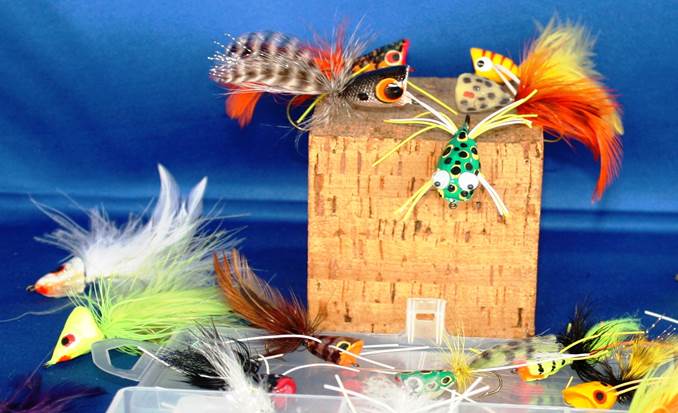
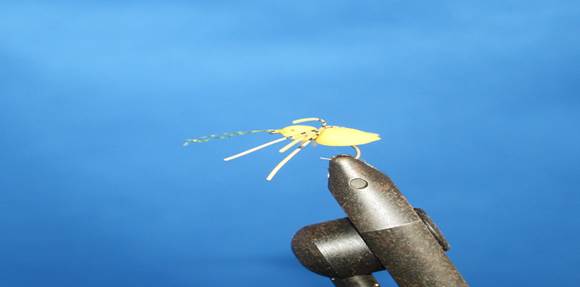
Yellow Foam Bluegill Spider
- Hook: Tiemco 100 Sizes: 8-12
- Thread: Yellow 6/0
- Underbody: Yellow Thread
- Body: Yellow Foam Body
- Legs: Four small Rubber Legs per side, barred with a Sharpie
- Antennae: Two strands of Yellow Krystal Flash
Note: I have caught more bluegill on this pattern than I can count and though I do tie this in black and chartreuse but the yellow is my favorite color and it is a pattern that I am never without. Oh by the way I have even used it on trout and it works.
Clouser Minnows come in many different styles and color combinations
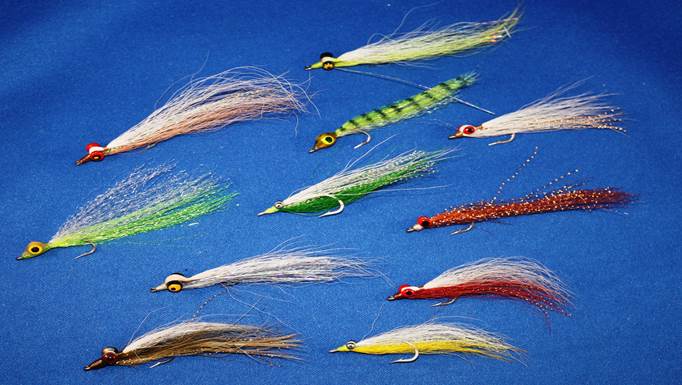
Clouser Minnows
If you are serious about fly fishing and you like to catch any species of fish on flies then you need to have a reasonable selection of Clouser Minnows in your fly box. The Clouser’s Minnow was developed by Bob Clouser and over the years both Bob and his minnows have become legendary, his patterns have worked on trout, smallmouth, various species of saltwater fish, steelhead, and just about everything that swims in the water. Clouser’s Minnows are tied with Bucktail, Fox Tail fibers, Super Hair, EP Fibers, Marabou, Rabbit Strips, Craft Fur and a whole host of other material both natural and synthetics.
For a better understanding of Clouser Minnows and the method developed to fish them. Then I strongly recommend studying the two volumes published by Bob Clouser, the first is Clouser’s Flies published in 2006 and Fly-Fishing for Smallmouth published in 2007.
Both of these books are filled with patterns and great insightful information on how to fish these patterns and many other types of flies.
Now I will list a few of my favorite Clouser Minnow patterns. The patterns I have selected have always worked well for me however I won’t be surprised if you have a few of your own favorites!
Chartreuse & White Clouser Minnow
- Hook: Dai-Riki 810 Sizes: 2/0-6
- Thread: White 6/0
- Eyes: Dumb-bell, Yellow with Black centers
- Belly: White Bucktail
- Wing: White Bucktail with 6 strands Silver Krystal Flash and 3 strands of Pearl Krystal Flash with two Strands of Black Krystal Flash
Olive & White Clouser Minnow
- Hook: Dai-Riki 810 Sizes: 2/0-6
- Thread: White
- Eyes: Dumb-bell, Yellow with Black centers
- Belly: White Bucktail
- Wing: Olive Bucktail with Olive 6 strands, Pearl 2 strands and Black 2 strands of Krystal Flash
White Clouser Minnow
- Hook: Dai-Riki 810 Sizes: 2/0-6
- Thread: White 6/0
- Eyes: Dumb-bell, Red with Black center
- Belly: White Bucktail
- Wing: 6 Strands of Silver Krystal Flash, White Bucktail
Black Clouser Minnow
- Hook: Dai-Riki 810 Sizes: 2/0-6
- Thread: Black 6/0
- Eyes: Dumb-bell, Red with Black center
- Belly: Black Bucktail
- Wing: 3 strands of Silver Flash-A-Bou and 3 strands of Pearl Flash-A-Bou and Black Bucktail
There are many patterns which I could add to this section and there are many patterns which are effective on warm water species but I think these will get you started on the right road towards building an effective selection of warm water flies.
Furthermore don’t be afraid to try something new or different with your Clouser’s.
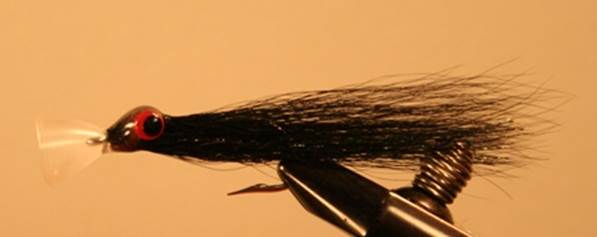
Black Clouser Minnow with a Magic Cone Head
There are always new variations to try in an effort to improve the performance of a proven pattern. Just remember to credit the original designer of the pattern.
BLACK CLOUSER MINNOW WITH A FLY LIPP
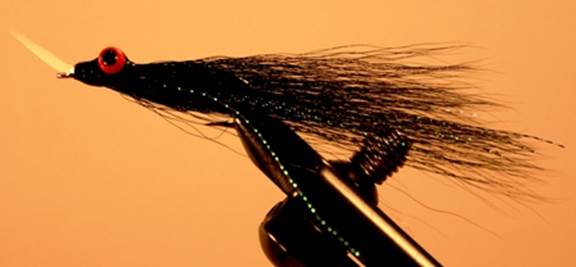
The willingness to experiment with fly patterns for me is all about improving a pattern as it relates to a particular situation I have encountered on the water or something that I have observed.
I will also admit that I play with new fly patterns at the tying vise because it is fun and that is what I enjoy about this wonderful sport.
All of the patterns listed in the Saltwater Chronicles #13 dealing with largemouth bass will work on peacock bass. Also prince nymphs, San Juan worms, hare’s ear nymph and many others will work on the bluegills, sunfish and black crappie. I hope this encourage you to leave the saltwater for a day or two and catch the fresh water fish of Florida or wherever.
Enjoy & Good Fishin’
| Sysadmin Note |
|---|
Originally published May 31, 2014 on Fly Anglers Online by Tom Travis. Combined from 12 parts.