Rainy’s Bead Back Scud By Joe J. Warren
Scuds are also known as freshwater shrimp and are a
part of the hard shell group of organisms called
crustaceans. Scuds tend to be very prolific in many
habitates, ranging from streams to lakes, that typically
hold trout. Their abundance, combined with a high
protein content, greatly contribute to a trout’s rapid
growth.
The Bead Back Scud was originated in 1994 by Rainy Riding of
Logan, Utah. Rainy is a “vision” fly tier, that is to say,
her personal patterns evolve while she sleeps. While it is
still freash in her mind, she wakes and heads for the tying
table. Rainy claims that the Bead Back Scud came about during
a 3 a.m. excursion. I’m guessing that her nightstand is
adequately equipped and ready to go.
As you can see from the scud picture above, the beads resemble
their thin transparent shell. The legs on the Bead Back Scud
are an additional feature that contribute to the uniqueness of
this pattern which does not open up large gaps between the beads.
The coloration of scuds varies from region to region as the color
is often a reflection of the scud’s diet. Their colors range
from shakes of olive to tan or gray.
Materials List:
Hook: Dai-Riki 135, Daiichi 1150 or 1250, sizes 12-16.
Thread: Color to match beads, 8/0.
Body: Five or six beads, small, color to suit.
Legs: Rainy’s Sparkle Dub, color to match beads.
Instructions - Rainy’s Bead Back Scud:
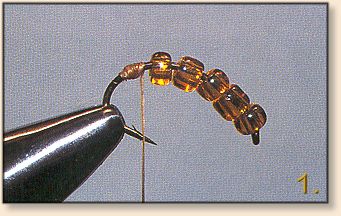
- Thread 4 or 5 beads onto the hook and place it in
the vise at a slight angle. Push the beads forward to
the eye. Tie in the thread at the bend of the hook at
least one bead width behind the beads and create a thread
butt large enough to keep the beads from slipping off the
hook, whip finish the thread and trim.
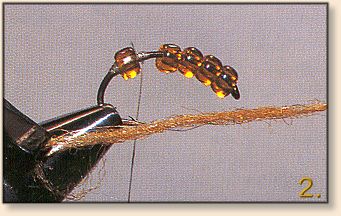
- Push one bead back to the thread butt and tie in
the thread. For the legs, collect a small amount of
dubbing and form a noodle-shaped body by rolling the
material between your thumb and index finger (dubbing
should be in inch long and half the diameter of a bead).
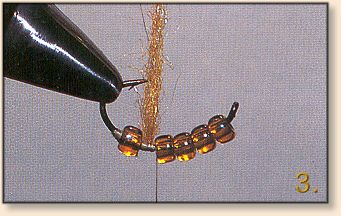
- Rotate the hook so it is upside down. Tie in the dubbing
strand by its center and secure with figure-eight wraps. tie
a couple of half hitches with the thread and trim. Do not
overwrap the thread, this causes too much bulk which prevents
the beads from closing tighly together.
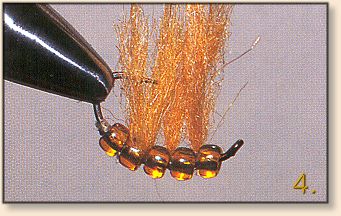
- Push the next bead tightly against the dubbing and tie
in the thread again. Form another dubbing strand and secure
into place as described above. Repeat this step until you
have completed the legs in between the beads. Tie in the
thread between the front bead and the eye to finish the head
with wraps and whip finish.
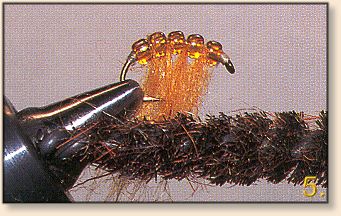
- After the legs are completed, rotate the fly back
into the upright position. Use a fine-bristled brush and
comb the dubbing fibers down to form the legs. Trim the
tips of the dubbing fibers to the width of hook’s gape.
Publisher’s Note: If using glass beads on flies is
new to you and you are hesitant to stock up with yet more
fly-tying supplies, Rainy Riding has this fly as “Bug in a Box” on
her website. The ‘box’ comes with
a sample fly and enough materials to make several.
How to Fish the Rainy’s Bead Back Scud
Scuds are primarily bottom dwellers, but can tumble downstream
in fast currents. Add a little split shot on your
leader to get it down if necessary. ~ JLW
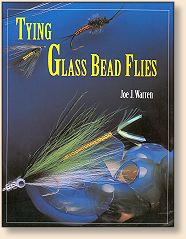
Credits: This fly is one of hundreds of innovation flies included in
the book, Tying Glass Bead Flies by Joe J. Warren, published by
Frank Amato Publications. We appreciate use permission!
Originally published April 28, 2003 on Fly Anglers Online by Joe J. Warren.