Every pattern I see for the Zebra Midge shows the hook used as curved or scud hook. Can it be tied on a straight shank hook and still be effective at catching trout?
Warren,
Yes, it can.
That ‘curved’ look is just one of the many positions that a small larva like that will assume. Straight is another of them, and I doubt the trout will care.
I gave up buying those ‘scud’ bend hooks years ago…but I like the look of the flies tied on them, so I just bend my hook to the shape I want before I tie the fly.
Buddy
Thanks Buddy for responding to this question. I have been tying up some Zebra Midges and that question came to my mind and I figured someone here could answer it for me. Now back to tying…
Thank you
I tie all of my zebra midges on straight hooks. I feel it gives you a more exposed hook point when you’re dealing with 18-22 flies.
There is a article in a recent Fly Fusion magazine claming scud hooks are better for smaller flies than “straight” hooks. I tie on both.
Some scud hooks have an offset in them. I find this really helps the hook up ratio. You can just bend the point to one side or another and get the same results.
Warren -
I like to tie midge larva on a Dai-Riki 135 scud hook, which does have that offset bend.
Having said that, tying them on a regular straight hook would give them a Joe Brooks “in the round” effect, which is not a bad thing, for sure.
No matter what hook you use, at some point the fish is just going to see the fly in a straight line. From certain points of view, there may be some curve in the scud hook, but from one direction, it also will be straight. Fish will used to be seeing a midge larva or pupa in a straight line, as well as any number of curved or contorted lines.
That was Brooks’ theory on tying nymphs - tying “in the round”. I pretty much incorporate it in all my subsurface offerings, to the extent I can, by tying flies that look pretty much the same from all directions.
John
I appreciate everyone’s input on this question. I think I will be tying some of each and see if there is a difference in “hook-ups” and “strike” ratio.
Thanks everyone,
If you haven’t seen this short video about the midge by Ralph and Lisa Cutter - http://www.midcurrent.com/video/clips/cutter_midge.aspx - watch it. I think it explains why the curved scud hook might be the better idea when tying midge larva.
Joe
A guide friend of mine ties all of his midges on Tiemco 200R hooks exclusively. He is very successful and came to them through much on the water “testing”. You might try them. I use them, as well as the 288H and Dai Riki 135’s. On big fish water, i try to use the heavier 288H’s.
Rich
I believe it was A K Best say that we tie our scuds on curved hooks because that’s how we have seen them when in our hands…that is a defensive position…in the water undisturbed they are straighter…at least that’s what he said.
Here is just my opinion, nothing more. I have tied Zebra midges on Tiemco 200’s, but the hookup ratio isn’t as great as with a wider gape on the hook. The fly looks good, but hard to drive your point home. I have gone to the DaiRiki 125 emerger hook (similar to the scud 135, but lighter wire, which gives a better midge-sized abdomen). The 125 still gives a good curved profile, but the gape is much more open than any regular straight nymph or dry fly hooks and much, much wider than the curved nymph hooks, i.e. Tiemco 200’s. (P.S.: the DaiRiki hooks are half the price of most other brands)
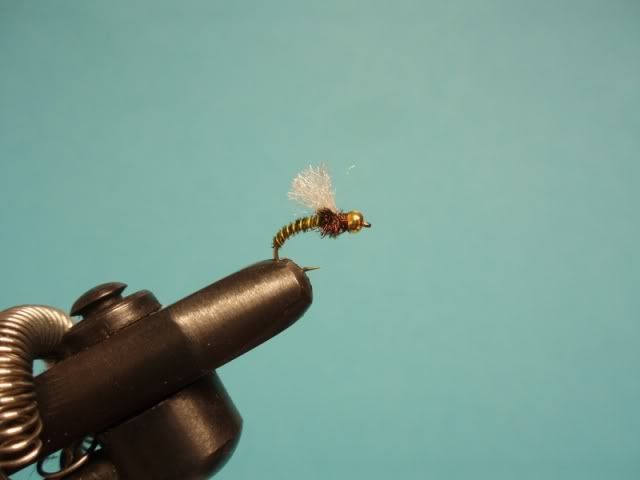
Here is a sample of a green zebra I tie with a chartreuse bead and rib:

In fact, for almost all of my ties I have gone to the 125 - dries, emergers, nymphs, scuds. Even though the hook is curved, when you tie a scud pattern on it the actual finished fly is more straight than curved, yet retains a little bit of curve which I have observed even in a swimming scud natural.
It’s about the gape and the ratio of hookups to not that is most important to me. If I’m going to tie a fly to fool my quarry then I sure want to hook up with him when I do fool him and the wider gape does this across the board. I’ve tied flies for a lot of years and have never been a slave to pattern recipes I look at a recipe as more of a “guideline” to get me started and then it morphs from there.
Here are some samples of various flies I have tied on the DaiRiki 125 hooks:
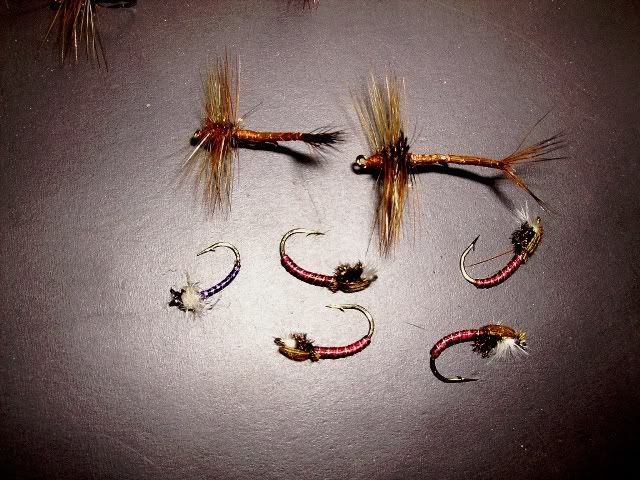

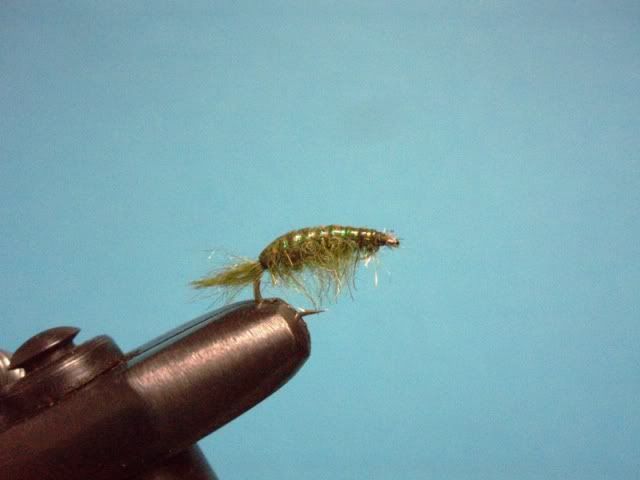
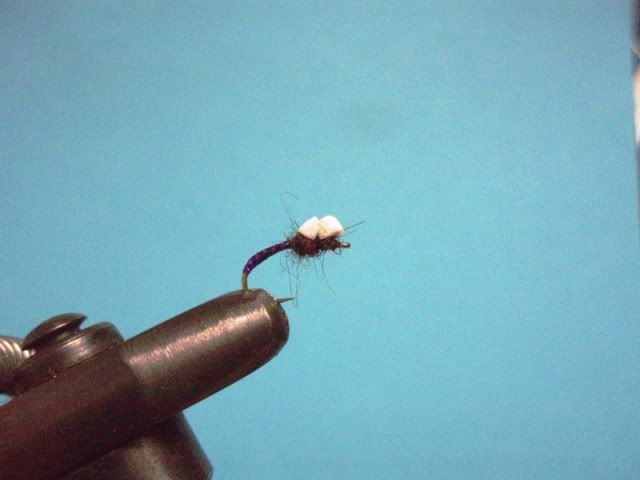
Anyway, that’s how I do it and it works for me. Nothing wrong with other methods, but make sure you find what works best for you - both at the vise and then for real on the water.
Good Luck!
Kelly
Kelly,
Thanks a bunch for your post. Like you, I want to “hook-up” and I was wanting to know what hook most use so I would have less “LDR’s”.
Yesterday, on the river, I probably had at least 25 bumps, strikes, jerks and pulls and only brought 16 to hand and I would much prefer better hook-ups. Part of it was my fault because I tied mine up on a #12 scud hook because I wanted the larger hook and gap. I did try a #14 and had many hits and pulls and several that just pulled off. Once I went up to the #12, the hook-ups were better. I just dislike a fish striking my fly and not getting hooked so I can see him and release him!
Thanks to all of you, I have several options to try…
Warren -
It may be clear to some, if not all, but just to expand on Kelly’s comments.
The Dai-Riki 135 is a 1X short and 1X strong ( read heavy ) hook with a down eye. The Dai-Riki 125 is a light wire 2X short hook with a straight eye. Thus, the larger gapes for a given hook size, albeit different between the 125 and 135 for the same nominal size.
The 125 has an advantage for emerger and dries since it is a lighter hook. The 135 has the advantage for nymphs and larva that you want to get down more without adding weight, or as much weight.
John
P.S. My own best midge larva is thread ONLY ( UTC 70 denier in brown olive ) on a size 16 135. My best midge pupa is a beadhead thread plus wire plus white CDC puff wing-over-eye on a size 16 135. If I weren’t using my own, I’d be asking Kelly to tie some of his for me, for sure.