Palmered hackle style wet flies are both beautiful and
successful fish-catching flies. The feather is tied in and wrapped
differently than the soft-hackle collar wet flies. Hen
feathers are good to use as the stem is very flexible
and will allow you to make this kind of reverse hackle.
The narrow stem also keeps it from being too visible,
as you are wrapping the feather on the outside of the body.
This technique is demonstrated by tying a Q-Back
Flymph.
Materials for the Q-Back Flymph
Hook: Mustad 3906B, size 16
Thread: Red 8/0
Ribbing: Red copper wire.
Tail: Four pheasant-tail fibers
Body: Two pheasant herls.
Hackle: Brown hen neck feather.
Method for the Q-Back Flymph
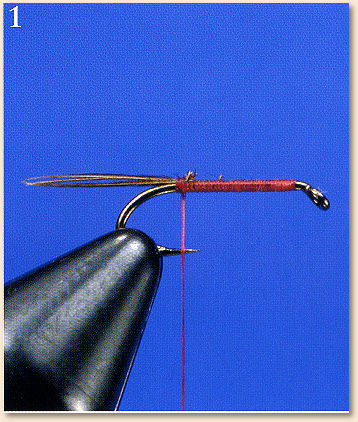
- Attach the thread to hook and wrap it back to the
bend tying in four pheasant tail fibers to the shank for the tail.
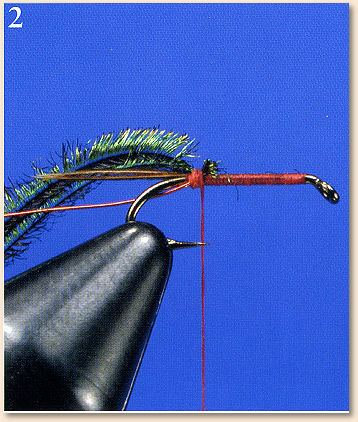
- Tie in the red wire and two to four peacock herls for the
body. Advance the thread to just beyond mid-shank
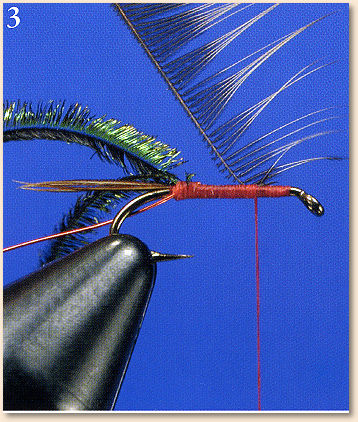
- Select a hen neck feather with webby barbs that are
slightly longer than the hook shank. Prepare the feather
by cutting or stripping the fibers from the side of the feather
that is to be wrapped against the hook and tie it in to the
top of the shank by the tip. Advance the thread to
behind the hook eye.
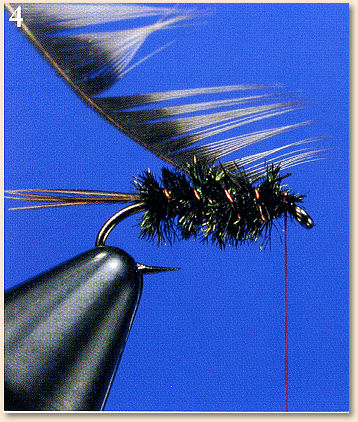
- Carefully form a single rope from the peacock herl by
twisting it between your thumb and index finger. Wrap the
peacock herl up to the hook eye avoiding the feather.
Then counter-wrap the wire and tie off. Trim the ends of
the peacock herl and the wire.
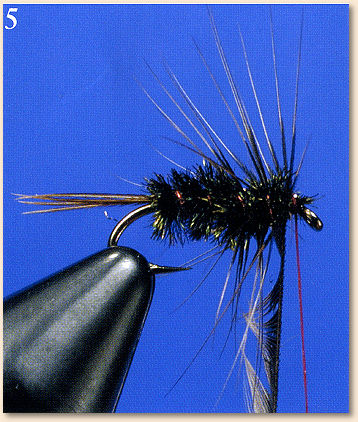
- Wind the hen feather one full turn around the hook shank
at the tie in location. Then palmer wrap the feather up the
shank to behind the hook eye. As you make each wrap with
the feather, stroke the fibers back towards the rear of the fly. It
will only take one turn of palmering between the feather tie-in
wrapin the middle of the shank, and the collar wrap at the
hook eye. Leave space between the palmer wraps. You want
the palmering to be obvious.
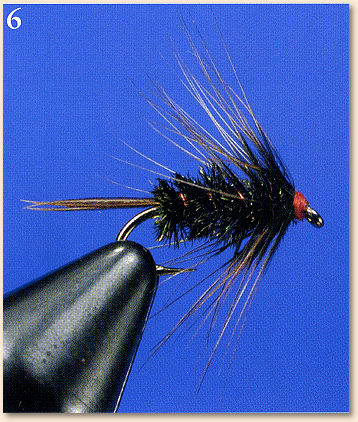
- Make two or three turns of hackle behind the hook eye and
tie off the feather. Trim the remaining feather stem. Form
a neat thread head and whip finish..
Credits: From Tying and Fishing Soft-Hackled Nymphs
By Allen McGee. Published by Frank Amato Publications.
For more great flies, check out: and
Originally published September 22, 2008 on Fly Anglers Online by Allen McGee.