If it were my original design and someone else was copying it with a minor change and it was costing me money, then it would be an issue. But, Al Toth’s Elk Hair Caddis was tied a specific way, if you add or delete a part of the fly, it is no longer Al Toth, It’s Joe Blow’s Elk Hair Caddis. Copyrighting Is not that expensive, especially if you did several at the same time.
A lot of variables there. Most patterns came from another in some way shape or form, either by technique, materials, reference or just plain inspiration. That includes most “originals”. You also have intent or knowledge of an earlier pattern.
Today, a lot of information is readily available. But 10-20 years ago the internet wasn’t what it is now. So you often had regional patterns that would be very similar, but the parties knew nothing of each other.
Then you have the question of…does the alteration or change make a significant change to the trigger of a given pattern? If it does, should it then be the “Improved Blah-de-Blah”?..remain “Joe Schmucks Blah-de-Blah”?..Or can it then be renamed “Heimy Goobsteins Big Blah-dascious”?
If I make a change to a pattern, I’d call it a variation but certainly wouldn’t put my name on it. If I radically alter one, I’d make sure to acknowledge where the inspiration came from.
I honestly think it’s hubris to attach one’s name to any fly. Why you gotta pat yourself backwards like that? The earlier “modern” flies, Elk Hair Caddis, Adams, etc., didn’t seem to need them. Why now? If it’s a good fly, and it already has a unique name, i.e. Stimulator, why call it the Kauffman’s Stimulator, when it is just a modified Improved Sofa Pillow?
Well, now that is a fairly inaccurate statement. Not your opinion of applying Hubris…that’s your opinion and you’re entitled to it. But fly tyers have been applying their names and identifying themselves with patterns since as far as I can remember. Does Wulff ring a bell?..Clouser?..Griffiths?..Gordon?
I have about 150 personal patterns over the years. Many inspired by others and I try to name them accordingly whenever that was my intent. I believe I’ve applied my identification to 3? Wouldn’t apologize to anybody for them.
I agree with Scott. Changing a pattern or substituting a material does not constitute a new fly. It is a variation. So if you want to call it a “Joe Blow’s Variation of some fly pattern” I guess that’s ok if you need the reinforcement.
To be strictly accurate, most of those weren’t named by the tyers themselves, but my somebody else. I believe, for example it was Lefty Kreh who renamed the Deep Minnow the “Clouser Minnow”. Griffith didn’t invent the fly named after him, nor did he name it. He just used it a lot.
Still, your point is valid, and goes back even further. Canon Greenwell may not have suggested “Greenwell’s Glory” but he heartily concurred when someone else did. I think that Wickham actually did name his Fancy. Naming flies after people has a long and honorable history.
I agree. As an example, there’s a bajillion (+/-) Woolly Bugger variants. Some have names attached to them, despite being, IMO, a straight up plain Woolly Bugger.
On the other hand, I’ve been using a pattern for bass lately that I (think I) designed. It isn’t a complicated design, so I wouldn’t be surprised if others have done it…but I haven’t seen a pattern like it and I don’t know what else to call it, so I named it after me. Sort of tongue-in-cheek, but I needed a way to talk about it with my fishing buddies, rather than always trying to describe it.
It is a way to identify a specific item, as different from another item.
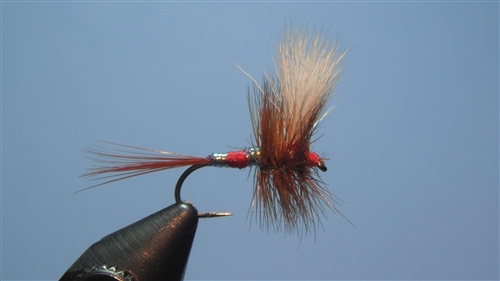
For example, a Royal Wulff. We all know the pattern and the name indicates a very specific pattern. How about noted fly tier and author Charles Meek’s Patriot. Instead of describing it as a Royal Wulff tied with red crystal flash for the peacock herl and brown hackle for the tail, it is a lot simpler to say Patriot.
So did author Charles Meek (Fishing Small Streams With a Fly Rod, Meeting and Fishing the Hatches, 101 Innovative Fly-Tying Tips, Fishing Tandem Flies, Fishing Limestone Streams, The Hatches Made Simple, Great Rivers: Great Hatches, Mid-Atlantic Trout Streams and Their Hatches, Pennsylvania Trout Streams & Hatches) steal a pattern?
There are a lot of very famous flies that are modifications of other flies. What is the Caucci and Natasi’s Compardun but a version of Fran Better’s Haystack and the Craig Mathews and John Juracek’s Sparkle Dun but a version of the Comparadun? So 4 famous fly tiers built thier signature fly on Fran Better’s Haystack. Who am I to decide if the Comparadun or the Saprkle Dun was enouogh of a change to deserve its own name?
Back in the early '80’s, tyers in the Southern Council - FFF and across the country were using bead chain to weight their “buck tail” streamers. The problem was that we still needed more wight… So we tried larger bead chain and even lead weight on the hook shank, but most of us were still unsatisfied with the results…
Then, Tom Schmuecker of WASPI developed and started producing lead, dumbbell eyes, and almost immediately, all the tyers that I knew were all using these lead eyes to weight our various bucktail streamers. These flies worked and virtually everyone in our part of the country started tying with Schmuecker’s new lead eyes… especially the tyers at the Southern Council’s Conclaves.
We didn’t re-name the buck tail pattern as “Schmuecker’s Minnow” or the WAPSI Minnow" or after ourselves, because we read that in the 40’s when Joe Bates wrote that when he originally added bead chain to a classic buck tail minnow, that such a change was not enough of a change to re-name the pattern…
A couple of years later (about 1988/89?), Lefty wrote the article in Fly Fisherman magazine about Bob Clouser and his “Clouser Minnows”. The day that magazine arrived at my tying buddy’s house, he opened the magazine to the article on “Clousers Minnows”, and he shouted, “Clouser Minnows! Hell, we’ve been tying these for years! How the hell could they be named Clousers?” He then proceeded to open about four of his fly boxes, which were full of the same fly described as “new” and in the article…
A few years later, I had the opportunity to eat breakfast with Lefty at an FFF conclave in Gatlinburg,TN (just me an Lefty at breakfast), and as I asked Lefty how he could justify naming a pattern after his friend that so many were already tying… Lefty looked up from his eggs, smiled at me and said, “I take care of my friends.”
IIRC, Dan Bailey is the one who assigned the appellation “Wulff” to Lee Wulff’s flies. Before the Royal Wulff, there was the hairwing Royal Coachman. The main difference seems to be the heavier hackling on the Wulff style of fly tying.
FWIW, I think the Patriot is different enough from a Royal Coachman, even a hairwing Royal Coachman, to warrant its own name. The Parachute Patriot has done well for me in both Michigan and Tennessee.
Silver,
Matthews and Juracek didn’t attach their names to the “Sparkle Dun”.
I personally think their replacement of the flared hair tails with Zelon was a very significant change to the comparadun. With that change, the fly became an imitation of a cripple with a shuck trailing the fly. It is instructive, I think, on how they came up with the idea. They were crossing a fence on the zhenry’s Fork and caught some “glimmers” in a back eddy. Upon closer inspection, they found glistening trailing shucks on crippled mayflies stuck in the film.
I think one would find that the sparkle dun pattern is now more popular than either the haystack or the comparadun. If I’m correct about that, it would lend credence to the importance of their change to the comparadun…and thus the validity of the sparkle dun being a “new/unique” pattern.
I think there has to be a significant change to a pattern to change the name. I’m with Byron on the sparkle dun because it changed the idea of what the pattern was supposed to imitate.
But to play devils advocate…What about Fran Betters Haystack? It does both, probably fishes as an emerger better than a straight-up Dun. I’m sure somebody will jump around and say that’s nothing but a Sparkle Haystack. Where does it end.
I tie patterns to catch fish. Some I tie with no thought to another. Some I tie as-is and never change it. Others I begin with the original and on a particular water determine that if I changed “this”, and shortened “that”…and removed “those” it would be a great pattern here. Sometimes i’m right. Many times I’m wrong. If it proves a better fly for me and earns a place in the box, it will get named and the pattern kept. However, I’m not so presumptuous to think that the next nimrod downstream may someday use my pattern and do much the same. And if he does?..name it something cool and tell your friends. Especially if it catches fish better for you on your water.
One more thought to ponder…for long ling time, prior to the internet…the only flies most folks knew were published patterns. Somebody within the industry either had to tie it, or stumbled upon it and write about it for a pattern to be legitimized. If it didn’t come a pattern book through Simon and Schuster, or get seen in Field and Stream or Outdoor Life, it would seldom be known outside the local fishing circles.
Again,
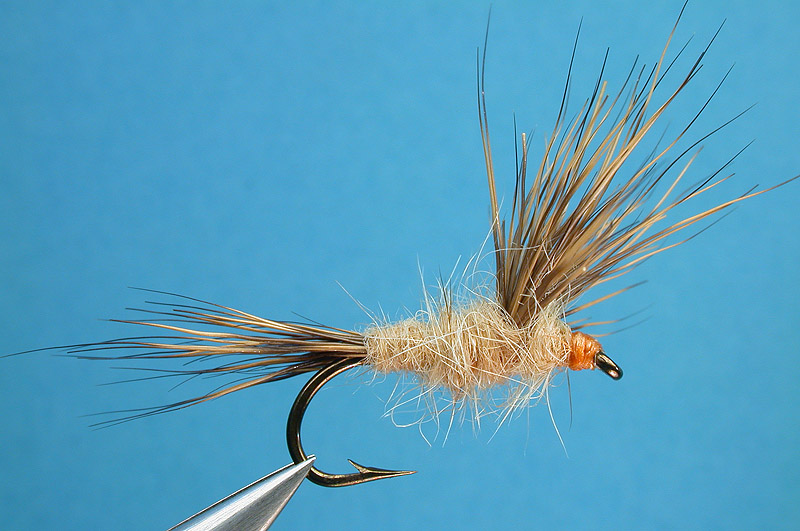
They modified the Comparadun, with a Zelon trailing shuck in order to imitate the shiny, reflective qualities of the trailing shuck of the 3/4 emerged dun…this, the name “sparkle” dun.
I’m not arguing with you Byron, I agree, it was changed in function…I’m just pointing out that the only pattern of that style was not the “Comparadun”. It was far more widely written about however than the Haystack.
Well aware Ralph. I am a big fan of Fran’s, and have a vise from his desk. There is some evidence that his father’s fishing buddy might have first tied the haystack which Fran popularized.
It is just that I don’t think Fran’s pattern is designed to represent the crippled dun as the sparkle dun is.