Para Glen By Al Beatty
Unlike other flies Al has developed, slightly modified, or kidded himself into
believing he actually invented, the Para-Glen did not happen due to a
specific need either on the water or from a customer’s request. This
fly came tumbling out of a bottle of twelve-year-old Glenlivet Scotch
whiskey one evening while Al was tying and creating flies with Lars-Ake
Olsson, a Swedish fly-fishing friend.
After an inch of that Scotch disappeared, the Para-Glen just
magically appeared. With such an unfortunate start in life you would
think the Para-Glen would have died a quick and merciful death, but
because the thing actually worked it has quickly become a favorite
parachute-style fly. It is particularly effective when fished as
an indicator with a smaller submerged nymph on a dropper. With
the bulk of the shank bare it fishes like a parachute even though
the hackle is wrapped around the hook: in essence, a parachute
that’s not.
In addition to producuing a quick, easy and effective fly, tying
the Para-Glen will teach a technique called furling. It’s a
method of quickly making perfect extended-body flies. Once
the furling technique in perfected, the fly tier can modify
the pattern to match almost any size or color of mayfly.
Materials for the Para Glen:
Hook: Scud or dry fly, size 12 - 20.
Thread: Color to match body.
Body/Wing: Poly, color to match insect.
Hackle: Grizzly or match the insect.
Tying Instruction for the Para Glen:

Step 1: The thread base is placed directly behind the hook
eye and only covers the front one-fourth of the hook shank.
Be certain to leave the back part of the hook bare so it
will readily sink into the water.

Step 2: Bind the poly yarn to the hook so a short tuft
sticks out over the hook eye and the rest extends toward
the back.

Step 3: Twist the section of poly extending to the
rear very tight. It should be twisted so tight it
starts to “bundle” upon its self.
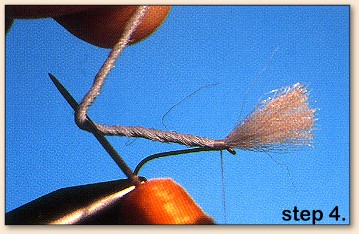
Step 4: Fold the tightly twisted poly over and allow
it to wrap around itself to form an extended body.
Bind furled body in place and trim excess even with
the poly remaining from Step 2. We find using a
bodkin at the fold-over point helpful with this
step.

Step 5: Take a couple of loops of thread around the
extended body and anchor it to the hook shank. It
should stick straight up in the air for the time
being. Tie on the hackle directly behind the
extended body. Also bind the excess stem to the
area just in front of the body.

Step 6: Wrap the hackle one or two turns behind the
body and several in front of the body. Tie it off
directly behind the wings.
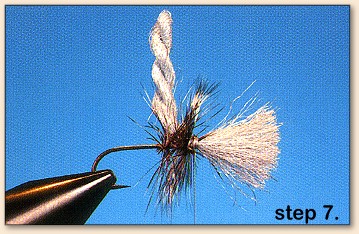
Step 7: Whip finish and trim the thread. Flip the
fly in the vise so yu can observe the position it takes
in the water. It fishes like a parachute but ties
like a regularly hackled pattern.
Finished fly:

~Al and Gretchen, Boise, Idaho
Credits: The O2 Stonefly Adult is from Al & Gretchen Beatty’s book,
Innovative Flies and Techniques, published by Frank Amato
Publications, (2005). You can read a review of this terrific book
HERE.
~ DLB
Originally published March 19, 2007 on Fly Anglers Online by Al Beatty.