Remember this old style way of tying an extended body flies? This one is tied with a teal feather. The thing I like about this method is the durability and the way the tail fibers’ separation is maintained.
Anyone else still tie these?
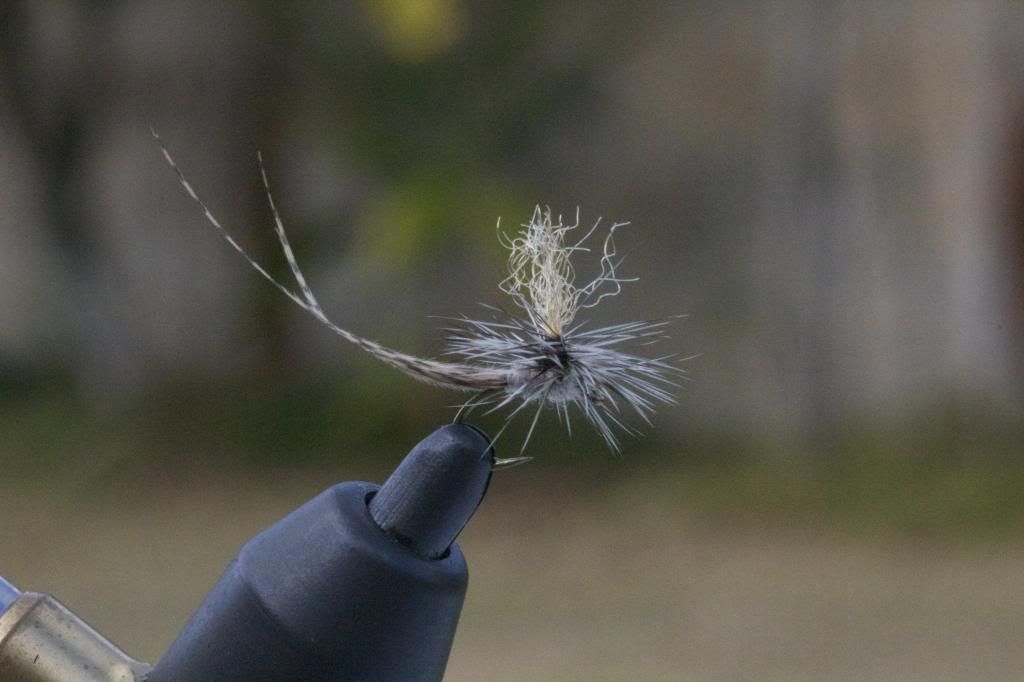
Remember this old style way of tying an extended body flies? This one is tied with a teal feather. The thing I like about this method is the durability and the way the tail fibers’ separation is maintained.
Anyone else still tie these?
I do tie that style quite a bit. I like it a lot, and it catches a lot of fish. So simple, and it works.
Try tying it with a CdC feather 
Cheers,
A.
I find the durability comment perplexing. I use wonder wings a lot - I love the look and that they hold their shape. But they aren’t exactly durable. The wings need to be checked after each hook up to make sure a trout’s teeth didn’t cut individual fibers. On a good day, I’m probably “fixing” the wings a lot.
Is teal or CDC more durable than hen cape?
Steven,
I realize that I screwed up. Mine is actually a pintail feather of a wood duck. It does hold up pretty well.
Post a pic of your wonder wing flies.
Byron,
You may possibly disagree but there was/is a style of fly called the ‘Riffle Dun’. I won’t name the tyer who, at least in one major fly tying book, is credited with its creation because that too might start some disagreeable comments. The style pattern you picture is somewhat similar. Oh, at the same time as the Riffle Dun style was developed, another pattern style known as the ‘Two Feather Fly’ or ‘HatchMaster’ was also developed but by another tyer. It was not a parachute style though. Both of these styles lend themselves to various recipies and therefore imitations of many insects. Both styles are ver effective.
Steven - Both of the fly styles I mention, when tyed properly, are just as durable as most other dry flies.
Allan
Why would opposing views on a subject be “disagreeable comments”? Just the nature of a discussion.
I do believe that Walt Dette tied a fly he called the “riffle dun”.
Hi Byron,
I can’t tell how you tied the extended body and tail.
Is it a flank feather trimmed and rolled a bit around the hook shank to form the extended body, and with the tail being a few barbules extending back after the center of the feather is cut off? It looks like the extended body may be trimmed a bit toward where the tail flares out. to make the body more slender.
Would you show a picture of the fly from above, etc., so it can be seen better, and describe a bit about how the extended body is tied?
The fly looks great! Thanks for posting it.
This kind of post is what has made this such a great site over the years! Good job Byron.
Thanks and regards,
Gandolf
Thanks Gandolf,
The body is made slender by simply stroking and pinching the feather fibers forward. Yes, the split tail is achieved by cutting the center of the extended part of the feather away.
It is certainly an old style pattern. I will try to post a pic of the fly from above and I think it will become more clear.
Top view. I notice that I should have brought the fibers in tighter to make a “skinnier” body.
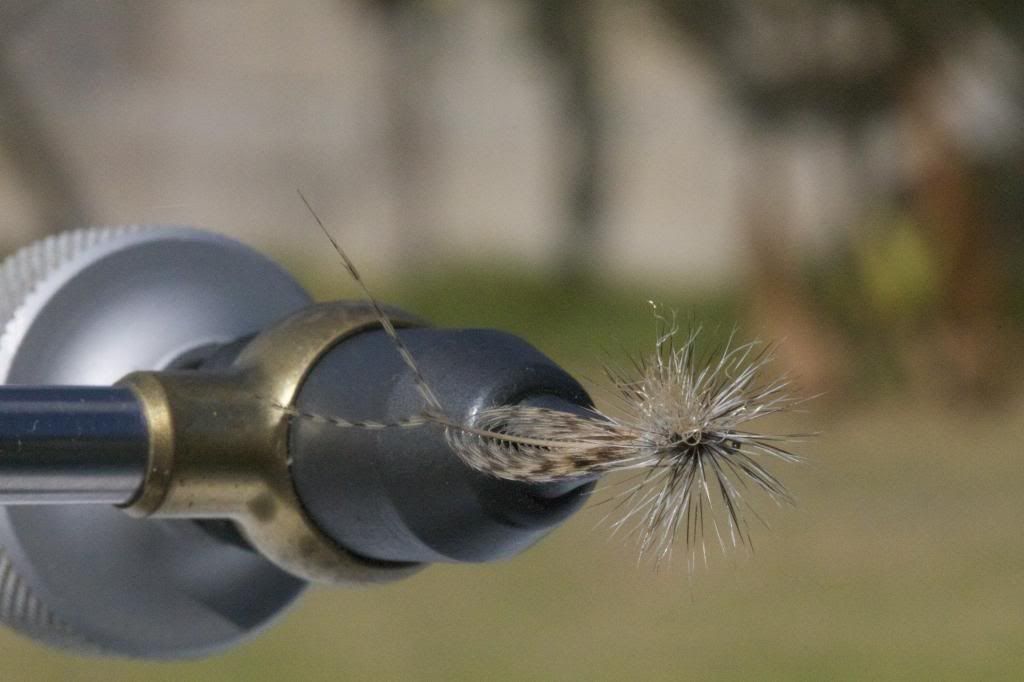
A “not quite in focus” pmd sparkle dun version
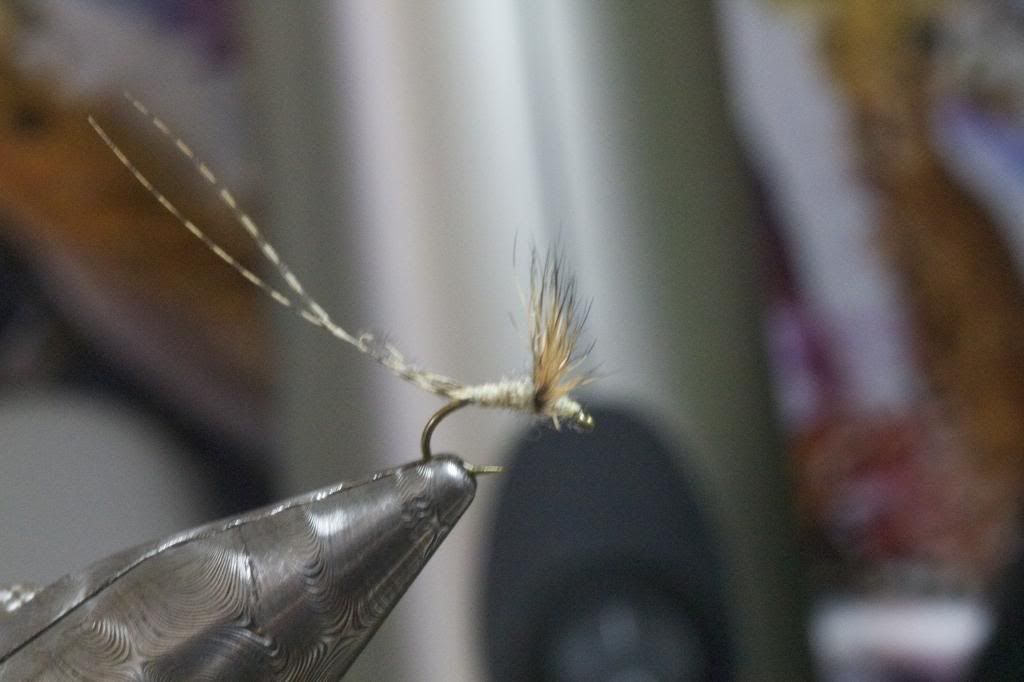
Just wondering what “durable” means to you all, in terms, say, of 10" to 15" trout in moving water ??
John
John,
Not sure about your scenario. I usually fish the Ranch on the Henry’s Fork. There, we are after bigger fish (and, regrettably, fewer fish). It is sort of stalking for large fish. Even just one over 20" would not be a problem if the fly had to be changed. I often change my fly after a large fish just to have a fresh dry fly. Quantity of flies is not a problem for me as I do quite a bit of tying.
Byron,
What I’m about to write is kind of funny and supports what I’ve written in other posts relative to the always lingering, ‘Who did what first (?)’ and that 'Fly tyers are inventive and come up with things on there own although unbeknownst to them, the thing they’ve come up with is already in use.
Here’s what happened. It happened today, and this involves the old way of creating extended dry fly bodies. I had to take my wife to the hospital for a test so I took an old fly tying book to read and kill time while I waited. Book was publ;ished in 1951. The author goes into extended bodies and describes how he made a base for the extended body, a problem he had with that technique and how he was able to correct that technical problem. Although I have had this book for many years, it was not until today that I read this part of the book. Funny thing though, now that I read that part, I realize that many years ago I came up with the same technique as the one that that author settled on. This is just another example of just improvising and coming up with something to fill a need.
Exactly!
That is why I once posted the question: “Had there been no Al Troth, would we still have had an Elk Hair Caddis?”. I am sure we would have. Now, that is to take nothing away from Al Troth. He was one of the finest tiers ever! In fact, each time I am in Blue Ribbon Flies, I am enthralled with the framed plate of his flies. Probably 25-30 exquisite flies.
It is just that I believe, with as many tiers as there are world-wide; with all we know of insects and their behavior; most any fly ever developed would have been tried by someone else. It might not get a lot of notoriety, but it would be there.
I believe there are a lot of “mute Picaso’s” out there…
… in the first post and one of Allan’s posts.
My normal fishing day is very different than what you have described. Fishing dry flies several times a week for seven months out of the year and catching, on average, between 20 and 25 trouts in the 10" to 17" size bracket, durability of flies is a major factor for me.
If a fly will only last for five such fish, say, that’s a lot of fly tying, compared to using flies that will last for ten, or fifteen, or more such fishies. Especially considering that I don’t particularly enjoy fly tying and would rather be out the door on the way to the river or doing something else outside.
So I’m wondering how durable this fly is, in terms of how many such fish it will usually catch before it needs to be replaced.
John
Hi Byron,
Thanks for posting the top view. To get a slimmer body, if I am reading your post correctly, you just pull the fibers tighter before tying the feather in. It is surprising that the fly floats well, so you just floatant the fibers well, and it floats like a cork? As webby as the feathers all, I would have thought keeping them afloat would be a battle. Having the fly float well is a good recommendation, and is good to know.
Newer isn’t always better, and it’s nice to see this older style fly that works well. Again thanks for posting it.
One thing I like about the pattern is that it looks quick and easy to tie. I have avoided the extended body flies because they look like they would take quite a bit of time to tie, and most of the patterns I see described indicate that they aren’t very durable.
In short, this pattern looks better to me than other ones that I have seen.
Thanks and regards,
Gandolf
i tie theese type flies myself and done in a veriety of different colours… This style is sposta represent a mayfly of some sort and does catch fish here… Im lucky if i get 5 or 6 fish before the extended body / tail gets damaged having to tie on a new one …They are an easy fly to tie
Hi,
Another way to make that fly ‘slimmer’ while at the same time a lot more durable is to use a ‘flexible’ cement. Pull the hackle fibers that you want for the body toward the base of the stem. Apply a drop of cement, I use thinned out GOOP, where where the pulled back fibers begin and slowly/gently slide the cement towrd the base. Do this a few times until the fibers stick. If you’re right handed, you should end up with an elongated sidewards <<<<<. There are other ways to apply the cement but this may be the easiest.
No floatant needed on this bodyand it becomes very durable.
Hope this helps.
Allan
Davie McPhail has something of interest, Tying a Hatchmaster Mayfly.
http://www.youtube.com/watch?v=G2rfvz0bGAA
Regards,
Ed
Unfortunately, I’m not really technologically capable.
Gandolf, this may be what you’re looking for: http://www.flyanglersonline.com/flytying/fotw2/040703fotw.php
