Over the 20 plus years I’ve been flyfishing, most
of which has been for the local “pan-fish,” I’ve
written several articles about colors and shapes of
flies used for catching various species of fish. While
“matching the hatch” works well for trout, many pan
fish prefer live or natural food sources such as
minnows, crayfish (or crawfish, depending on your
locale), and, of course, bugs - hoppers, crickets,
ants, moths, mosquitoes, dragon flies, etc. and
their aquatic larvae.
What I’ve tried to do with all of this information
is boil it down to some basic colors, sizes, shapes
of flies that I use for specific pan fish. Please
keep in mind, I live in the upper Midwest and what
works here might not work entirely in your area, but,
for the most part, it should. I’ve broken the list
down by species of fish and then listed what colors,
shapes and sizes of flies work for me. I really hope
that the information will be of some assistance to
both beginners and veteran pan fish anglers. The first
rule of thumb is to keep in mind that the weather,
specifically cloud cover, seems to play the most
critical part in selecting what flies to use: Bright
days, light colored flies. Darker, overcast, days,
darker colored flies. Even this has a few exceptions,
like you’re not going to use a bright, yellow ant
on a bright day (unless they naturally occur in your
area of the country!)
Blue Gills and Sunfish (Bream)
Generally, “gillies” are not very fussy when it comes
to eating. These fish are my favorites for teaching
beginning and novice fly rodders because they’re easy
to catch, fun to play, and don’t usually scare easily
if a line gets dropped in the middle of a cast, not to
mention, easy to clean and great eating. I’ve seen them
eat (or try to eat) everything from 3" minnows to
cottonwood seed fluffs that hit the water. One rule of
thumb is if you haven’t caught a gillie in the first 5
minutes in one location, move to a different spot or
try a different fly or approach. They also live in a
wide variety of water conditions, from mud bottom lakes
to slow moving streams. They do, however, seem attracted
to structure of some sort: docks, boat hoists, fallen
trees, underwater vegetation, but usually can be found
in water 4 feet deep or shallower.
Crappies (Black or White)
Crappies are a little fussier when it comes to food.
They seem to prefer submersibles and it needs to be
presented as if it were alive, especially streamers
or minnow variations. They will hit top water flies
at different times of the year, especially during
spring spawning season but, again, the fly or popper
needs to look and act as if it were alive or “fresh.”
Also, because of the difference in the mouth structure
and the way they take food, more patience is needed
with crappies than sunfish species. Usually a sunfish
will grab the fly, swallow it and run. A crappie, on
the other hand, will usually “taste” it first. Then,
if it likes it, will close its mouth on it. So I usually
leave the fly or popper go until the crappie is swimming
away before I set the hook otherwise it will just spit it
out. Crappies definitely relate to structure of some sort
and prefer shady areas, like under docks or overhangs,
during bright, sunny days. They seem to stay closer to
deeper water near downed trees along shorelines or in
the eddy’s of rocks or trees in the middle of streams.
Once you find a school of crappies and find a fly that
works well you’ll have yourself a great time pulling in
these little scrappers. One other tip I’ll mention is to
take plenty of flies and tippet material because once you
have a crappie on the line the first thing it does is head
for the cover of the thickest bunch of branches or timber,
meaning your going to lose a lot of flies if your not quick
enough to react.
Here are some of my favorite flies, sizes and color
variations I use for catching gillies and crappies:
Top Water and Dry Flies
Poppers
-
Poppers are one of my favorite “flies” for pan fish.
For gillies and crappies they need to be small though,
usually in the — inch to — inch range. They can be in
almost any color but white, yellow and green seem to
work the best for me. Some have “whiskers” or legs,
some have feather or marabou attached to the back ends,
some have both and some have neither. Some also have
flat fronts, some have slant fronts, while still others
have cupped fronts. They all seem to work at times. So
what’s the best? I prefer a cupped front so that it
actually traps air when it’s jerked and makes a “popping”
sound. I also like legs and a marabou tail for more water
movement. Others anglers will agree or disagree with this
but my argument is that these are attractor type flies
and the more attraction you can make the more fish your
going to catch. -
If you make or tie your own poppers make sure
you buy some “popper” hooks. These have a couple of bends
in the shank, like a “W” to keep them from turning inside
the popper. You can also make this style of hook if you’re
careful, using a 4x long shank hook and a small pliers,
as long as the hooks aren’t made of tempered metal which
will break instead of bend.
Dry Flies
-
Royal Coachman and Variations - Royal Coachman
flies seem to work very well on both gillies and crappies.
I also tie several variations of them, substituting white,
yellow, green and blue silk or rayon thread or floss for
the red body of the normal coachman. The white seems to
be especially good for crappies. -
Humpy Style Dries - Humpy style flies naturally
trap air inside the body of the fly which keep them
floating longer. They also seem to make a lot of “noise”
on the top water which attracts the fish. I use a wide
variety of humpy style flies, including the Royal,
Yellow, and Grey Humpy, Horner’s Deer Hair, and Irresistables. -
Other Light Colored Dry Flies - Almost any
good, light colored trout fly seems to work well on
crappies and gillies. Cahills, Hendricksons, Quills,
etc. all seem to do the job, as long as they are
hatching at the time. If it’s in the air or on the
water it’ll work.
C. Terrestrials - There are as numerous terrestrial
patterns out there as there are fly tyers, with as many
variations as you can tie. Grasshoppers, crickets, ants,
spiders, caterpillars, “water-walkers” and the like all
fall into this category. I’m not going to give you specific
patterns because there are so many and so many variations
to choose from. Try several different patterns out and
find one you’re comfortable with and use it. What I will
do is give you a few tips on when and where to use them.
-
Hoppers and Crickets - Use them when they start
emerging and you start finding them all over your yard
and flower beds. Crickets are usually first, in late
May or early June, then hoppers, in mid July until frost.
Use them along shorelines, especially a shoreline with
a lawn or grass. Usually you’ll have better luck on the
upward wind side of the water since they are usually
blown into the water by the wind and the fish will
lay there waiting for lunch. -
Ants and Spiders - Ants and spiders usually wind
up in the water because they fall from something like an
overhanging tree or rock ledge, tall grass or cattails
and docks. So look for those types of areas and either
cast or drift a fly into it. Just be prepared for a
quick sucking sound and your fly to disappear! -
Water-Walkers - Again, there are so many kinds
and so many variations that it would be hard to list
them all. Sow bugs, long legs, creepers, stink bugs
all fall into this category. Amazingly, I’ve seldom
seen many fish eat these insects. I know the water
around my dock is full of the little black-shelled
insects but none of them ever seem to disappear into
the mouths of the crappies and gillies that live there.
So, my advice is, don’t bother with them, unless you
happen to see fish around you eating them.
Wet Flies and Submersibles (Divers)
A. Wet Flies such as the wet versions of the
Royal Coachman and variations I mentioned above work
very well on both types of fish, especially during
the spring spawning. Work them through the areas very
slow but deliberately. In other words, don’t drift them
but, rather, mend the line slowly to show movement.
B. Streamers such as Clouser Minnows, Muddlers,
Spruce, Silver Darter, and Shiner Patterns, and the
perennial favorite, Mickey Finn, all work well. If
the water your fishing in has a good population of
bass then the Clouser is a must. Gillies and Crappies
feast on little bass. Most of these patterns should be
tied on #8, #10 or #12 size hooks, with either 3x or
4x long shanks. This translates into minnow patterns
between 1½-inch to 2½-inch streamers. Yes, you can
make larger ones if you want, but remember what kind
of fish your trying to attract.
- Nymphs and Deep or Bottom-Running Flies such
as Weighted Ants, Nymphs, and Stoneflies and, one of
my favorites, crayfish. Remember the old adage about
90% of a fish’s intake is from underwater aquatic
insects and larvae? Well it’s true with these species
of fish also. They bump their noses and heads on dock
legs, underwater tree branches and grass stems to knock
meals lose. Cast near a shoreline and let the fly slowly
sink of its own weight. Maybe mend the line a little,
but you want a natural presentation, like something that
just fell into the water off the side of a cattail stem
or that the current just swept off a rock. Crayfish
patterns, on the other hand, need to be mended in short,
quick little darts, allowing time to settle on or near
the bottom between mends. Usually the fish will hit
while the fly is floating to the bottom so be prepared.
Give some of these suggestions a try. Hopefully, you’ll
wind up with a big batch of tasty sunfish, blue gills,
and crappies for supper! In the next section I’ll write
about bass. Feel free to email me about the article at
fritzfratz@earthlink.net.
~ Fritz Fratz
Originally published c. October 2, 2009 on Fly Anglers Online by Fritz Fratz.
Part 2
Bass
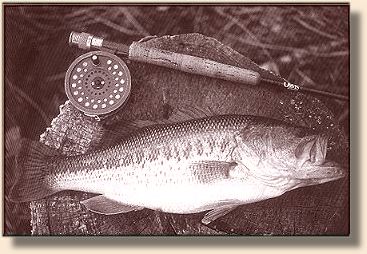
Many books have been written on the subject of bass
and there are probably a dozen magazines that are
written specifically for bass fishing. Television
shows and numerous regional, national and international
tournaments have been based on bass fishing. I think
more money has been spent designing and marketing boats,
rods, reels, tackle and baits for this family of fish
than the rest combined. So what is so special about
this species of fish that attracts so much hoopla?
That’s an easy question to answer, as far as I’m concerned:
1.) There’s an extremely wide territory that the
species can be found. Literally, bass can be found coast
to coast from Canada through South America.
2.) It has a very wide range of conditions that
it has adapted to live in, from muddy swamps, farm ponds
and lakes to clear, pristine, fast moving rivers.
3.) There are a large number of subspecies, large
mouth, small mouth, rock, white, striper, wiper (hybrids),
peacock, and sea bass.
4.) Finally, and in my opinion, probably the most
important, they are easy to catch at almost any time
of the day and all year long.
Bass are generally territorial, aggressive fish. Many
times bass will strike a bait, regardless of the type,
merely because it’s in its territory, not necessarily
because it’s hungry. That’s what makes it easy. Bass
also relate primarily to structure of some sort, fallen
trees, logs, rocks, reefs, sand bars, weed beds, docks,
etc. Find the structure and you’ll find the fish. Find
the fish; toss a fly into its territory, and it’ll strike.
It’s really pretty simple.
One real variable I’ve found to catching bass is the
weather, especially large, windy storms with a lot
of lightening and thunder or an extreme cold front.
In a case like this the fish normally will go to the
deeper areas of the water for a day or two then resume
its normal feeding and territorial patterns. The spring
spawn is one other variable. The bass will leave its
normal haunts and head for the spawning grounds, they
become extremely aggressive at this time. One important
factor here is that it’s the males who build the nest,
take care of the eggs and protect the new hatchings
(for up to a month) after the eggs hatch. If you are
fishing a spawning bed please be sure and release the
fish as safely and quickly as possible so that they
can get back to their beds and take care of business.
Ok, what to use for fly fishing for bass. In this
part of the country, the upper Midwest, the white,
stripers and hybrid wipers tend to run in large
schools which many times can be seen “finning” (the
dorsal fins actually extend out of the water) at the
surface of the water. When they’re in large schools,
feeding on bait fish, toss them a streamer (match
the hatch). I have lost track of the number of whites
and stripers I’ve caught on a Clouser or Muddler tied
with a medium to light brown top, a dark brown middle
and a white bottom. I tie these from size #6 to #1 and
use very little weight or a very slow sink tip line.
Mend the line erratically during the retrieval so it
looks like an injured bait fish, wait for the hit and
hold on. I’ve followed a feeding school around for
several hours at different times, catching as many
as 30 fish in a couple of hours. Unlike other species
of bass, fighting and making a disturbance in the middle
of a feeding frenzy doesn’t seem to disturb the school
in the least. We’ve been able to float up to within 15
to 20 feet of the school without bothering them. It’s
a real ego booster after a dry spell to get into these
fish.
The black bass, large mouth, small mouth and rock bass
are more prone to be found one or two per location.
Other than during spawning, I’ve never run into a
school of them. In my humble opinion though, pound
for pound, the small mouth bass is one of the best
fighting fish there is, not to mention, pretty good
table fare. I usually start out fishing with poppers,
from about — inch to — inch in size. My favorites have
either legs or whiskers made from “living rubber” and
a marabou feather tail. The color is dependent on the
weather and the time of year. Again, on overcast days
I use a darker colored popper, bright sunny days, and
a lighter colored popper. The other thing to keep in
mind is the time of year. Around here frogs don’t start
appearing until late April or early May so using a frog
colored popper in early March probably won’t work too
well. Another favorite is the streamer, a Clouser, Spruce,
or Silver will all work well. 3 to 4 inch bunny tails and
marabou leaches also work very well when mended erratically
along the structure cover. One of the best flies I use is
the crawdad (or crayfish) tied on a # 8 to # 4 hook. These
flies work especially well along a rocky shoreline or a
midstream or lake drop off. The best tip I can give you
on using a crayfish fly is to remember how a crayfish swims;
in a rhythmic, slow, up and down motion.
Other top water flies that work well on bass are hoppers,
crickets, and ants. For deep running flies try a large
hellgrammite or stonefly. That’s probably what I like
best about bass, they’re not real fussy. When I’ve
cleaned bass I’m always surprised to see what’s in
their stomachs. There’s usually a little bit of
everything that’s in the local water, crayfish,
minnows, frogs, insects. In one I found an entire
spinner rig, complete with plastic worm!
Another great thing about bass is that you can catch
them from shore, in a float tube or from a boat. They’re
usually found fairly close to the shore line where the
sides are rocky and the bottom drops down fairly quickly.
But other times along the sides of an eddy formed by a
rock midstream or next to stumps or downed logs and
along the edges of weedbeds. They like to ambush their
prey, streaking out from their hiding place, grabbing
it and heading back for cover. If you get a hit, but
miss the hook set, keep trying the same area for a while,
many times you’ll irritate the fish into another hit.
If you’ve ever been using a popper or other top water
fly and had a small mouth come crashing through the
surface and engulf your fly you’ll never forget that
adrenaline rush of the explosive power of this fish.
If you’ve never fished for bass on a fly rod you’re
really missing some major action! So tie something
on and give it a try, you won’t be disappointed.
fritzfratz@earthlink.net.
~ Fritz Fratz
Originally published c. September 29, 2009 on Fly Anglers Online by Fritz Fratz.
Part 3
Perch and Walleye
Perch and walleye go together like bread and butter.
Usually if you find one the other one is somewhere
close by. A lot of studies have been done and it’s
been found that the main diet of the walleye is perch.
I’ve also read many times that walleyes are the
laziest fish that swim, meaning they nearly never
move too far from their food source. I’ll attest
to this also, having caught many of each specie
while fishing for the other. Now there is a huge
fallacy out there that says that walleyes and perch
are deep water fish. I’m here to tell you, “I ain’t
so!” Yes, you can catch walleyes in 30 to 60 feet of
water at times, but having lived on a river that doesn’t
have a depth greater than 12 feet and fishing in the
local lakes where the water never gets deeper than 25
feet and having caught a lot of both perch and walleyes
in both situations it kind of debunks that whole line of
thinking. About the only thing I will say is that both
species do live and feed near the bottom of the water
so you do need to get down to them, regardless if it’s
4 feet deep or 20 feet deep.
To me, a stringer full of perch is one of the tastiest
suppers you can put on a table. Especially when they’re
rolled in a good Cajun seasoned batch of cracker meal
and deep fried! Catching them is the tricky part because
they they’re either feeding or not. Which means you’ll
either catch a lot or none.
No, I can’t tell the magic
formula for when they are or aren’t. I watch the seagulls
here at the lake. When I see them flock to a spot it
usually means they’re feeding on bait fish, which is
what perch feed on also. They are also very fond of
“wigglers,” which is angler talk for maggots of the
golden fly. Don’t ask, because I can’t tell you. It’s
like how many earthworms do you see swimming in the water?
Another important factor to remember is that perch swim
in huge schools, numbering from hundreds to thousands.
I’ve seen 40+ boats in an area and it looks like a “wave”
at a football game. As the school of perch comes under the
boats on the outside the rods start jerking, as it gets
farther into the circle boats, more rods start jerking.
Pretty soon the guys on the outside slow down and then
stop as the last of the school passes under them. About
15 to 20 minutes later the whole thing repeats. The perch
seem to circle swarms of bait fish and feed on them; it’s
like a slow motion whirl wind.
So, what type of line and flies do you use to catch
these delicacies? Obviously, you need a fairly fast
sinking line. Along with that, small, light colored,
weighted nymphs or small, # 8 to #12 Clouser minnows
or streamers in the color of the local bait fish. I’ve
had very good luck using gold, bead headed nymph, a
fly called a “Near Enough” tied using additional weight
and some of the lighter colored caddis flies, tan shrimp
and Cream Nymphs. The bite of the perch is also very
tricky. It’s one of the lightest of any fish I’ve found.
There’s really a fine line between a natural looking
free fall of the fly and keeping enough tension to feel
the bite. Keep at it and you’ll find that point.
As I said earlier, walleyes and perch usually go hand
in hand. Usually hanging around the outsides of the
schools you’ll find the walleyes, picking up perch
that stray to far from the school. But catching walleye
is a completely different game! For one thing, walleye
have teeth. Very sharp teeth and their gill covers are
also sharp enough to cut your fingers, not to mention
your line. Many times I’ve been perch fishing only to
get a tremendous hit on the fly followed by the line
going limp. When I pulled the line in it was cut off
as clean as if I’d used a knife on it! Another thing
to keep in mind is that when your fishing for perch
you need very light tackle, like a 2wt. to 4wt. rod
with very light line and a fairly long tippet. On the
other hand, for walleyes you really need something a
lot heavier, say a 6wt. to 9 wt. rod, heavy leader and
tippets made from a braided or Kevlar line or steel.
Personally, I prefer the Kevlar, but that’s just my
preference. Others will argue other lines or combinations.
When it comes to flies, walleyes seem to like them
bright, colorful and large. Yes, they also like them
to look like their favorite food, perch, but I’ve
caught many on what would normally be considered
salt water flies. Deceivers, dressed to look like
blue gills, very large (I’m talking 0/1 down to #2)
Clouser “minnows” dressed in the normal bass colors
but also in white with yellows, orange or chartreuse.
They also like large marabou and bunny leeches. You
can increase your catch chances by adding a “stinger”
hook onto the main hook, using a steel leader.
When casting, be sure to allow enough time for the fly
to sink to or near the bottom. Then slowly mend or reel
the line in. When a walleye hits it usually feels like
light tapping feeling on the line. When you feel the tap,
lower the rod tip, wait a second or two until you either
feel the tap again or the line tighten, then set the hook,
hard! You’re going to want to get this fish on the reel
as quickly as possible, trying to fight a walleye by hand
with your line will usually wind up with the fish getting
away and you getting burned by your line. Play the fish
using your reel drag or by palming the reel, keep the
rod tip up and the pressure constant. If the walleye
wants to run, let it run then reel back in. If you allow
too much slack it will usually shake the fly and you’ll
lose the fish. I’ve had many of them run me into the
backing before I could get them turned around. Once
you get into a walleye you’re hooked on big game fish
like northern pike and muskies. On a fly rod it’s like
you’ve just hooked onto a freight train. Just hold on
and enjoy the ride! fritzfratz@earthlink.net.
~ Fritz Fratz
Originally published c. September 26, 2009 on Fly Anglers Online by Fritz Fratz.
Part 4
Northern Pike and Muskellunge
Most fly anglers who go after northern and muskies
on purpose are usually in a whole different class
than the rest of those in Pan Fishing. Most do it
for the sport, catching and releasing nearly all
of their catches. Most use heavy rods and lines,
usually in the 9 or 10 wt. category and, if they
use tippets at all, they’re usually of the steel
variety. If you’ve ever been fresh water fishing
for bass or crappie, had one mean hit and felt your
line go limp, reeled it in only to find the line
sheared off by something that resembles a knife you
can probably assume it was done by a northern or
musky. These fish are notorious for their sharp
teeth and gill plates and can cut through monofilament
line like a warm knife through butter! On the other
hand, if you’re geared up for them and trying to
catch them and have the skill and luck to lay into
one be prepared for something like hooking onto a
freight train once you set the hook. I’m talking
about screaming reels and Nantucket Sleigh Rides!
I’ve personally watched large northern come up behind
a hen duck swimming with her young hatchlings and pick
them off, one by one, from the row behind her. You
also hear a lot of stories about Muskies being “the
fish of a thousand casts.” So what do you use for
equipment and flies and where do you find these
“freshwater barracuda?”
For rods, the smallest I’d recommend is an 8 wt., medium
fast to fast, at least 9 feet long with a fighting butt
for leverage. You can also go with the traditional Spey,
or two handed rod, in the 12 to 14 foot range. The rod
should be equipped with a large arbor reel, about 150
to 175 feet of heavy backing material, a good quality
fly line, followed by an 8 to 12 foot leader made of
something in the 30 to 40 pound test category. I prefer
the Kevlar or braided lines over monofilament because
they have a smaller diameter per line test and are harder
for a northern or musky to cut though.
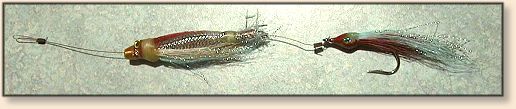
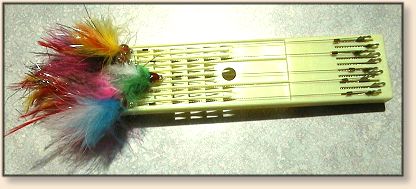
One tip I’ll pass on, and some will argue about it, is
I make a loop connector at the end of the leader. I do
this because I pre-rig all of my northern and musky flies
with a 12 inch steel leader that is crimped onto the hook
and has a loop crimped on the other end. I then keep the
flies on a stretcher board to keep the lines straight and
untangled. When I want to change flies I pick one off the
stretcher, make a loop to loop connection and I’m back
fishing within seconds. Plus, the stretcher board is
great for drying the wet flies that I’m done with.
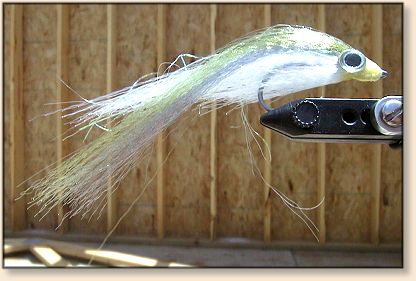
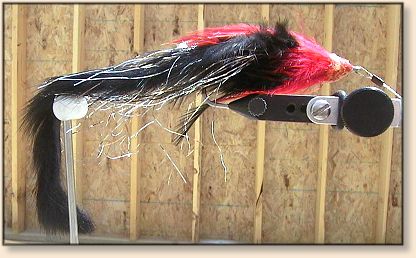
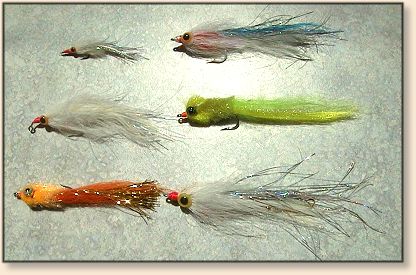
What type of flies, what sizes and colors do I recommend?
In a word, BIG! Neither of these fish seems to waste time
or energy on snack food. I’m sure that most of you have
heard stories (or experienced it first hand) about someone
pulling in a fish and having the whole thing swallowed by
a northern or musky while they were reeling it in. My
smallest fly hook for a northern or musky is size 0/1,
nickel or chrome plated. I go up as far as size 0/4. Most
of the flies are 5 to 9 inches in length and some have a
smaller, “stinger” hook in them (I prefer catching to
fishing). Most of the flies I build are larger variations
of streamers, others smack of salt water. I’ve caught both
species on “traditional” looking flies which mimic local
bait fish and I’ve caught them on orange/chartreuse/blue
color combination Clouser’s. The only thing in common is
that they all have heavily epoxied heads. If you want to
use a fly more than once on northern or musky then you
have to apply epoxy at least down past the threads. Even
then, many times the fly will be torn up so badly that
it’s not repairable.
How and where do you find and fish for northern and musky?
They range over most of North America and nearly coast to
coast. They live in everything from small streams to large
lakes and both stained and clear water. During the heat of
the day they generally can be found along shady outcroppings
or weed beds. Pure muskies have a smaller range usually
from about the Mason Dixon line to the southern 200 miles
of Canada. Some newer hybrids, like the Tiger Musky, can
live in warmer water and smaller lakes and ponds but don’t
get nearly as large as the traditional muskies. I’ve caught
most of mine early in the morning or in the evening, when
they come out of deeper, nearby water to feed in the
shallows. That’s not to say that neither of these species
can be caught during the day, they feed when they’re hungry
and they feed on what’s available! I’ve also caught these
predators at high noon, along a shoreline, when it was 90
degrees in the middle of August so don’t feel you have to
wait for the perfect time of day or weather. The things
that seem to be common in nearly all the northern and muskies
I’ve caught is that they were in water less than 8 feet deep
and most hit either a surface or floating fly or one that was
less than a foot under water.
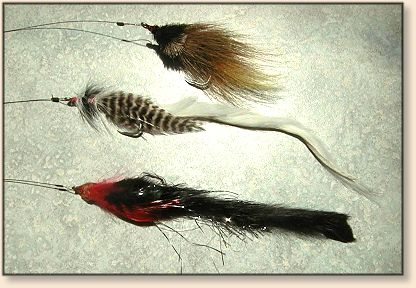
The last bit of advice I’ll give you is not to put your
hand anywhere near the mouth of these critters. Use a
long hemostat or long-nosed pliers to remove the hooks
and a sturdy landing net to control them. They’ve been
known to reduce fingers and hands to something that
resembles hamburger in a matter of seconds. Now go
have fun and be sure to play nice!
fritzfratz@earthlink.net.
~ Fritz Fratz
Originally published c. September 23, 2009 on Fly Anglers Online by Fritz Fratz.