My Thoughts on the Swiss Master Vise by Marc Petijean

A month or two ago, I bought the heavy pedestal model of Marc Petijean’s Swiss Master Vise. There were a few here who indicated an interest in hearing about how it functions.

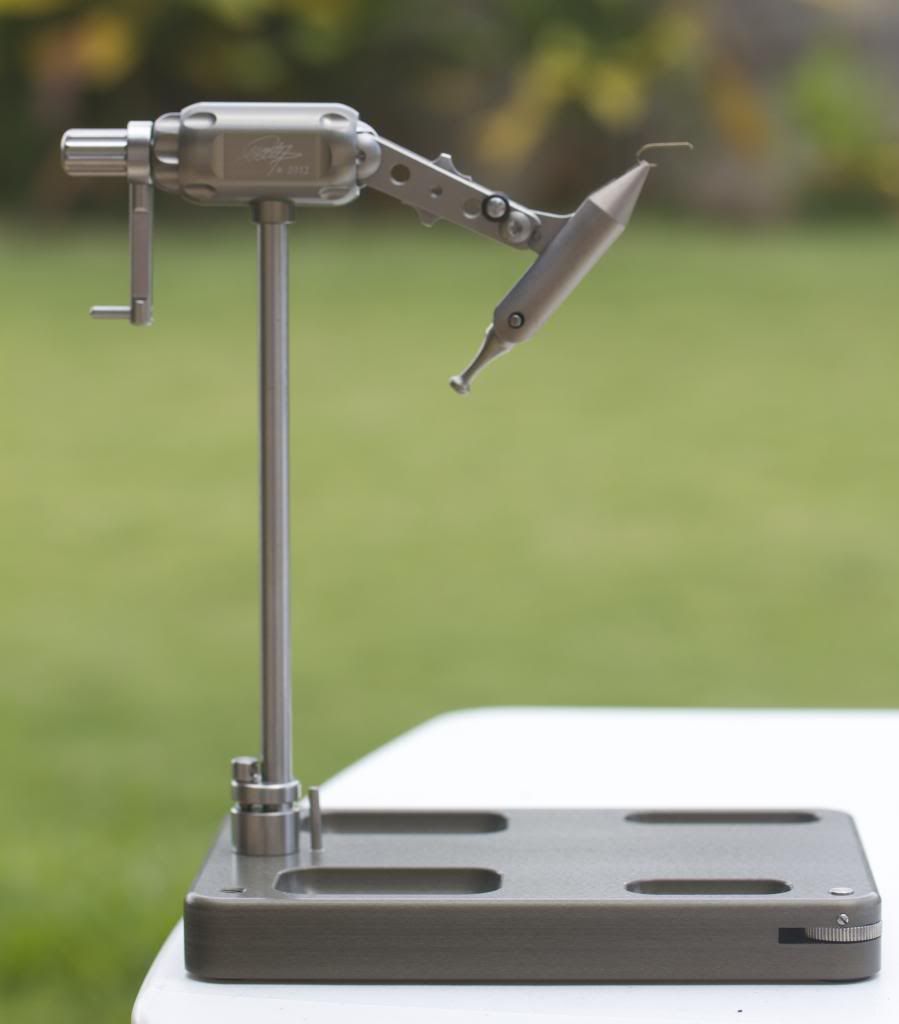
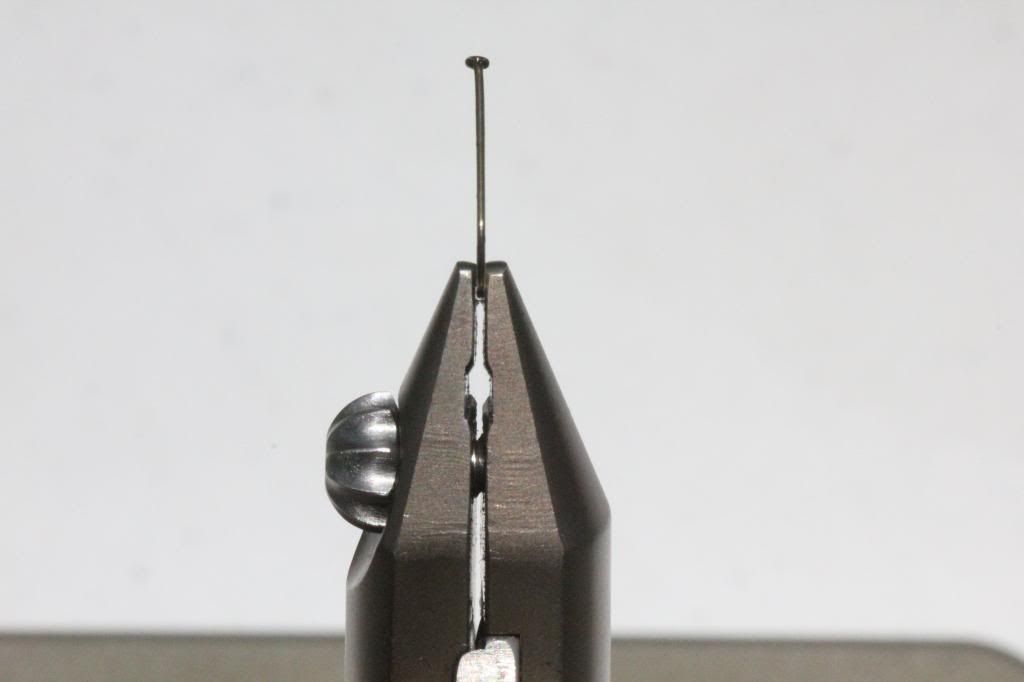
Here is the vise with a size #12 hook in the jaws.

[
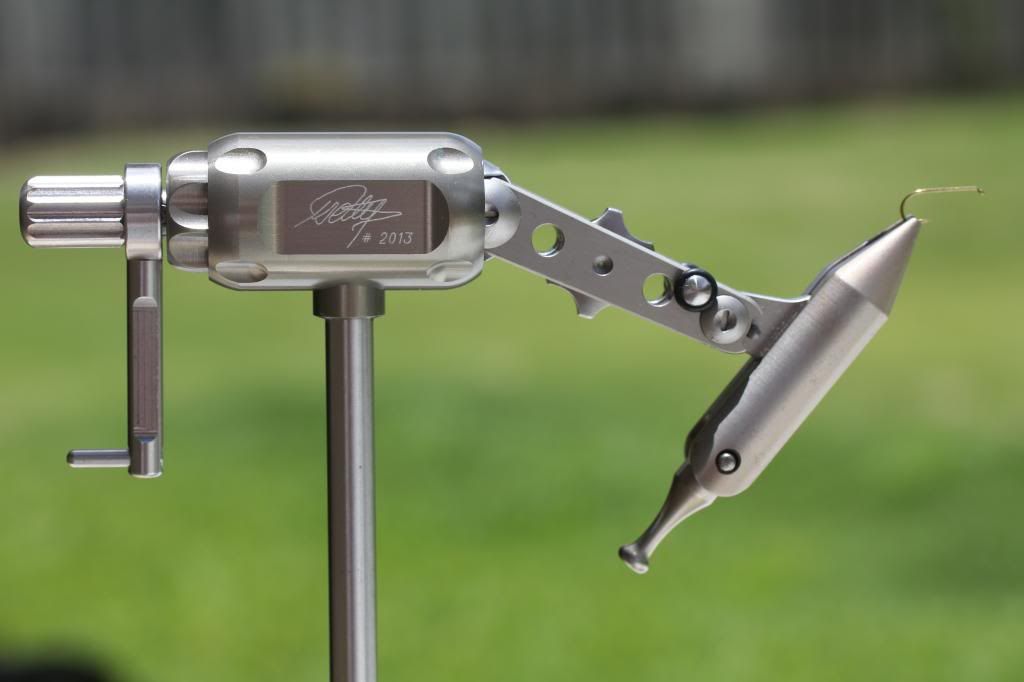
A](http://s1101.photobucket.com/user/byhaugh/media/IMG_5827_zpsce4dd9f7.jpg.html) closer look at the business end of the vise.
The little black washers (on either side of the vise arms) serve as material clips.

[
T](http://s1101.photobucket.com/user/byhaugh/media/IMG_5828_zpsf0bf5c7f.jpg.html)he vise comes in a zippered carrying case. The contents:
The weighted base…nice and heavy. It will remain steady during tying
The vise stem and vise head
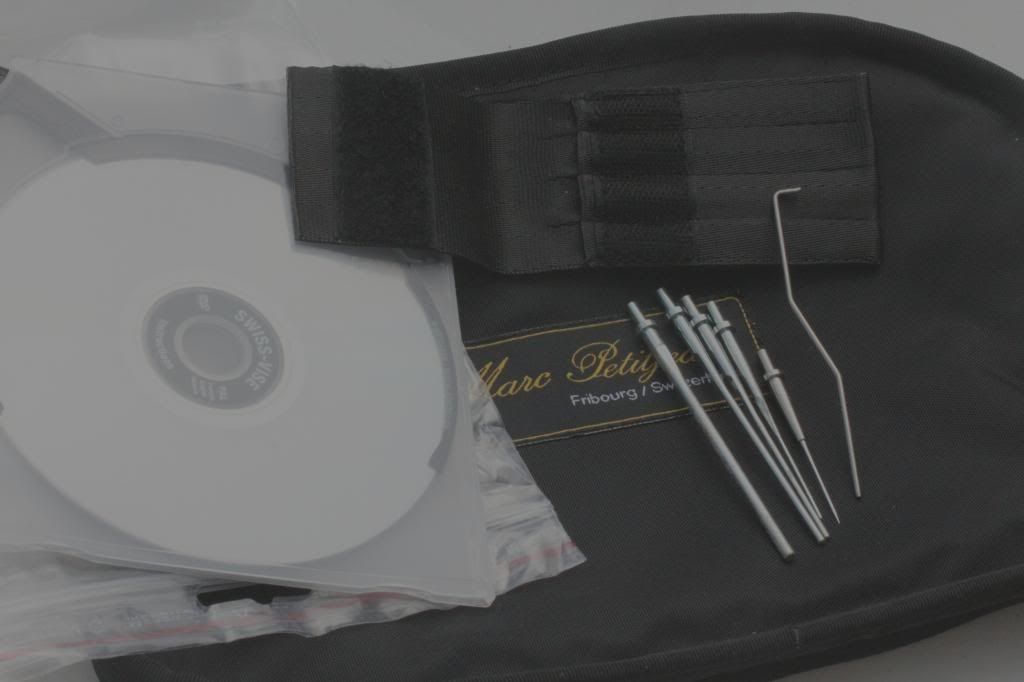
A separate velcro case containing 5 tube mandrels for tube flies and an alignment tool
Written instructions of use as well as a DVD for viewing the instructions

[

T](http://s1101.photobucket.com/user/byhaugh/media/IMG_5814_zps88ae9d5e.jpg.html)he vise is designed to hold hooks from size 9/0 to #32

There is a groove in the jaws for the larger hooks

From directly above the jaws with the #12 hook in the jaws

[
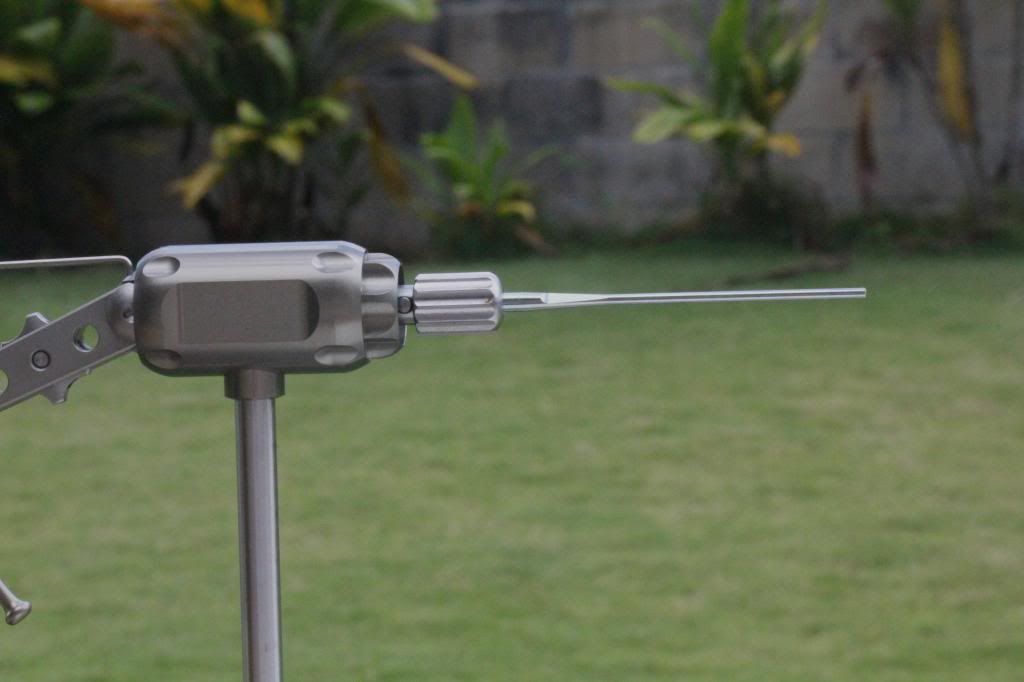
T](http://s1101.photobucket.com/user/byhaugh/media/IMG_5829_zpsde8fe4c7.jpg.html)he vise is an off-set true rotary vise. It is buttery smooth with ball bearings in the jaw housing as opposed to a plastic sleeve as is the case in many popular vises.

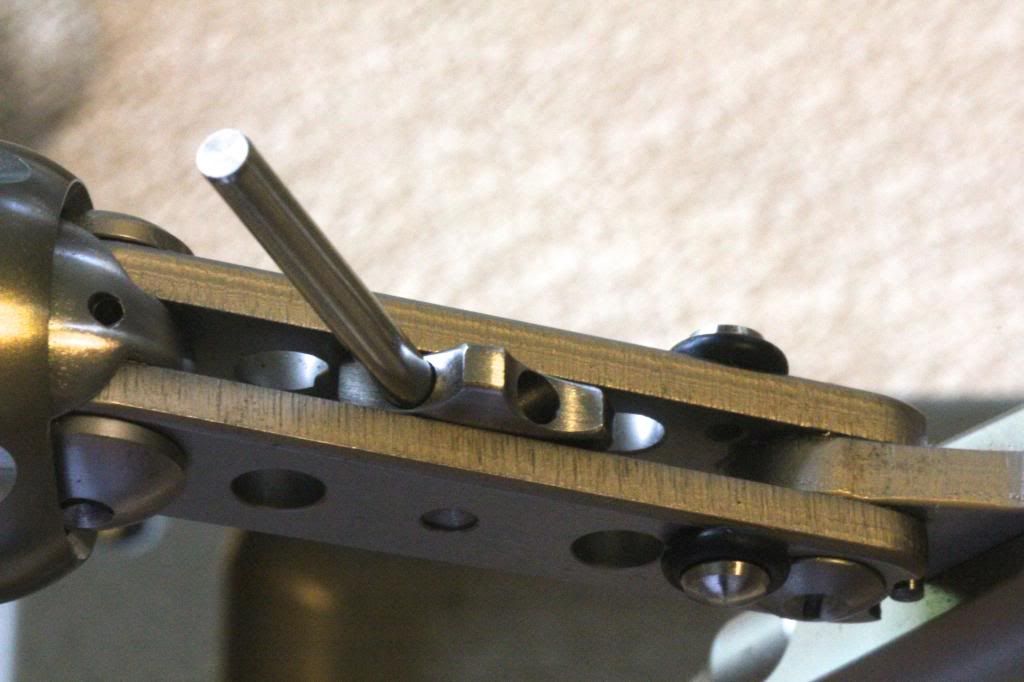
True rotary is achieved by adjusting either, or both, of the two pivot points. One is locoed just outside the jaw housing and the other at the bend below the location of the jaws themselves.

This picture shows the vise with the supplied alignment tool in place. The two pivot points are those with the rounded nut “heads” shown. The tension star wheel is the locking mechanism to “lock” the jaws in the position you have chosen. This locking star wheel locks both pivot points by tightening it. There is a small “tool” which can be used to apply extra force to provide an actual “lock” on both pivot points.

[

T](http://s1101.photobucket.com/user/byhaugh/media/IMG_5824_zps801b0386.jpg.html)o use the tube fly mandrels, you simply reverse the vise in the base, remove the crank handle and replace it with one of the 5 supplied mandrels. You can use the vise jaws as the handle to rotate the mandrel.

[
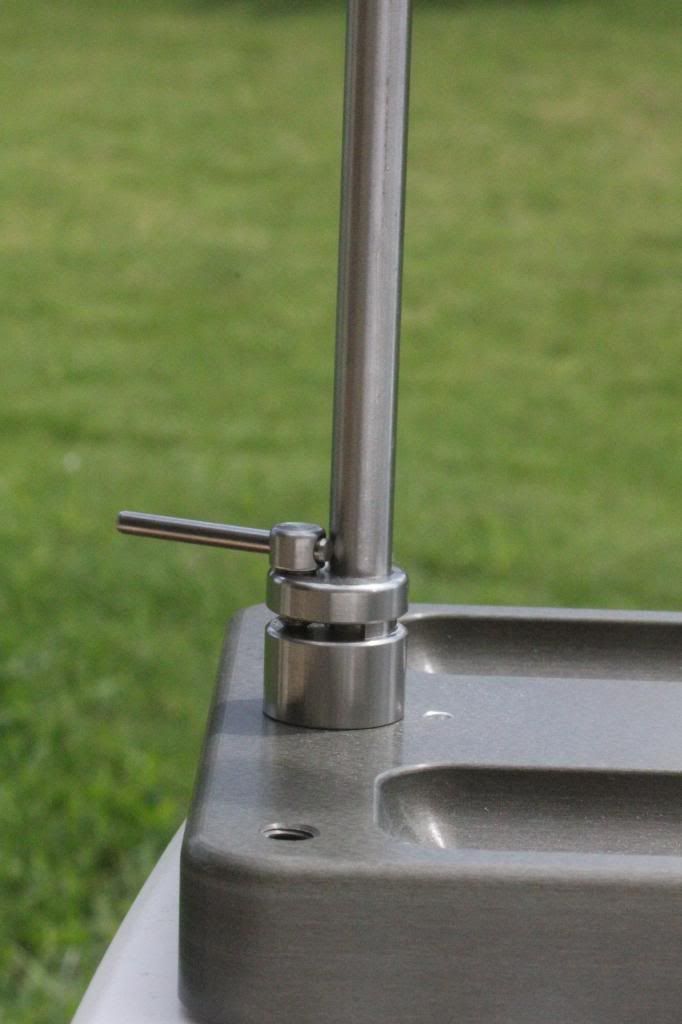
T](http://s1101.photobucket.com/user/byhaugh/media/IMG_5820_zps16d10dc9.jpg.html)he stem of the vise locks into the weighted base using the same little tool to turn the locking device at the base. The base has several “ports” or built-in pockets to hold beads or hooks while you are tying.

[
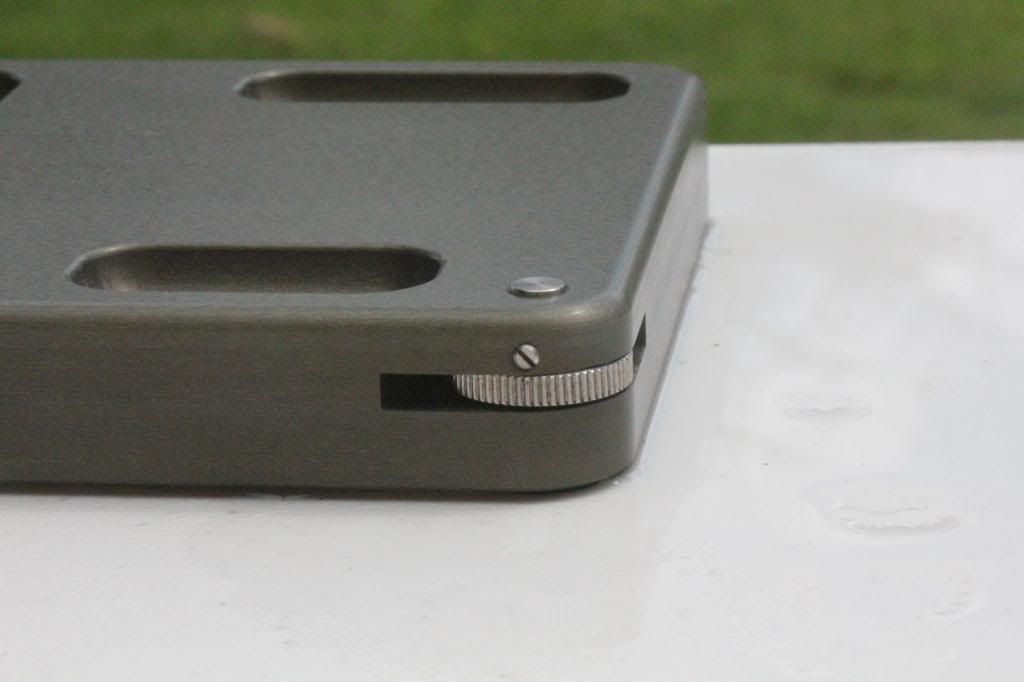
A](http://s1101.photobucket.com/user/byhaugh/media/IMG_5819_zps2ced650e.jpg.html)n interesting feature of the base of the vise is a thumb wheel leveling devise at one corner of the vise in case the tying table you might be using is not level itself.

[
M](http://s1101.photobucket.com/user/byhaugh/media/IMG_5817_zps5179579c.jpg.html)y personal conclusions on the vise:

This is a quality made vise. Like a Swiss Watch, it is very well made and a beautifully finished fly tying tool. It reflects a great deal of thinning on the part of the designer Marc Petijean.
The jaws are positive locking jaws. One nice feature is that the jaws are spring loaded. To open the jaws, you squeeze the rear of the jaws to open the points of the jaws. This allows you to make sure you have your hook positioned properly before locking the jaws with the locking lever. If your hook is not quite aligned correctly, you simply squeeze the rear of the jaws and the hook is released for repositioning. The same applies after tying a fly. After unlocking the jaws, the fly remains in the jaws until you squeeze the back of the jaws.

The vise comes with tube fly tying mandrels. Oddly, it does not come with a bobbin cradle. This is a separate accessory which must be purchased. I am sure it is done to keep the base price of the vise down, but it is odd not to have one in the package.

Speaking o accessories, there are two threaded holes in the weighted base to accept accessories such as tying light assembly, etc.

Overall, I think this is a wonderful vise. It is truly “buttery smooth” in operation. If I were to change anything about the vise, I would have made the entire vise 5-10% larger, overall.

One note for honesty:

When the vise arrived, I was not able to completely “lock” the two pivot points in the jaw arms. I spoke to someone I know who owns one. He did not have the problem and I was operating the vise correctly. So, I contacted Petijean. Petijean had me return the vise to him. He/they verified the vise with my serial number had missed one quality control step.

He returned the vise very quickly and it functions perfectly. He also included $50 cash (to cover the postage for my having sent the vise back) with a note from Marc Petijean himself.

Thank you Byron, Good information, well worth considering for anyone looking for a quality vice.

Could I be cheeky and ask for a further piece of information? I am quite particular in the setting of rotary tension (the adjustment of how heavy it is to turn the vice head). On many vices this is achieved by a screw acting directly on the shaft. To me this is not a good design, as the total adjustment from off to solid is covered in 1/4 turn of the screw or less. Could you tell us how much he adjustment knob turns between locking the head, and it falling under its own weight please?

Thanks, great review,
A.

AlanB,

Thank you.

The tightening knob/nut is just to the right of the crank handle shown below. It only takes a quarter turn or more to tighten. The knob will not “lock” the jaws as some vises do. It tightens the rotary function plenty to maintain position while tying, but does not lock it completely - just provides enough tension that the jaws won’t rotate during tying.

Good question…As comparison, my Jvice will positively lock the rotation. I do not believe, however, that the Jvice shaft is in a ball bearing housing. Not positive about that, but believe that is the case.

Thank You Byron for the well written and complete evaluation of the Pettijean vise, It is not one which I will ever own in this lifetime but when I reach my magnificent tying bench up in the sky, I will have one and will crank out very beautiful flies that will always catch heavenly fish. I am going to save your report on a zip drive so I can continue to see it, wish and dream about what it would be like to tie flies on such a beautiful instrument.
Regards,
Gerri

Great review, Byron. Is there any difference in the actual vise functions for tying between the various models? I hope you understand what I mean by that.

Joe

Joe,
I assume you mean between what I call the “erector set” Swiss Master and this one? The “erector set” version is the one which has a C-Clamp configuration which can be re-configured to become a desk-top base.

The vise head is the same on both models. So, I don’t think there would be any difference there except that I don’t think the “erector set” version as a table top base would be as stable as the weighted base version.

There is also a version called the “Premier”. It is a scaled down version from this one. No knowledge on its performance.

Geri,
Thanks. What do you currently tie with?

Nice vise.

Hi Byron,
I currently tie on a Renzetti presentation 2200. I have had it since the 1993-4 and it has served me well. I am not a professional tyer but I am the family tyer. I enjoy tying, the artsy aspect of it, the pride in the end results and I tie regularly mostly trout, warmwater flies and some saltwater for our son who lives in Fla. I keep thinking of Jimmy Carter and how he was “lusting in his heart” for some actress. I guess I fall into the category of a weirdo who lusts after a Swiss made vise! It is beautiful!
Gerri

Geri,
Thanks.
I have a 3000 and like it a lot.
Renzetti makes good vises.
I agree with you. A vise does not make a tier, but a nice vise seems to add to the enjoyment of tying…don’t you think?

Very true as is ‘a comfortable vise’ (and I know that’s an individual thing).

Invariably, when you attend one of the many shows, you see tiers using top end vices. One of the main reasons for this is their commitment. Anyone who learns to tie a few flies has started to develop the skills of fly tying. The major difference between the beginner and an accomplished tier is the commitment they have to developing their tying skills. One manifestation of this commitment is seeking out better equipment.

The chairman of one fly fishing club would tell me “You don’t need an expensive vice to be a good tier”. This went on for months at the weekly meeting, when he would point out that his vice, bought in the 1950s, cost less than 3 pounds. When I pointed out that a weeks wage for him in the 1950s was less than 3 pounds, and that my so called expensive vice cost less than 2/3 s of his current weekly wage, he stopped. As the functions of today’s vices are more advanced than those of 50 or 60 years ago I would argue that, relative to income, vices have never been cheaper.

Cheers,
A.

AlanB,
Lot of truth in what you say, I think.
Just as an example, if one were a smoker today, that would cost as much as $3,000 a year. To fill my car, it costs about $60.

I personally tie each day, and have done so for about 40 years. And, I obviously have a big weakness for tying tools -
particularly vises.

In the last 10-15 years, there have been some really neat vises on the market!

Defeated the same problem by punching (leather punch) a nylon/polypropylene plug of a diameter near to the tapped hole’s diameter and placing a small stout spring (that also fits into the hole) over the plug and beneath the screw so the spring compresses before dead tight happens. You may have to cut a few coils off the spring or even give it a stretch to adjust the strength. If the nylon is too slick, a plug of leather gives a little more friction. Smoooth revolutions with no ‘sticky’ spots. Hope that is all more clear than mud.