Kind of late to the party on this one, Byron. But most of the naturals that I’ve been able to examine do exhibit a decided taper with the rear of the abdomen being wider than the front. I started tying my biot bodied caddis patterns tying in the butt ( rather than the tip ) of the biot at the bend to get that “forward taper” a number of years ago.
John, I take it you’re speaking of emergers? Don’t think anyone would disagree with that. It is the adult where I see the mayfly taper being used.
Even in Weilemann’s widely popular CDC & Elk, the very nature of tying the tips of the feather in at the rear and then wrapping forward naturally produces a taper larger at the thorax than the butt.
I’m talking about adult / dry fly caddis patterns. Somewhere back in the FOTW archives you’ll find a Harrop’s Henry’s Fork Caddis, which was my most productive caddis pattern for quite a while, which shows tying the biot in by its butt at the bend to achieve the forward taper ( what PT refers to as a “reverse taper” ).
John
P.S. Here is a pic I took last week. Not great, but it does kind of show the taper of the abdomen wider at the rear and narrower at the front.
I never seem to hold a caddis for a pic of the trout’s view in such a way that the proportion of body to wing is clearly shown. I catch them by the ends of the wings and don’t think to reposition them by grasping them along the top of the body before doing the pixel thing.
I think you are right that the wings on the naturals are typically “longer than most flies tied.” But I also think most adult caddis on the water do not have their wings “at rest” and the shorter wings on flies represent fluttering or moving wings that definitely appear shorter than the wings at rest. That could also be true for emergers and cripples where the wings are not fully developed or extended.
On spent caddis patterns, I think longer wings are a good idea. The Harrop’s Henry’s Fork Caddis is a good spent caddis pattern and I tie it with a very long wing for that reason. That pattern rides very low, and triples up as an emerger and cripple as well as a spent adult, and, quadruples up, perhaps, as an ovipositing adult ?? Whatever — it is a very effective pattern.
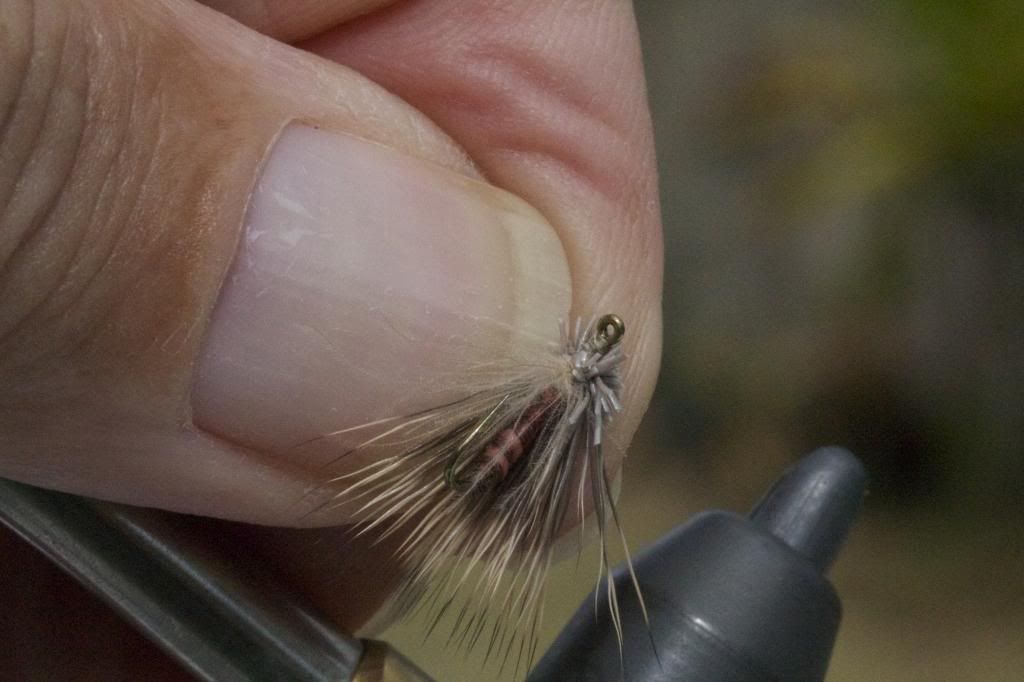
Tied this one up with a smooth biot body and used CDC for legs. Has a reverse tapered smooth (yet segment looking) body.
Not the best photo as is hard to show the bottom of the fly in a vise.
Anxious to try this one out.
I think the caddis fly fell out of favour somehow, and has come back. I see in Theakson’s 1888 book (where he calls them Duns - Theakston had his own convention for naming different insects, spnners, to him, are diptera to us, and our mayfly is his drake. He felt calling a “drake” a “dun” then a “spinner” was to misidentify it, despite the fact anglers had been doing this for centuries) Anyway, here’s the first part of his description:
“They have two long feelers, small heads, short necks, and small jumped up shoulders ; their bodies consist of eight or nine joints, are rather longer than the head and shoulders, and a little thicker in the middle ; …”
I stopped at the end, as he meantions how the abdomen is shaped, though he suggests something more like a double taper I guess. Anyway, Theakston indicated that browns, drakes, and duns were the mainstay of trout food, though which predominates the diet will depend upon the stream. (Browns = stoneflies, drakes = mayflies; and duns = caddis, in his terminology).
And, many of the North Country Flies were meant to represent caddis as well (along with stoneflies and mayflies, etc). But, as others have mentioned, I recall books of the mid 1900s, and I think even late 60s maybe early 70s, tending to suggest that caddis were at best a casual aspect of the trout’s diet? Anyway, I’ve always been told to tie a reverse taper for “tent wings”. It may be that commercially tied flies don’t do this as it is more cost effective to tie all bodies the same basic way since there is less training involved.
Anyone know how to change the title of the post of a thread??? I would like to change this one to “Although I have always tied caddis adults in a reverse taper, so has the entire tying community”…