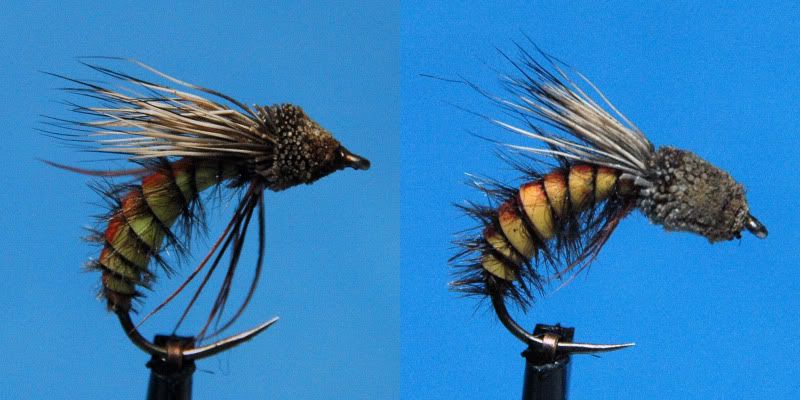
I realize there won’t be many, if any, who agree with me, but I believe this to be true.
When you look at patterns of caddis flies, you will note that most, if not all, are tied somewhat similar to a mayfly (body only). That is, there is a taper to a larger thorax.
In all the insects I have observed, it is pretty much the opposite. That is, the back end of the caddis body is larger than the thorax. So, that is the way I shape mine.
Now, one can say: “It doesn’t matter”. But, if it doesn’t matter, why tie them differently than the insect?
Perhaps I am wrong and have only looked at deformed caddis adults, but that has been my observation/belief.
The caddis flies that were tyed for Al Caucci’s shop had what we called a ‘reverse taper’. Larger at the bend and tapered down as you wrapped toward the thorax. I know that caddises with this body shape were sold in his shop prior to 1999.
The oversea tiers tie flies the way they are taught by US professional tiers who go there to teach them.
I can tell you with near certainty that most of the current “big name” tiers taper Caddis bodies to a fatter thorax.
Perhaps but nevertheless the observation is an old one. To add to the examples of already cited, Al Troth’s Elk Hair Caddis is described as having a “reverse taper” by most authors I’ve read. How commercial fly houses produce flies has more to do with catching fly fishers than accurate representations of naturals, but that also is not a new observation.
Sorry, guys, I didn’t mean to say that this is some sort of a “new observation” - in fact, I didn’t. I’ve been tying my way for many years. It is just that most of the caddis flies I see being tied on youtube, in shops, and in step by step presentations show the “mayfly taper” to the body…
Here’s an interesting video by Craig Mathews tying a Mothers’ Day Caddis sort of borrowed from Walt Weise (whom he credits). Towards the end of the video he says to tie in a “robust” thorax.
Byron, I must protest. Independant thought does exist outside the US!
As to your main point you are right. This is a pattern I developed for emerging caddis a couple of years back.
The taper is controled by adjusting the tension on the Nymph Skin while winding the body.
Cheers,
A.
This is interesting. Looking at the photos of many different types and stages of caddisflies on Troutnut, it appears that the thorax IS NOT overly large compared to the rest of the body. In fact, in the first photo (long bodied green caddis), the body enlarges as it approaches the head. Similar taper can be seen on some other caddisflies photographed. Which now leads me to question the shape of the caddisflies I’ve been tying these many years and WHY a ‘reverse taper’ came to be. I have 2 ideas on this:
When the caddisfly, in its larvae or pupa stage curls up, the body compresses and creates the enlargement toward the rear. Thus a reverse taper.
The body was tyed with a narrower thorax so that the wings or wing pad would be able to hug the body. If instead the thorax was large, the wings would be pushed out and that was undesireable.
Just 2 theories I came up with. What do you think?
My first post here, so hello to everyone. If my memory serves correct I think the reverse taper started with Leonard Wright. His caddis were tied with hackle wings and this allowed the wing to sit flat over the body. His book “Fishing the Dry Fly as a Living Insect” is truely a classic.
Gene
First - welcome aboard. Hope the conversations here keep you interested and you continue to participate.
Second - Good point about Len Wright. As I recall, caddis’ weren’t too highly thought about back then(50s & 60s) so your reasoning may very well be accurate. I don’t know to what extent the tyers across the pond fished caddisflies and I wonder, if they did fish them, the history there about tying the bodies?
Steven,
I see a smile. But, just wondering, was your comment meant as a slam given the slang meaning of a “lousy troll”? I certainly did not intend to post anything disruptive.
Thanks,
Byron
Allan,
You are certainly correct about caddis flies not being “popular” in the old days. I posted once about this and most current fishers had no idea that caddis flies were not widely used back in the quite old days. Yesterday, I was reading Preston Jennings’ book “A Book of Trout Flies”. In it, on pages 8/9, he says:
“The Caddis flies are not as important to the flyfisher as the Mayflies, as most of the Caddis flies emerger or hatch out just at dusk or after dark, when the light is usually so poor that it is difficult or impossible to see a dry-fly on the water.” “…both their creeper and pupal states furnish a great proportion of the trout’s diet, but as both of these forms are either crawling around on the bottom of the stream or else are firmly attached to a rock, an imitation of the Caddis worm or pupa is of little value to the fly-fisher”. Wowsa!!!
I figured you were looking (trolling) for a discussion on the merits. I’m totally up for that.
But it doesn’t really work if everybody agrees with you!