Here are some Killers that I’ve tied that you might find of interest. The bodies are pretty much always either yellow or red wool (traditionally yellow is for day, red for night), so I’ll just mention the tailing material and side feathers.
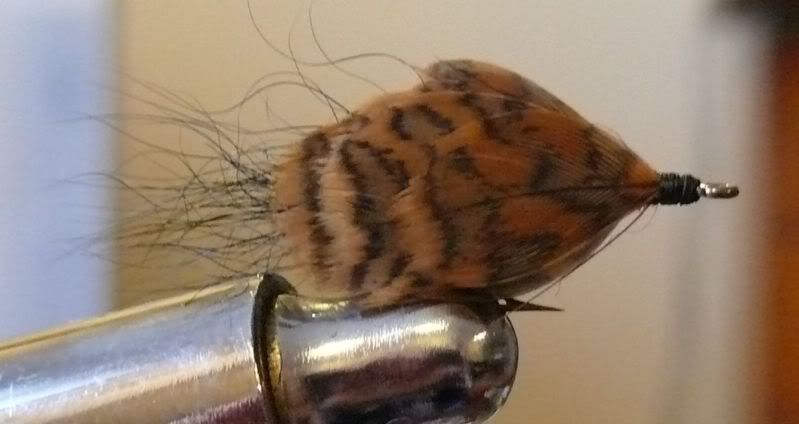
Lord’s Killer:
sides: woodcock
tail : black squirrel tail
This is a pain to tie. The side feathers are quite soft and it takes about four to six pairs to construct a fly. But, it is considered one of the best killer patterns out there.
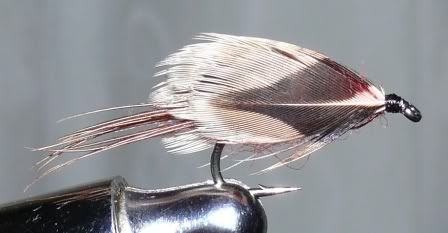
Leslie’s Lure:
You don’t see many of these for sale anymore, but I’ve had good luck with it.
Sides: hen pheasant
tail : pheasant tail fibres
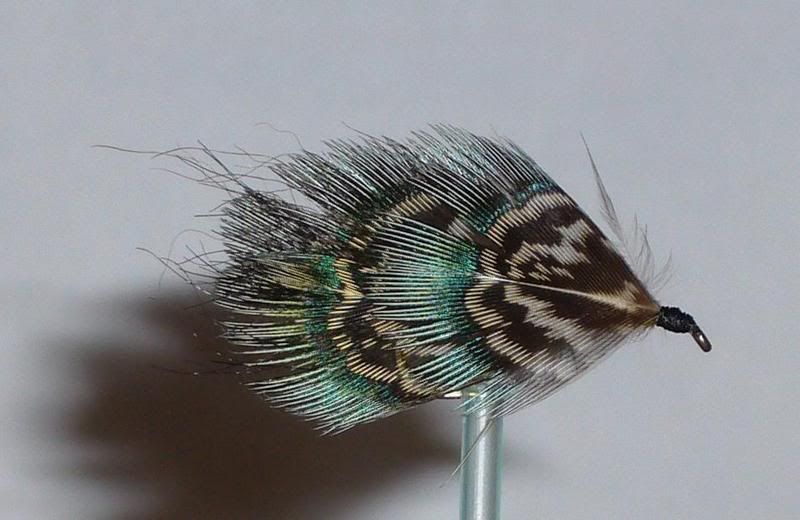
Mrs. Simpson:
Which we’re talking about
Sides : pheasant rump feathers
tail : black squirrel tail
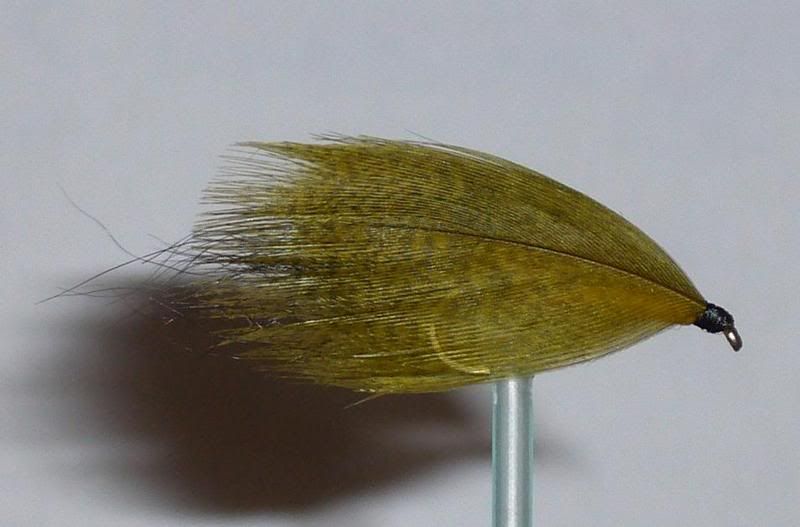
Hammil’s Killer:
This is another very popular pattern, especially where there are damsel nymphs around.
Sides: partridge dyed olive (or mallard dyed olive)
tail: black squirrel tail
Great flies Jeff. I am glad you posted those! I need some woodcock then…lol. I don’t have any. What part of the hen pheasant is that? I have some feathers that may work, will look at it. Mainly it is the style I am looking for. I only have hen pheasant tail. I do have Hungarian Partridge. Sharp tail grouse, and some other grouse that has no name on the package. I am going to play around with this. I noticed some flies have only one feather on each side, I’ve seen some with two pair, and then the 3 pair is common. I have not figured out if the Hamill Killer is a total of one pair, or two pairs to tie it though.
The Leslie gets the feathers from the wings of the hen pheasant. The number of pairs tied to each side sort of depends on the size of the hook. I tend to tie in the smaller sizes, so usually just use 2 pairs. The Hammil’s killer, because I’m using dyed mallard, just has the one tie in location, but there’s 2 feathers per side. The Leslie has 2 pairs as well, both tied in at the head, but on a larger hook you would tie them in staggered, as the Mrs Simpson. The 3 pair set up is more common on the largest sizes.
There are some patterns that use grouse (but I’ve forget what it’s called). Anyway, you can more or less use feathers from anthing on these.
Have fun with them. They can be finicky to get the feathers to sit right. The ideal is for the feathers to meet both top and bottom (like an almond). If you can get one to turn out well, they are very attractive.
Oh yah, just remembered, the yellowish/gold feathers on a ringneck pheasant (with the black tips) and black squirrel tail is a Dutchess.
Fantastic Jeff, I am thinking Hungarian Partridge may work too…hehehe. I am going to play around with this stuff, and see if I can have some cool variations as well. Thanks for that info once again, that was EXTREMELY HELPFUL. THANK YOU!
Hi,
I went through Keith Draper’s “New Zealand Trout Flies, Traditional and Modern” and pulled out all the killer patterns that I could find. There were only 15 listed, so this is an area where there’s lots of room for your own imagination. Anyway, since these are the patterns you’re most interested in I figured I would list them for you. Hook sizes generally listed as 2-8.
These should keep you busy!
Unless specified, the bodies on these are traditionally tied two ways, with either red or yellow wool with red for night, yellow for day. If the pattern specifies an alternative, I’ll list it specifically.
Killers
Black Phantom
Body: black wool with silver rib
Tail: Black Squirrel with optional red tag of wool underneath
Sides: black pukeko feathers (use magpie for sub)
Cheeks: jungle cock nails
2)Brown Killer
Tail: brown squirrel tail
Sides: dark chestnut feathers from the breast feathers of a shoveller drake (Mallard breast dyed deep brown as sub)
3)Brown Quail Lure
Tail: black squirrel
Sides: flank feathers from common brown quail
Dutchess
Tail: fibres from ring neck pheasant tail
Rib: silver tinsel
Sides: golden black-tipped feathers from ring-necked cock pheasant
Green Sleeves (developed separately from almost identical Hammil’s Killer)
Tail: black squirrel
Body: green wool
Sides: grey partridge dyed green
Hammil’s Killer (developed separately from almost identical Green Sleeves)
Tail:black squirrel topped with golden pheasant tippets
Body: red,yellow, or green wool
Sides: grey partridge dyed green (mallard dyed green often used as sub)
Kilwell No. 1 (sometimes erroneously called a Mrs. Simpson)
Tail: black squirrel
Sides: striped brown partridge (there’s a small patch of these on each side of a Hungarian partridge)
8.) Kilwell No. 2.
Tail: black squirrel
Sides: mottled grouse
Leslie’s Lure (also called Awahou)
Tail: pheasant tail fibres
Sides: hen pheasant breast feathers or small coverts from hen pheasant wings
Lord’s Killer
Tail: black squirrel
Sides woodcock, brown rather than buff
Mallard Lures
Tail: 2 versions A) black squirrel or B) grey cock hackles laid back to back
Body: red, green, or yellow
Sides: grey vermiculated feathers from breast or flank of mallard drake
Mallard Hen
Tail: two nicely matched grizzle hackles laid over two ginger hackles
Sides: well-mottled mallard hen breast
Mrs. Simpson
Tail: black squirrel
Sides: green/bronze rump feathers from ringed neck cock pheasant
Mrs. Simpson Kea
Tail: black squirrel with a topping from the red underwing feather of a kea
Sides: green kea plumage
Note: the kea is now protected, so I’m including this for historical reasons only
Spa Special
Tail: a bunch of fibres from a mottled grey secondary feather from a turkey’s wing
Body: yellow mohair
Rib: silver tinsel
Sides: grey partridge, two, one on top of the other, tied each side (so not staggard)
Wow Jeff, thank you!!! This is an awesome list to have. I just saved a copy of these. I appreciate the time you took to look that up, and post them here. I am thrilled with this info.
No problem kelkay. The differences between what I posted earlier and the above list reflects my poor memory. Note, none of them use fox squirrel tail! I was thinking of the double hackles, which is another NZ type of fly (i.e. Red Setter is the most well known; or look up my submission for the Fuzzy Wuzzy in the archives to see how they are made).
I saw black squirrel body, or black squirrel tails on several recipes. I don’t know what a kea is. I don’t imagine I will be using that. If we could get it, it is probably expensive. I am on a limited income, so I imagine I will be substituting where possible.
Yah, dyed black squirrel tail is the most common tailing material for the killers. However, hackle feathers are used in some patterns so you could always use black hackle feathers as a substitute and keep within traditional construction methods. The dark hairs from the racoon tail would work, or the black bear. Black bucktail could be used, and maraboo is always a good idea.
A kea is a New Zealand parrot, green in colour. You could try the green neck feathers from a cock ringed neck pheasant (the ones that would be tippets from a golden pheasant) as a kea has black edges on it’s feathers too. Speaking of which, I’ve tied a few killers using feathers from golden pheasants and they look good too.
Anyway, have fun with these. There aren’t a lot of patterns partly because they are finicky to tie, so they aren’t a commercially viable pattern for the professionals to tie. Home tiers would have their own secret weapons, so I’m sure you’ll come up with your own.
Well I made one on a size 4 hook this time. I used olive marker for the duck feathers. I used black bear for the tail as a substitute. Not great, but it’ll do. I also used H2O product cactus braid in med Electric Yellow for the body shank. I figured it would get the attention of a fish.
Looking in my other Keith Draper book, I see he lists one more killer pattern:
Orange Witch
tail: black squirrel
body: orange wool or cheneil
sides: striped flank feathers from a chuckor