Here’s my opinion on rod action, casting, and nymphing.
First of all loop size is not related to whether a rod is slow or fast. There is nothing inherent about a slow or fast rod that prevent a SLP (straight line path) of the rod tip. A rod bends when loaded and a slower rod bends more for a given load. That means the chord (effective rod length = distance from casting hand to rod tip) of the shortens and this shortening makes the softer rod more prone to tailing loops unless the acceleration is very smooth.
The fly line follows the rod tip. The rod tip follows the path of the hand except for one change. As we apply power to the rod, the rod flexes, and when it flexes, the effective rod length shortens so that the rod tip comes closer to the casting hand. See illustration below and note that as rod tip comes closer to the casting hand, the convex stroke path compensates for shortening of the chord.
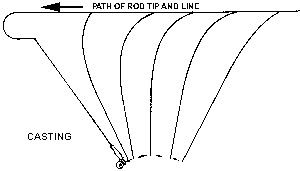
If we move our casting hand in a straight line rather than the convex path above, we are not compensating for the shortening of the rod tip. The rod tip will travel not in a straight path but in a concave path as it flexes and straightens during the straight line casting motion. This causes a tailing loop.
The video with the rod butt fixed shows that the shortening of the rod must cause a tailing loop.
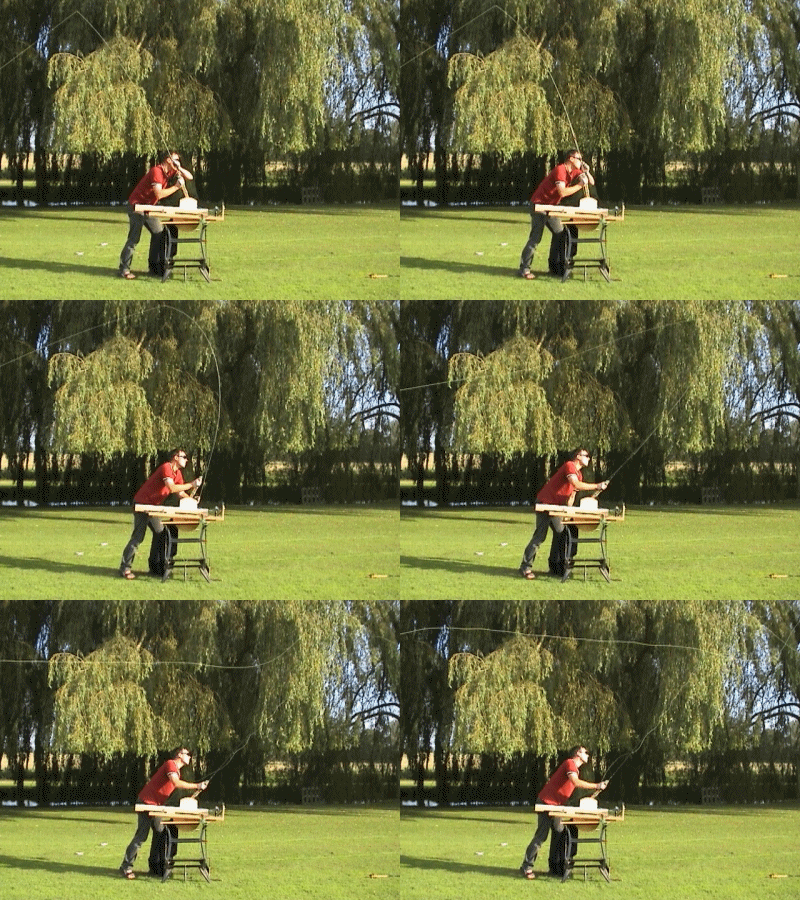

Fast rods for equivalent casts require a straighter casting stoke vs a more convex casting stroke for a tight loop with a slower fly rod. To open up a cast with any rod, make the stroke path more convex. The stroke path and the rod tip shortening determine the shape of the loop and not whether the rod is a fast or slow action rod.
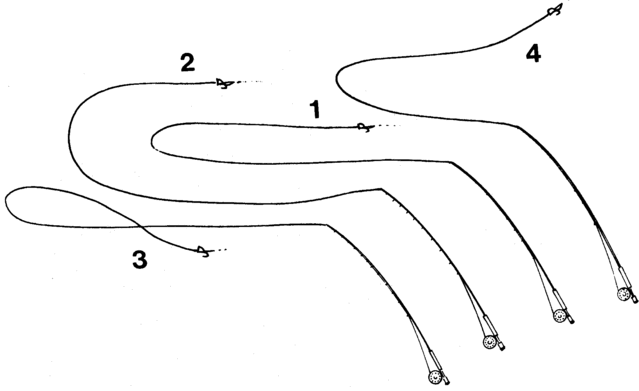
Secondly, going up or down in line weight does nothing to change the action of a fly rod. I read all the time that over lining a rod will turn a fast action rod into a medium action rod.
That simply is not true. Action is how the rod bends under a progressive load; it is the flex profile of the fly rod. The flex profile is designed into the fly rod and as long as the fly rod does not break, it has the same action regardless of load.
What we are changing by changing the fly line is the load. A fast action rod with a higher load is still the same fast action rod with a lighter load. It will still have the same flex profile.
What changes is the timing of the cast. So although the timing slows down with increasing loads, the action remains the same. When you hook the fish, you will still have the flex profile of a fast action fly rod with a stiffer rod tip.
Finally, when casting a strike indicator and several flies and split shot we are changing both the load on the fly rod and the distribution of mass. The fly line, leader, and terminal tackle are not longer in balance. There is not a gradual distribution of mass but several spot areas of very high relative mass.
There are several ways to cast this. With lesser mass imbalances, an oval cast is the best method. This will keep the rod leg and fly leg of the cast separated horizontally in space and they will not tangle or hit the rod.
By using an oval/elliptical casting motion, the back cast and forward cast are made in different planes and this separates the two legs of the loop formation. Even if the upper and lower legs of the loop formation cross vertically, they cannot catch on each other because they are separated horizontally in space; they are in different planes.
Heavy nymphing rigs cannot be cast in the normal sense of a fly cast with a separate forward cast and back cast. They must be lobbed. You can lob with a fast or slow rod, but a fast rod will lob further than a slow rod. That is because a fast rod bends less for a given load and it maintains it’s length (chord). A longer chord is a longer functional lever and a longer lever give the caster a mechanical advantage over a shorter lever.
The way that I cast very heavy rigs is to use a water tension cast. You don’t form a normal loop or a normal cast. You let out as much line to water load the rod and then you shoot line into the lob. I allow the river flow to take the indicator and flies below me. When the line straightens, the drag of the water on the indicator and sunken flies loads the rod as I make the forward lobbing cast. This kind of fishing is not for everyone but on fast flow rivers, it is very productive.
 ](
](