There is a delicious guilt in targeting PETA. Members of
People for the Ethical Treatment of Animals (PETA) are
such an easy target, some folks might feel bad taking shots
at them. Ummmm…not me. PETA lives by strange
and inflexible ethical principles, supposedly good intentions
that are twisted into a vitriolic bias – only their opinion
counts. PETA also believes in guilt, especially that fisherman
(including fly fishermen) should have it. Guilt is PETA’s
favorite weapon.
Gautreaux’s wife was showing off her new fur coat and diamond ring.
“It was nice of Gautreaux to buy them for you,” remarked her friend.
“He had to,” replied Mrs. Gautreaux. “He was supposed to be
out fishing and I caught him kissing the maid.”
“Oh, my. You fired her at once, didn’t you?”
“No,” Mrs. Gautreaux said, “I still need a new car.”
Do you have guilt? Well…yes…practically
everyone does. Guilt is your personal internal conflict from
having done something you shouldn’t or not done something
you should. You have guilt because you have a conscience
and, for most folks, once you get guilt, it is not easily shed.
PETA likes guilt and wants to use guilt as a tool of angling
social control. PETA wants fly fishermen to be ashamed of
what they do because people who feel shame believe that they
themselves are bad, not just that what they do is bad.
Toussant got his mother fly tying lessons where she produced
two nice flies she gave to him on his birthday. The next time she
visited his home, Toussant made sure his rod was easily noticed,
rigged with one of the flies. As she looked around the living room,
Toussant’s mother saw the rod in a corner sporting her fly.
“What the matter, son?” she asked. “You didn’t like the other one?”
PETA wants to cultivate shame among fishermen to make
them more tractable. PETA is displeased that fly fishing has
a certain political correctness and by insisting that even the
most protective catch and release techniques are sinful, PETA
assumes guilty fly fishermen will feel they are undeserving and,
consequently, will be less likely to assert their own opinions
and preferences. (See footnote 1)
PETA believes that fly fishermen who feel no shame should
be treated as psychopaths because they lack an appropriate
moral framework. In other words, either you are ethically
behind PETA or you are crazy.
Jones was the most henpecked member of the fly fishing club,
married to a harridan who is always complaining about money.
A group of the club members were sitting around the lodge after
a day of fishing when Jones lost $5000 to Wilson on a single
hand of poker, stood up, clutched his chest and dropped dead
on the floor.
The rest of the members felt guilty and responsible for what
happened, Wilson most of all because he won the hand. He
looked around and asked , “Great. Now, who is going to tell
his wife?”
The remaining fishermen agreed it should be Wilson but they
told him to be discreet, be gentle, don’t make a bad situation
any worse than it is. Wilson drove to the Jones’ house, and
knocked on the door. After a few moments he knocked again.
After a few more moments he knocked again. Jones’ wife
yelled “I’m coming,” jerked the door open, looked the
fisherman up and down and said, “What the hell do you want?”
Wilson replied, “I’ve been sent to tell you that your husband
just lost $5000 playing poker.”
Mrs. Jones hollered, “You tell him I said to DROP DEAD!”
Wilson answered, “Yes, Mam. Whatever you say.”
PETA labeled certain activities as “guilt-free,” suggesting that
practically anything else should bring you guilt. PETA’s ethics
are someone’s moral principles based on someone’s beliefs
and someone’s truthsé regardless of other moral principles –
and applied by PETA to environmental issues. What happened
next is that PETA created the “obliged to” stream of logic. It
works this way: a fly fisherman might ask, “Don’t animals fish
and eat fish?” PETA explains that this an absurd argument, a
non-sequitur, because PETA says eating for “survival” is an
exception. Creatures, other than man, are “obliged to” eat
other creatures, but anyone who has the option to be a vegetarian
and chooses not to is depraved. You didn’t know fly fishing made
you morally corrupt? Shame on you.
Of course, PETA’s anti-fishing stance makes PETA such an
easy target it almost takes the fun out of it. PETA assumes
modern fishermen are stupid and forgetful. When a fly
fisherman is supposed to wallow in guilt because of his
own moral bankruptcy, he need only ask: “Excuse me but
didn’t Jesus eat fish?” [Matthew 14:14-18] or and “Weren’t
most of the apostles fishermen?” [Matthew 4:18] or “Didn’t
the Creator give man other creatures as meat?” [Genesis 9:3]
Only two choices for PETA here: atheism or oops.
Chicot was going to drive through Lafayette after his fishing
trip to Toledo Bend and decided to visit his grandmother, Esther,
who lived there. He called and Ester started giving him directions.
“I live at 234 East 32nd. You come to the front door of the
apartment complex. I am in apartment 4A. There is a big panel
at the door. With your elbow push button number 4A. I will buzz
you in. Come inside, the elevator is on the right. Get in, and with
your elbow hit 4. When you get out I am on the left. With your
elbow, push my doorbell”.
“Grandma, that sounds easy, but why am I hitting all these buttons
with my elbow”?
“What? You’re coming empty handed?”
Frequently environmental moralism is barely comprehensible in
the context of traditional American thinking because of
anthropomorphism. Huh? ( Trust me here, okay?)
Anthropomorphism is based in large part on the Judeo-Christian
view that man was created in the image of his God and that man
is the most important aspect of the Universe and has a divine grant
of dominion over nature. (Now it sounds kinda familiar, right?)
(see footnote 2, below)
Consequently, when someone makes an anthropomorphic decision
about the environment, the interests of human beings matter most.
Anthropomorphically, the value of non-human things is measured
purely by the human aspect, so that if something is good for humans,
or pleasing to human senses or human desires, then it is deserving
of consideration. For example, a beautiful wildflower may have no
economic value but can have a sensual human value, so, you’ll mow
the grass but leave the wildflowers because they give you, a human,
pleasure. Similarly, other creatures can have a value to humans,
sometimes as a companion but often only as sport and food. You
have a dog because he’s your buddy, we fish because it pleases us
and they taste good. Americans consider our natural bounty the way
we think of physical beauty — as a way of enjoying our riches
and resources without guilt. The Bible says God did it…for us.
This drives PETA up the wall.
Deacon McNally was an ardent fly fisherman and as spring
arrived he heard the reports of huge catches of bluegill and bass.
One perfect Sunday morning he couldn’t resist. He called up the
Pastor and claimed he had laryngitis and had to skip his church
duties. The deacon then headed out to his favorite fishing spot.
His fly hadn’t been in the water two minutes before he got a strike,
and landed the biggest bass he had ever caught. A half hour later
he caught the biggest bass he had ever seen. Another forty-five
minutes later he landed a bluegill that broke the state record.
All this time Saint Peter and God had been watching the deacon
from heaven. Saint Peter turned to God and said, “How can you
reward this man? He should be buried in guilt. He declined to
perform his liturgical duties. He lied. He let down his congregation.
Now you give him the greatest fishing day of his life.”
God smiled at Saint Peter and replied, “Who’s he going to tell?”
Think about Earth Day. Since a healthy natural environment is
crucial to human well-being and survival, there is an indirect
duty that anthropomorphic societies must exercise toward the
environment so that the earth remains environmentally hospitable
for supporting human life in a pleasant manner. You might have
heard this called “sustainability.” Trees make oxygen so we
shouldn’t clear cut them all. Similarly, most fly fishermen practice
catch-and-release. So, an anthropocentrist would believe in fishing,
but would not believe in fishing a species to extinction — because
humans need fish in the future. Hence the success of the CCA’s
species protection programs.
Then why does PETA hate fly fishing? (Remember that their arguments
are limited, as is their science.) They say fly fishing is bad because:
(1) It hurts the fish. Notably, the world’s foremost expert on the
subject is Dr. James D. Rose of the University of Wyoming. He’s
spent 30 years working on questions of fish neurology and examining
data on the responses of animals to painful stimuli. In 2003, Rose
published a landmark study in the journal Reviews of Fisheries Science,
concluding that animals need specific regions of the cerebral cortex in
order to feel pain. Fish don’t have them. (2) Anglers are depleting
endangered fish populations (and hatchery fish don’t count). Duh,
catch and release. (3) Non-target species are killed by manipulation
of water levels in lakes and impoundments. Huh? Well, PETA says:
“Some lakes are completely drained just to improve conditions for
anglers killing countless animals who live in the lake or depend on
it for food and water.” (www.fishinghurts.com) After a dozen readings
this still doesn’t make sense. Consider that south Louisiana’s Henderson
Lake was drained because hydrilla was choking the waters and making
them unusable for practically any species.
Millions were spent to save sport fish, fish eating birds and animals,
and sport fishing. During the draining process there was no reported
fish kill, because the fish migrated to deeper waters. There is serious doubt that PETA can
cite even one legitimate example related to fly fishing that supports
this argument. (4) “Birds, marine mammals, endangered sea turtles,
and dozens of species of fish are injured by abandoned fishing equipment:”
Pu-lease! No fly fishermen ever abandon their tackle. If a fish breaks
you off, the hook and tippet will either dissolve (in days or weeks
depending on species) or the fish will die and become food for other
aquatic inhabitants. Circle of life and all that. (5) Fish are the most
contaminated food man can consume because all fish contain
dangerously high levels of heavy metals and other toxic materials.
Of course, this is patently absurd and scientifically false.
[See https://www.cfsan.fda.gov/~frf/sea-mehg.html for the FDA
mercury findings.] (6) All else failing, PETA would argue that, by
fishing at all, a thinking being is wrong to serve trivial human desires
like using fish as food, because man can overcome his selfish desire
to fish and can be a vegetarian. PETA believes man is destructive
and that all living things have value in their own right — independent
of their usefulness to human purposes — and, in many instances,
may be more valuable (hence worth saving) than humans.
A group of friends went fly fishing and paired off in twos for
the day. That night T-Bob’s partner, Jacques, returned alone,
staggering under the weight of a trophy catfish.
“Where’s T-Bob?” someone asked.
“T-Bob had a stroke of some kind,” Jaques, said. “Died instantly.
He’s a couple of miles back up the bayou.”
“You left T-Bob lying out there and carried the fish back?”
“A tough call,” nodded Jacques, “but I figured no one is going to steal T-Bob.”
Let’s face it, PETA may be very wrong, but it is not
necessarily stupid. That is why they like guilt. Guilt is
omnivorous, feeding on a vast array of emotions. PETA
wants guilt to consume fishermen so that fishing is no longer
fun, but merely something that brings feelings of discomfort.
BUT…here’s how things can get confusing. When
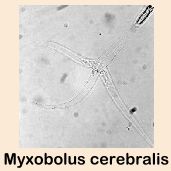
does a living creature not count. Consider Whirling Disease,
a parasitic infection caused by the microscopic parasite,
Myxobolus cerebralis. The disease is named for the
haracteristic swimming behavior that results as the parasite
multiplies in the head and spinal cartilage of the infected fish
(primarily wild fingerling rainbow trout) and these fish
subsequently die. In the absence of rainbow trout, fishing
on many wild rivers will cease to happen. Fishing has an
intrinsic value to man so man anthropomorphically strives
to eliminate the parasite and seeks to eliminate it completely.
But….is it acceptable for man to choose to extinct the
parasite (which PETA presumably considers to have its own
intrinsic value) and save the fish when the same man may
ultimately catch, kill and eat the fish? And…aren’t
humans the guardians, stewards and protectors of ALL
other species? If not all, is human protection of intrinsic,
aesthetic or amorphous values of fish species directly
related to the enjoyment of such things by humans, hence
latently anthropomorphic, therefore evil? Confusing, huh?
Standing at the edge of a lake, a man saw a woman
flailing about in the deep water. Unable to swim, the man
screamed for help. As Boudreaux came by, the man said,
“My wife is drowning and I can’t swim. Please save her. I’ll
give you a thousand dollars.”
Boudreaux dove into the water. In ten powerful strokes, he
reached the woman, put his arm around her, and swam back
to shore. Depositing her at the feet of the man, Boudreaux said,
“You mentioned a reward?”
The man answered, “Look, when I saw her going down for
the third time, I thought it was my wife. But this is actually
my mother-in- law.”
Boudreaux replied, “Sorry. How much do I owe you?”
Interestingly, many members of groups such as PETA are conflicted
by the parasite versus fish type of scenario. Why? Because they
focus on harm to small populations, not the whole of an ecological
system. PETA would argue that each individual living thing in nature
has a quality of existence which can be enhanced or damaged
(whether those organisms are capable of consciousness or not),
and since, as they see it, every entity has value, that entitles every
creature to moral respect. Even parasites? Uh-huh. But wait,
there’s more. PETA believes the intrinsic value of living things
demands that man always consider the equality of human versus
non-human value and work toward the betterment of non-humans
quality of existence and not undertake any activities which might
disrespect their rights to enhanced existence. Equality here means
that everything has equal value whether it is human, or mammalian,
or reptilian or avian or potentially any other “-ian.”
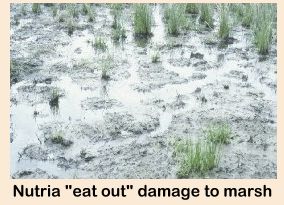
For PETA, an act of man sacrificing members of a species is
inconceivable, even if necessary to preserve other species
(including man) or others of the same species. A perfect
example is shown by the fact that PETA destroyed the
American fur trade around 1990. (Not single-handedly, but
PETA was the prime mover in the effort.) Prior to 1990 there
was a booming market for the thousands of nutria hides produced
by Louisiana trappers annually. Remember, the nutria is essentially
a rat, but the hides are actually pretty when used for clothing. Since
1990, when hunting was stopped, the unchecked nutria population
has become a plague and nutria have eaten out and destroyed
thousands of square miles (yes, miles) of wetlands and marsh
that previously served as an estuary for hundreds of other species.
There is a natural holocaust taking place — the greatest loss
of wetlands ever (discounting hurricane damage) and not even a new
Department of Wildlife and Fisheries bounty on nutria can stem the
losses. It is a disaster of epic proportions devastating the nation’s
most productive estuaries and harming or destroying hundreds of
other species.
Simply stated: It’s PETA’s fault. Curiously, you won’t hear them saying “mea culpa.”
~ Bob
Footnotes: 1. Not all civilizations have guilt so
where do we get guilt? Actually it is a product of our
Judeo/Christian upbringing. Judaism is famous for guilt (where
guilt is institutionalized, ritualized in daily prayer and part of the
fabric of religious practice and language). Christianity more or
less adopted the concept from the Greeks and Romans, although
ancient societies put more importance on the social consequences
of getting caught than feelings of guilt. The Latin word for guilt is
culpa, used most frequently in Latin liturgies as “mea culpa,”
meaning “my fault,” or more expressively, “I take responsibility.”
Guilt is not always understood today since liberals believe that
every time a law is broken, society is guilty rather than the lawbreaker.
But, as for personal guilt, each individual is supposed to be accountable
for his actions hence — “mea culpa.”
- “God created man in his own image, in the image of God
created he him; male and female created he them. And God
blessed them, and God said unto them, Be fruitful, and multiply,
and replenish the earth, and subdue it: and have dominion over
fish of the sea, and over fowl of the air, and over every living
thing that moveth upon the earth.” Genesis 1:27-8.
About Bob:
Robert Lamar Boese has fly fished for five decades. He is an
environmental negotiator, attorney and educator who has provided
environmental legal services for more than thirty-three years including
active duty with the U.S. Coast Guard and Department of Justice. He is a
well known fly tyer with several unique patterns to his credit. He has
developed and authored federal and state regulatory programs
encompassing a broad spectrum of environmental disciplines, has
litigated environmental matters at all levels of the federal and state
court systems, and is a qualified expert for testimony in environmental
law. He has authored over 60 published text chapters, comments or
articles on environmental matters, is a member of the Colorado, District
of Columbia and Louisiana Bar Associations, and is a certified mediator.
In addition to his legal practice, Mr. Boese has been a high school
teacher, an associate professor of Environmental Law and Public Health,
has authored numerous fiction and sports publications, and is a softball
coach and nationally certified volleyball referee. He is the president
of the Acadiana Fly Rodders in Lafayette, Louisiana and editor of
Acadiana on the Fly. He has been married for thirty years and is the
father of two fly fishing girls (25 and 21). For additional information
contact: Boese Environmental Law, 103 Riviera Court, Broussard, LA 70518
or call 337.856.7890 or email coachbob@ymail.com.
Originally published April 20th, 2009 on Fly Anglers Online by Bob Boese.