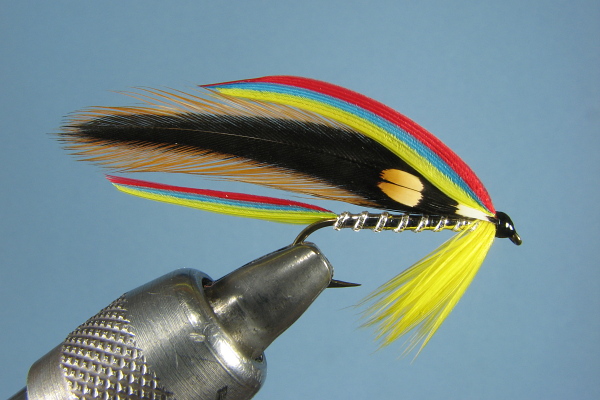
Lord Iris
Here is a rather unusual streamer from Preston Jennings. It puts into practice some of his theories regarding the way trout see underwater. He thought that the water would break up images into their component colors, as a prism breaks up light into individual sections of the spectrum. This theory was just one component of his scientific approach and treatment of all things fly fishing. He stated: The proper coloring of the lure is determined by viewing the object which it is desired to simulate through a prism and coloring the lure in exactly the same manner as it appears through the prism.
I have a little trouble with the logic here myself. If the object in the water, whether it be minnow or insect, is broken up through refraction into its various fundamental color components, and the trout sees it that way, wouldn’t it follow then that the artificial, if it was representative of the natural, would also be broken up into its component colors as well? If so, why go to all the trouble of looking at the original object through a prism? Just look at the object, copy it, and the water will break it up into its components, if that is indeed what happens.
While Preston Jennings may have been a little off the mark with some of his prismatic ideas, that didn’t make him any less important to the scientific investigation of fly fishing. In A Book of Trout Flies, written in 1935, he put forth the first American entomology of stream insects. Before him there had only been a passing interest by scant few American fly fishermen in just what it was they were trying to imitate with their flies. With the possible exception of Theodore Gordon, who was quite interested in the British approach to dry fly fishing and its associated matching of the hatch, most fly fishing was based on colorist ideas and trial and error. Jennings would change all of that with his book, and inspire a more scientific look at an old pasttime. Directly inspired by Jennings was Art Flick, who had helped Jennings obtain specimens for the book. Ultimately, Flick would go on to do his own stream entomology, Art Flick’s New Streamside Guide to Naturals and Their Imitations.
The prism ideas are found all through the Iris series of streamer flies by Jennings, and they are quite spectacular as a group. Great fun to tie too, and this one’s a real challenge.
Lord Iris Streamer
- Tail: In two matched sections; each a married section of swan or goose wing feathers, red, blue, and yellow, with the red at the top. Each completed married section is narrow but rather long
- Body: Medium flat silver tinsel
- Ribbing: Narrow, oval silver tinsel
- Throat: A yellow hackle tied on as a collar and then tied downward
- Wing: Four ginger furnace hackles
- Shoulders: Each a matched section or red, blue and yellow swan or goose wing, married together with the red at the top. The shoulder is dressed along the top of the wing and is two thirds as long, but rather narrow
- Cheeks: Jungle cock
Credits: A Book of Trout Flies by Preston Jennings; Streamer Fly Tying and Fishing by Joseph D. Bates; Trout Fishing in the Catskills by Ed Van Put; ~ ELA
Originally published December 7, 2009 on Fly Anglers Online by Eric Austin.