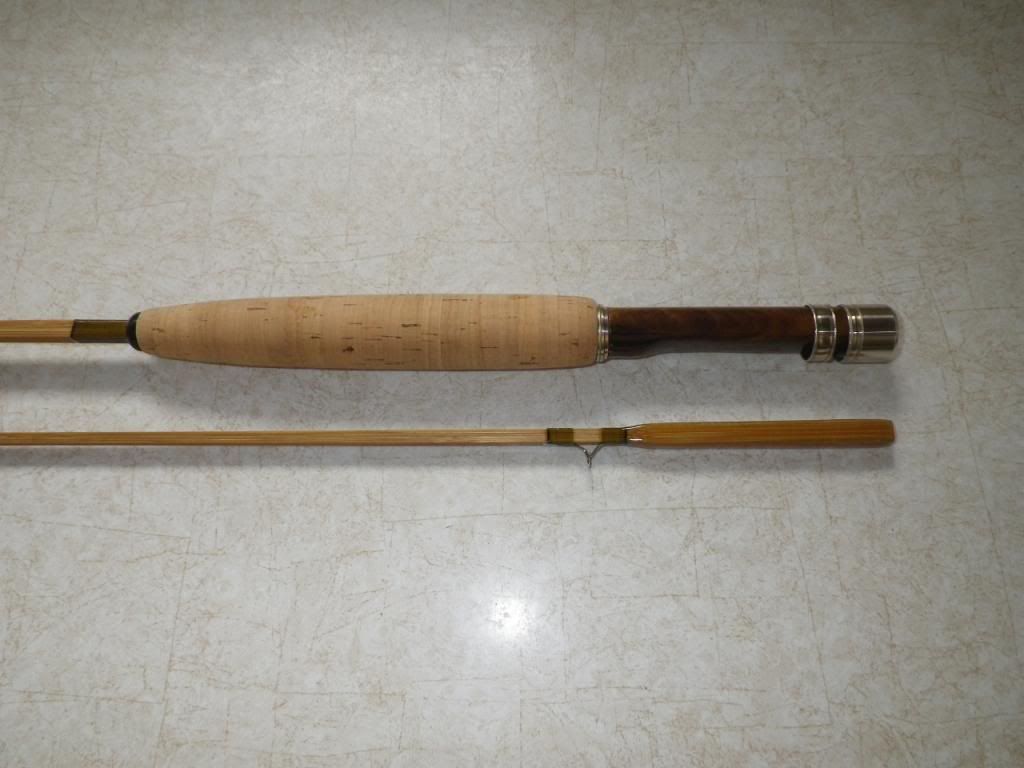
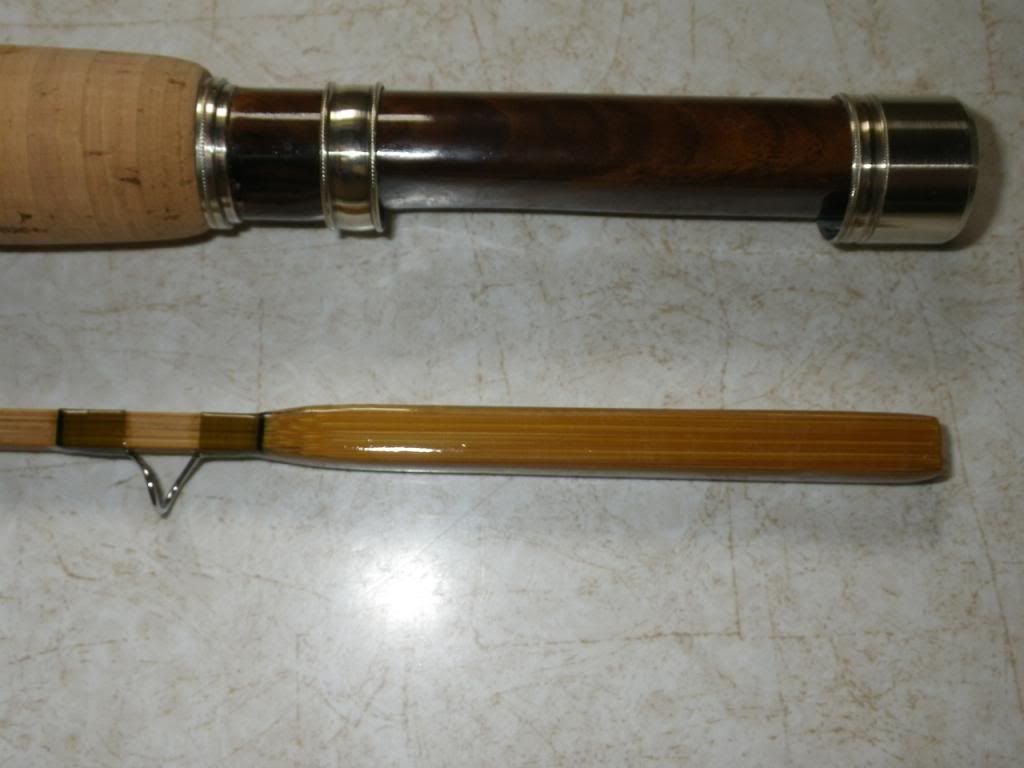
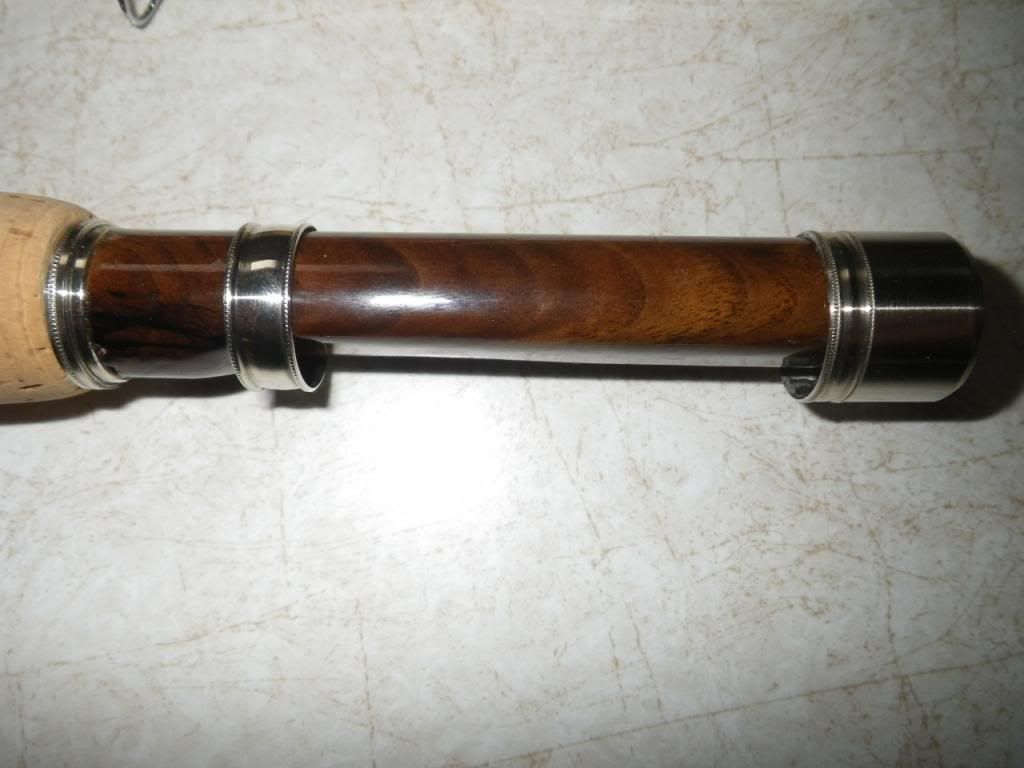
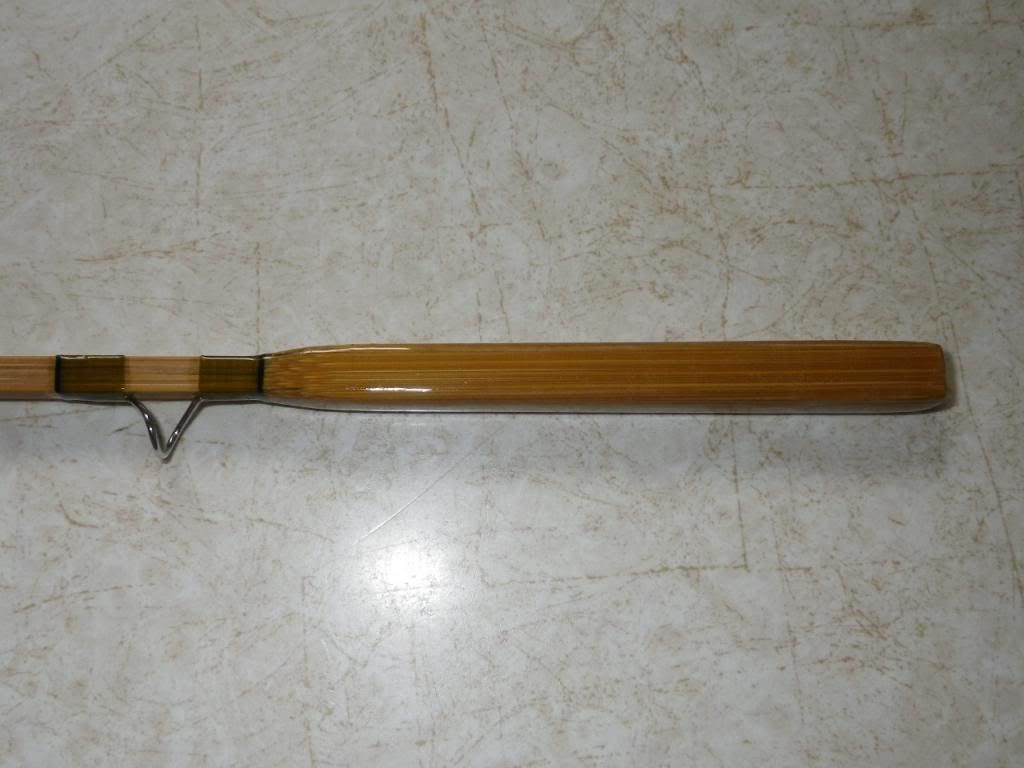
Just finished the latest and hopefully the last PMQ for a while. Based on a PHY Driggs River with a Bamboo ferrule. (Ole Mr Young is spinning in his grave as I type this!). Blank is impregnated. Spalted walnut reel seat spacer with nickle silver hardware. Granger Green wraps(YLI #236), black tipping. Wrapped the ferrule in white thread. Finish on the wraps is 1 coat of thined FC Light followed by 4 coats od Helmsman Poly Spar.
That is most likely the most beautiful rod I have seen recently. Great job but, I do have a question and maybe a link or pictures would help in understanding. How do you make a quad from two strips instead of four? I actually just got a quad that a friend from Indonesia made for me but, he used four strips. I will post some pictures of mine along with the ferrule ends which are also bamboo.
In each case, there will be a 90 degree angle and two 45 angles. In a normal four strip quad, the 90 degree angles are on the inside (glued together). With 2 strips, the sides opposite the 90 degree angles (i.e. the hypoteneuse) get glued together. I suppose that you’re going to be removing more power fibers in the latter case while planing the strips, but otherwise, less work is involved overall.
Brad can answer your question better, but, a true quad is made from 4 pie shaped pieces of bamboo with 2 strips wider which will give you a rectangle or 4 sided rod. A Poor Man’s Quad is made from 2 pieces of bamboo glued together which will make a rectangle with 2 sides wider than the other 2 sides. Both will require planning to form your taper and you end up with the same look, but, one method takes more time and hours.
I know Brad can explain this better and he can correct anything I stated which may not be correct.
So basically you are taking 2 slats which have been planed and joined and glueing them together and then planed to a taper in layman terms. It sounds a hell of a lot easier than other ways of building bamboo blanks and the end result was beautiful.
There are NO 45 degree angles. You take 2 strips for each section, flatten the nodes, cut to length and then plane each piece to 1/2 the final dimension of the rod. Planing is done on the inside of the strip to preserve all the power fibers on the outside of the strip. On the rod above, the power fibers go to the inside edge of each strip. All the pith was removed in the planing process. I was able to choose a culm of bamboo with really deep power fibers so all the pith was removed.
Glue them together, then plane the other sides to the final dimension. It seems easy, but you are measuring after almost each stroke with the plane since you have no planing form to limit the renoval of the cane. It is very difficult to keep each strip flat and level with no form to guide you.
In reality, I think that a standard 6 sided rod will be eaiser to do. We will be finding out soon enough!
Nice job on the Poor Mans Quad Brad. After making a bunch of hex Boos I had cast a True Quad built by Bob Nunley while attending a Fish In out in NY. Must have been in 2000? Anyhow I was impressed with his lil 6’Quad!
I just had to build myself one. Some how or another I got side tracked into building a couple PMQs. These rods were not all that difficult for me because I have the full blown shop with all kinds of very good equipment.
The PMQ is just two strips glued together. I opted to make myself a slave jig to hold a strip and run thru my thickness planer. I split out my strips in the normal manner that I had always used for hexes. I do not like to flame, prefer to heat treat and temper in the furnace I built especially for doing boo rods. This way I can leave them natural as I do not care for the flamed look. With my furnace I can control the exact temp and the results are very good. I found that there was a bit more work to finish plane the strips, but with very sharp, good planes it worked well.
At last I realized I had to make myself a few true Quads. I have a book written by Ray Gould, “Cane Rods tips & tapers. In this book are tons of different tapers and a chapter on how to build your own quad planning form and how to build the Quad.
A quad is 4 strips of bamboo, enamel side out, exactly the same. If properly made you will have a perfect square when completed, not a rectangle. The quad is more difficult to make because you must have a form similar to the one you use for hexes. The difference is you need a right and a left hand taper groove. Ray’s chapter in his book has measurements and very good photos of how you can make your own Quad forms. He uses Maple and polyethylene. I gathered my materials and built my own forms and they are lasting quite well and do work. He also showed how to make a roughing form. I went with making myself a power planner, using a 45 degree router bit. This gives me a strip with no taper. Then I go to the double planning form for whatever taper I am building. Really quite simple.
My first quad was Driggs River special, 5 wt, 7’1 with a bamboo ferrule. I did not like the feel of the bamboo ferrule when casting so removed it and made my own NS Quad ferrule. ( I have a lot of experience in Jewelry making so was not too difficult.) One can buy a non-serrated ferrule and make your own 4 serrations to fit a Quad.
I am presently making myself a Quad based on a Don Anderson 5 wt, 7’9”. I did the math conversion myself. This is one of my favorite bamboos and the first one I made myself years ago in a hex. Love it.
I obtained my Ray Gould book from Frank Amato Publications. I highly recommend it to anyone interested in DIY Bamboo.
I enjoy making all of my own equipment almost as much as my making my own rods. I find it relaxing and makes my inner self feel better than just assembling some other guy’s blank. True Rod Making.
Denny
Glue I use: Epon 826 Resin, Versamid 140 Hardner. I help it kick off by using the Manuf recomendation of placing in my furnace for 4 hours @ 180 degrees. This is the glue most Pro Bow makers use on custom bows and by many Pro rod makers.
I have used other off the shelf glues but always go back to what I know will not delam. It is tops in my mind.