Prologue:
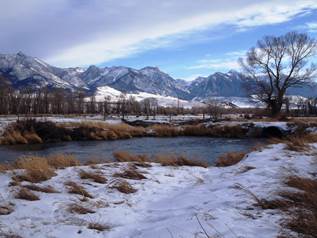
Snow on the ground with Absarokee Mountains in the back.
Either visiting anglers to Montana or local fishermen everyone enjoys fly-fish during the breath-taking Montana summer. So do I and that’s why fly-fishing guides are needed and how they make a living in Montana. However there are several rivers in Montana that are open year around. Around Livingston, the Yellowstone River accepts and challenges us all year around. If we drive a bit, we can fish Lower Madison as well. Then, three spring creeks in Livingston WILL NEVER freeze during winter months. Those are within private lands and requiring rod-fees. As in public waters, spring creeks experience highest angler traffic during summer months in spite of higher rod-fee. Indeed it’s worth paying to fish on those glorious Montana summer days. Insect hatches are the most prolific of the year and days are long. One can enjoy fishing there from very early to way after dark. On the contrary, during winter months, starting from October 15th, rod-fee is the lowest and so is the fishing pressure. Scenario goes on till April 14th. Though there are days when fishing is physically impossible due to several feet of snow and 50MPH winds, fishing at spring creeks can be fun all through from fall to next spring. Besides, one can experience some of the best fishing of the year. Actually these are the months that one can search for “trophy” of the year or even of life-time. Since I guide visiting anglers during summer months, I don’t have much time to fish for my own. Hence I unleash my internal desire to catch “fish of the year” after the peak guide season. It’s also time to experiment new methods and flies for next season. Fly fishing will never end in Paradise Valley. In this series of columns I’d like to introduce late and early fishing on Livingston’s spring creeks, exclusively about DePuy’s.
Creeks: There are three fabled spring creeks in Paradise Valley; Armstrong’s (www.armstrongspringcreek.com), DePuy’s (www.depuyspringcreek.com), and Nelson’s (www.nelsonsspringcreek.com). These three share similar hatches and fishing conditions most of the time. Fishing techniques and knowledge can also be common. They share the same rod-fee schedule as of writing this. As a Livingston guide, I am asked every now and then “which is the best?” My Answer is “all three!!” These ranching families have been thriving for generations. Besides rod-fees, you’d better pay some respect for the fact they let us on their land and allow us to fish on their creeks. Each creek has its own character. So, in my opinion, “which is the best?” is not worth arguing. However, there’s a huge distinction at DePuy’s, and it’s nothing but length of the creek. DePuy’s is 3-miles long, while Armstrong’s is 1.5-mile and Nelson’s is 0.5-mile. Relatively fast-paced and aggressive anglers (I become that type once in a while) can cover Armstrong’s and Nelson’s in a single day (REMINDER: that does not mean fishing on those two creeks is easier than at DePuy’s!!). It’s impossible to cover and fish the entire three miles of DePuy’s in a single day, which are filled with tremendous diversities.
Winter Pass on DePuy’s: Only DePuy’s offers Winter Passes which is effective from October 15th to April 14th. To me, it’s more like “Fall to Spring Pass.” For local anglers, visiting only in the fall (till sometime in November) and spring (after March) it can still pay off. Then in the middle of winter (December to February), when one develops cabin fevers and a dying desire to go fishing, then the creek is running just right there for you! Besides, considering recent fuel costs, buying the Pass and driving less is very economical and wise. Spending days during the least crowded period is more than money worth. Also this is the time to explore different spots and sections where one has not been able to cover (or afford to cover) while rod-fees are higher. For anglers from other parts of Montana, other states, or even from other countries, it may be recommended to visit Paradise Valley along with other plans such as skiing or hunting during these months. Then choose a certain day or two to fish either one of creeks. Yet another attraction at DePuy’s is that they provide “warming huts” with woodstoves. There are three of them along the creek. One can thaw out frost on rod-guides and warm up body and soul!!
| Depuy’s spring creek | Depuy’s spring creek |
| As the Sun sets among Gallatin Range in the west, “steams” are observed. | Thawing my feet! |
As a local angler, I enjoy every time I visit. However, as a guide in probably the most competitive area in Montana, if not in entire US, these months with the Winter Pass are meant for experiments and tune-ups. Some may argue “you are only fishing one piece of water, do you guide only there?” That may hit a point (I do conduct float-trips on Yellowstone River and take clients to other walk/wade destinations) but let me remind you “Spring Creeks are the classroom of fly-fishing”. That’s my mantra learned from Montana’s Master Angler himself, Tom Travis. What I gain from DePuy’s during the winter months can be applied to different waters and other seasons.
I’m going to unfold hatches, tactics, flies, months, so forth one by one. Then I will explain applications of this information and knowledge to other situations.
Blog @ https://leftyangler.blogspot.com
Japanese Blog @ https://leftyanglerjpned.blogspot.com
Fly Sales Online Catalogue @ https://leftytyer.blogspot.com; YouTube Channel
| Sysadmin Note |
|---|
| Sysadmin Note |
|---|
PART 3: FALL ATTRACTION – 1
Two Attractions: When you are able to use your winter-pass that starts on October 15th, there are two big attractions at DePuy’s.
- Blue-Winged-Olive (fall baetis, hereafter BWO) is the last major hatch in this area.
- Brown trout are coming into creek from the Yellowstone River to spawn, followed by rainbow trout. Some of them (both species) are really big and could be a trophy for the year.
In this part, I focus on fall BWO hatch.
Hatch: Fall BWO can be seen from September around Paradise Valley and Yellowstone National Park, so it’s safe to say that BWO hatch is in full-swing at DePuy’s when the winter-rate starts on October 15th. It usually lasts till middle of November. Only one limiting factor is the infamous SW gusts through Paradise Valley. I don’t mind fishing in those windy days as I know trout are in the creek but gusts seem to blow all the insects away to Canada. Along with terrible waves at most parts of creek, it’s hard to have trout see your dry-flies. When the wind is calm one can see BWO spinners in the morning. They are remnants from previous days. The BWO hatch starts from 12:30 to 1:00pm and trout will rise. The typically hatch will last for two hours. Unfortunately the BWO hatch can be stronger on overcast, rainy, or even snowy afternoons. Those conditions are barely tolerable for anglers but that’s when big trout that are measured in pounds and not inches join the rising group of trout. If you encounter this kind of days, that can be some of the best dry-fly and match-the-hatch fishing of the year!!
| Late & early season fishing at depuys | Late & early season fishing at depuys |
| Fall BWO: sizes 20 & 22 are most common (plus sizes 18 & 24) | One of the stomach samples. This trout was exclusively feeding on ascending nymphs with split wing-cases. |
Basic Technique: The most important aspect when casting dry-flies at spring creeks is “the angle of presentation”. By applying the reach and down and across cast without mending, one can show the flies first to trout, not tippets, and without drag. Angle and distance can be adjusted by taking a step rather than handling more line or disturbing the water by mending. This idea corresponds to the size of the tippet. Since we are showing our flies first, does the size of the tippet really matter? Some may argue even 6x is too bulky at DePuy’s, but if trout could detect a 6x tippet, they must have been able to detect hook-points and pinched barbs on our flies. Trout detect our flies as “fake” and decide to pass them up because of drag and/or wrong patterns (also trout may recognize our presence and some other factors). This is why mastering “the angle of presentation” is very important. Fishing for fall BWO hatches, on bright sunny days, I tie my first fly on 5x then trail my second fly with a piece of 6x. On windy days (which is norm in Paradise Valley), I go with 4x then 5x (first and second fly, respectively). Besides wind, if the weather turns overcast (cloudy, rainy, snowy, or mix of all), I stick with 4x and 5x. In one wet afternoon, I could keep casting to really tight spots (a few inches off over-hanging grasses), hauling trout in quickly, and fishing more simply because I was with 4x and 5x. My best dry-fly caught trout ever was on size 20 tied on 4x tippet!
| Late & early season fishing at depuys | Late & early season fishing at depuys |
| “20-20” = 20-incher on size 20 dry-fly!! | Size 20 Pheasant Tail Mayfly Cripple tied on 4x. |
Flies: I almost always fish with two flies. That can be: two dry-flies (duns and emerger patterns, one is more visible than the other); or one dry-fly (parachute or other visible type) + nymph patterns (for various depths). Here are some of my most effective patterns.
| Late & early season fishing at depuys | Late & early season fishing at depuys | Late & early season fishing at depuys | Late & early season fishing at depuys |
| Pheasant Tail Mayfly Cripple – Yamamoto’s Hook: Standard dry #18, 20, 22 Thread: olive dun, rusty dun 8/0 Tail/Abdomen: Pheasant tail Ribbing: Fine gold wire Wing: Widow’s Web or EP Fibers Hackle: Medium dun, trimmed flat on bottom | CDC Dun Hook: Standard dry or emerger hook #18, 20, 22 Thread: olive dun, rusty dun 8/0 Tail: Sparse strands of Zelon, dark dun Abdomen: Tying thread Wing: dark dun CDC fibers topped with white or light dun CDC fibers Head: Superfine Dub, BWO or gray | Winged Victory Nymph – Yamamoto’s Hook: Standard dry #18, 20 Thread: olive dun, rusty dun 8/0 Tail/Abdomen: Pheasant tail Ribbing: Fine gold wire Thorax: olive or gray, dubbed fuzzy & hairy Wing-case, eyes, & wings: two medium-size black round rubber legs Indicator: Sally Hansen Hard as Nail, hot orange | Sawyer PT (Master Angler Version) Hook: Standard dry #18, 20, 22 Thread: dark brown 8/0 Tail/Abdomen: Pheasant tail Ribbing & Thorax: Copper or brown wire, medium fine for #18 & fine for #20 & 22 Wing-case: Pheasant tail fibers |
| My own design is great success at DePuy’s. On overcast day, synthetic wings are very visible and dry quickly. CDC fibers can be used for wings too. | This classic pattern is still one of most important go-to flies at DePuy’s. | My intention is to imitate emerging/ascending nymphs of which wings are protruding with cases split. Look neat eyes!! See the stomach sample picture above. | One can’t go fishing without this all-time favorite fly. Tom modified the tying procedure of original Sawyer by using thread, which makes mass-production much easier. |
| Late & early season fishing at depuys | Late & early season fishing at depuys | Late & early season fishing at depuys | Late & early season fishing at depuys |
| Paraloop Emerger/Cripple Hook: Emerger hook #18, 20, 22 Thread: Olive dun, rusty dun 8/0 Tail: Dark dun Zelon fibers or medium dun hackle fibers Abdomen: Turkey biots dyed BWO, PMD, or gray Thorax: Superfine BWO, PMD, gray Hackle: dun feather wrapped around monofilament and finished in Paraloop style | Foam Post Parachute – BWO Hook: Standard dry or emerger #18, 20, 22 Thread: Olive dun, rusty dun 8/0 Tail: Dark dun Zelon fibers or medium dun hackle fibers Abdomen: Turkey biots dyed BWO, PMD, or gray Thorax: Superfine BWO, PMD, gray Post: foam, color of your choice Hackle: dun feather wrapped around foam post | Double CDC Emerger – Yamamoto’s Hook: Emerger # 18, 20, 22 Thread: Olive dun, Tail: Sparse amount of dark dun Zelon Abdomen: Brown goose biots Thorax: Olive Henry’s Folk Hackle – Montana Fly Company Wing: Dark dun CDC fibers | Turkey Biot Nymph Hook: Standard dry #18, 20, 22 Thread: dark brown 8/0 Tail: Pheasant tail Abdomen: Turkey biots BWO, PMD, gray Thorax: dubbed fuzzy, olive or gray Wing-case: Pheasant tail fibers |
| This fly shows different silhouette to trout due to Paraloop. | One can’t go fishing without parachute. It sits low on the surface and can represent dun, emerger, and spinner. | I fish this fly solely depending on floatation of CDC, no grease. Of course I will dry it later but I want it to sink a bit in the surface. | A totally unweighted nymph is very important when trout are taking ascending nymphs. It should be fished behind visible dun imitations. Let it sink by its own weight. Dropper tippet can be greased. |
These are just examples. I suggest keeping many BWO patterns available to you in your boxes. By this time of the year, the water level is low (as aquatic weed beds degenerate) and trout have experienced all kinds of flies and tactics, i.e., selective and wary. This situation demands the best out of skilled anglers at DePuy’s, which is always technical and challenging in its own right. So one can’t have enough fly patterns for fall BWO. As my list notes, BWO’s are not always olive. They can come with light olive and Adams gray.
(NOTE: Also refer to author’s earlier articles “BWO Happy-Hour, Waterloo, and Solution”.)
Satoshi Yamamoto - Livingston, MT
Blog @ https://leftyangler.blogspot.com
Japanese Blog @ https://leftyanglerjpned.blogspot.com
Fly Sales Online Catalogue @ https://leftytyer.blogspot.com
| Sysadmin Note |
|---|
| Sysadmin Note |
|---|
PART 4: FALL ATTRACTION – 2
Time of Aggression: Although streamers and nymphs can always produce trout, fall is the glorious time to target the largest trout of the year with your favorite “meaty” patterns. Lots of large brown trout swim into DePuy’s from the Yellowstone River for spawning, followed by rainbow trout (they enter the creek to munch on eggs but also some of them stay in the creek till their own spawning time). Sight is amazing. Trout population is as thick as aquarium all along the creek. Before I go on, here’s a note to remember: When the BWO hatch is strong in the afternoon, as discussed in PART 3, even determined streamer/nymph fishers may consider matching the hatch. During those two hours trout seem to lose interests in large objects. Besides, I can’t emphasize that several-pound class trout do rise for BWO dry-flies. Before and after that, one can enjoy heavy artillery to one’s hearts content. This is just a suggestion to add varieties to your days.
Trout Behavior: Right after large brown trout enter the creek, they literally crash streamers and large soft-hackles passing in front of their face or territories. They need to accumulate some energy before spawning. That’s where aggression on large flies comes from. This action typically goes on till early November. Once they are in spawning mode, they don’t really chase streamers and large soft-hackles as ferociously as before. Instead they mostly bite on stuff coming toward their mouths. One can still present streamers and large soft-hackles slowly but nymphing is definitely more efficient. The number of rainbow trout increase as the fall goes by. They are either behind or among the browns’ redds to devour eggs. But also they do bite on our streamers and large soft-hackles as browns do. Smaller individuals who don’t look like spawners (residential or run-up) are also hanging around redds and can be taken by either method. Those are the ones I’d like to conduct stomach samplings on to observe what they are eating. Are they eating eggs as we guess? Yes, but oftentimes I find something very interesting to note.
Basic Tactics: Well-known fact – trout choose relatively shallow and moderately riffly area with pea-sized gravels on the bottom to make spawning beds. When one spots a few trout or group of them at those spots, experience will be very visible = sight-fishing. Streamers, large soft-hackles, or nymphs can be bounced right in front of them. As noted above, when large browns and rainbows are aggressive, streamers and large soft-hackles can be fished by swing, retrieve, twitch, or mix of them as in typical river tactics. Other structures to look for are deep holes and runs, which are numerous in DePuy’s (distinctive features compared to other two creeks). Those are spots you’d better search and fish thoroughly. Nymphing with an indicator is certainly productive. Streamers need to be fished deep and retrieved or dead-drifted.
Flies: It’s impossible to list entire rosters of effective patterns in this chapter. More detailed chapters that are dedicated for nymphing and streamers will follow. Showing here are my first arsenals of streamer, large soft-hackle, and eggs for the fall.
| McKnight’s Home Invader | Yamamoto’s Coyoted Pheasant | Otter’s Egg |
|---|---|---|
| Fall Attraction | Fall Attraction | Fall Attraction |
| * Hook: TMC 700 size 6 & 8 * Thread: Red Ultra Thread 140 * Barbell Eye: Small, color of choice * Tail: Olive marabou, two plumes (yellow, brown, or mix of colors can be great.) * Body (rear & front of eye): Natural fox tail wrapped around hook-shank * Flash: Copper Flashbou * Wing: Metz Magnum Cape Olive-Grizzly | * Soft-Hackle * Hook: Dai-Riki 280, MFC 7231, size 8 & 10 * Thread: Orange Gossamer. Ultra * Thread 140 burnt orange can be substituted. * Under-Tail & -Wing: Tan Zelon, Yarn, Darlon * Ribbing: Gold wire, medium * Hackle: Pheasant ramp * Head: Pheasant aftershaft plume | * Hook: Dai-Riki 135, MFC 7045, size 10 or 12 * Thread: 3/0 or 6/0 to match eggs * Egg: MFC Otter’s Soft-Egg material. Colors yellow & pink and size 6mm are most common as trout eggs. * Egg Veil: MFC Otter’s Egg Veil, white. White Zelon or Z-Yarn can be substituted. |
| Not only in the fall, but all through the year, I never visit spring creeks without this streamer by Doug McKnight (www.bigwaterstudio.com). Concoction of materials produces unbelievable “fishy” movement under water. | My famous pattern is greatly accepted by fall- & spring-runners at DePuy’s. One can swing, strip, twitch, or bounce it. It can be fished even under an indicator. | Probably no other egg patterns can be as realistic as this one. Period. Egg materials needs super-glued and secured well with thread. One can enjoy catching frenzy till it’s ruined or till one’s inventory runs out. |
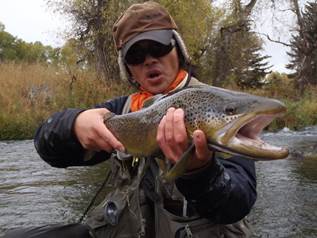
Best fish of 2011 and my record brown in Montana was caught with McKnight’s Home Invader at one of deep spots of DePuy’s on October 16th, 2011.
Note for Fishing Spawners:
There is nothing wrong for targeting spawning trout at DePuy’s (NOTE: in spring some rules apply, which I will discuss in the future chapter).
As posters in each hut suggest, rules are: do not step on (or totally stay away from) redds, use 4X or heavier tippets, and bring trout quickly then release them accordingly. There are a couple of apparent spawning beds that attract most of anglers. I fish there once in a while, especially right after Winter Pass starts (prespawning mode). Then I would fish slightly below those areas for trout which are waiting for eggs washed away in front of them. I’m in no position to preach at other anglers about ethics and morals but I’d rather avoid trout that are actually making redds and mating. We are expecting them to produce the next generations so we can keep fishing. Besides, when one targets those trout who don’t have much appetite (don’t really care flies, that is), they often get snagged somewhere (bellies or fins) as heavy objects pass by. That makes landing them very hard and ends up exhausting the trout more than we are supposed to. Since I fish more than norm, I’d rather find and explore different spots. Then I am still able to find and catch some of largest trout in the creek.
| Sysadmin Note |
|---|
| Sysadmin Note |
|---|
SPRING HATCHES
Bugs: Midges can be seen even during winter months as discussed in PART 5. Then spring BWO start to be observed from any time in March. Flies and tactics are very much similar to those applied in the fall (PART 3). In April, as weather gets warmer, caddis can be observed too. Trout rise on each of them with delight. We can expect great dry-fly fishing after long winter. As in the fall, BWO and midge tend to hatch in great numbers on calm overcast days.
Flies: Here is the list of surface types (adults, cripples, and emergers).
Midge (more patterns in PART 5)
| Dupuy Spring Creek -EOTG | Dupuy Spring Creek -EOTG | Dupuy Spring Creek -EOTG |
| Multi Purpose Midge – Master Angler Hook: Dai-Riki 310 size 18, 20, 22 Thread: Black 12/0 Tail: Gray synthetic fibers Abdomen: Stripped peacock herl Thorax: Peacock herl Hackle: Grizzly | Foam Wing Emerger Type 2 Hook: Dai-Riki 270 size 20, 22, 24 Thread: Black 12/0 Abdomen: Tying thread Ribbing: Fine silver wire Thorax: Peacock herl Emerging body: Gray foam | Coming Out Midge Emerger Hook: Dai-Riki 125 size 20, 22 Thread: Black 12/0 Tail: Grizzly hackle tip Abdomen: Thread Wing: White or gray synthetic fibers Hackle: Grizzly |
| At the beginning, this pattern represents an emerging midge. By trimming tail, it will represent adult midge. By trimming top & bottom hackle fibers, it will imitate low-riding spent midge. All can be done while fishing at the creek! | I wouldn’t apply any floatant on this one. I’d rather let it float with buoyancy of foam as it will imitate suspended midge along surface film (just ready to emerge). | A great cross-dresser of adult and emerger. Tail of this pattern actually represents a shuck of pupa. Like Multi-Purpose or my own MMM (Part 5), tail can be trimmed at the creek to fish for adult midges. |
BWO (more patterns in PART 3)
| Dupuy Spring Creek -EOTG | Dupuy Spring Creek -EOTG | Dupuy Spring Creek -EOTG |
| CDC Sparkle Dun Hook: Standard dry or emerger #18, 20, 22 Thread: olive dun, rusty dun 8/0, 12/0 Tail: Dun synthetic fibers Abdomen: Thread Wing: CDC fibers – white or dun Thorax: Super Fine dub – olive, gray, light olive | Yamamoto’s Pheasant Puff Hook: Dai-Riki 310 size 18, 20, 22 Thread: olive dun or rusty dun – 8/0 or 12/0 Under-Tail: Dun synthetic fibers Tail: Mallard flank fibers Abdomen: Turkey biot – olive, gray, light olive Wing: Soft & short fibers from stems of any pheasant feathers Thorax: Super Fine dub – olive, gray, light olive | Yamamoto’s Pheasant Tail Mayfly Cripple – CDC Wing Hook: Standard dry size 18, 20, 22 Thread: olive dun, rusty dun 8/0, 12/0 Tail/Abdomen: Pheasant tail Ribbing: Fine gold wire Wing: CDC Fibers – white or dun Hackle: Medium dun, trimmed flat on bottom |
| Regular Sparkle Dun (or Compara Dun) still works. However CDC wing version has been proven to be more effective. Besides, CDC has more color variations than deer hair and is easy to adjust density of wing. | A slight twitch of old RS-2. It’s also a waste-recycle project at my tying bench. No other materials have such natural dun coloration like fibers from the stem of pheasant feathers. | Tied with CDC wing, entire silhouette looks lighter than the original synthetic wing. Yet it’s still highly visible and floats really well. |
Caddis
| Dupuy Spring Creek -EOTG | Dupuy Spring Creek -EOTG | Dupuy Spring Creek -EOTG |
| X Caddis Hook: Standard dry size 14 – 20 Thread: 8/0 to match your intention Tail: Synthetic fibers – tan, olive, amber. Body: Misc. dubbing to match your intention Wing: Deer hair | Henry’s Fork Caddis Hook: Standard dry size 14 – 20 Thread: 8/0 to match your intention Body: Goose biot to match your intention Under Wing: Dark Dun CDC Wing: Dark partridge feather Thorax: Peacock herl Hackle: Dun or grizzly | CDC Bubble Back Caddis Hook: Dai-Riki 125 size 14 – 20 Thread: 8/0 to match your intention Tail: Synthetic fibers (amber, tan, olive), topped with mallard flank or partridge fibers Loop Wing: CDC fibers – dun, natural dun, dark dun Body: Dubbing to match your intention Hackle: Partridge Head: Hare’s Ear dubbing to match your intention |
| This simple & classic pattern is still one of go-to caddis flies. Common colors are olive, tan, and black. | Definitely one of most realistic caddis imitations. Tying procedure is straight forward. Trim or make a v-notch bottom hackle fibers if desired. | A great emerging imitation to fish the surface film. One can’t go wrong with the combination of CDC and partridge. |
Cope with Winds: Only one limiting (and frustrating) factor for dry-fly fishing in spring is the same old SW winds. When wind gales during winter, we can simply cancel fishing or defreeze ourselves in warming huts. In spring it can be frustrating because the air temperature is warm enough to be outside but winds are typically stronger than winter months and blow all the bugs away to Canada. However, as a Livingston guide and resident, let me advise you “stop complaining (whining), we can fish”. Let us see this way; we know bugs are plentiful and ready to hatch and trout are willing to take them (after being fed up with eggs and scuds for months). My tactics is soft-hackle swing. I rig up a combination of BWO, midge, and caddis soft-hackles. I first choose riffles. Just try to cast cross-stream, and wind will set your angles automatically. You may need to mend your line up-stream in order to slow down your swinging speed. One of my favorite spots is the tail-end of closed area around Eva’s Hut. Often I’m with my little 4 weight rod with tiny soft-hackles. But I’m afraid other anglers might suspect that I would be assaulting spawners by throwing eggs and leeches up-stream. If you readers happen to see me there, I’m not poaching!! Besides riffles, I keep flat sections in mind as next game plans. Winds cause waves at sections where the creek runs flat and smooth on calm days. With newly and temporarily generated water movements, soft-hackles can be swung just below the surface in a manner different from calm days. That really entices trout curiosity.
| Dupuy Spring Creek -EOTG | Dupuy Spring Creek -EOTG | Dupuy Spring Creek -EOTG |
| Flymph – Master Angler Version Hook: Dai-Riki 310 size 18, 20, 22 Thread: Olive dun or rusty dun 8/0 or 12/0 Tail: Partridge or mallard flank fibers Abdomen: Turkey biot – olive, gray, light olive Thorax: Hare’s Ear dubbing Hackle: Hen cape dun or Coq de Leon | Tom’s Simple Soft Hackle – Master Angler Hook: Dai-Riki 125 or 135 size 18, 20, 22 Thread: Olive dun, rusty dun 8/0 or 12/0 Abdomen: Turkey biot – olive, gray, light olive Thorax: Hare’s Ear dubbing Hackle: Partridge or Hen cape dun or Coq de Leon | Yamamoto’s Double Soft-Hackled Caddis Hook: Dai-Riki 280 size 16 and 18 Thread: Danville’s 6/0 Brown Under-body: Tan & olive dubs are most common. Top-body: MFC Henry’s Fork Hackle Ultra-Light – natural dun or mottled dun Ribbing: Pearl Crystal Flash Hackle: Hungarian Partridge |
| This Flymph represents many stages all at once. It can be fished from surface film to certain depth where trout are keying on. Also it can be fished by dead-drift, swing, and twitch. | Tied in Emerger hook, it will be deadly on the surface. To let it sink where trout are keying on, tie with scud hook (same shape but heavier). | This is the super-versatile soft-hackle. It can be fished from the surface to any depths. It’s also deadly at Yellowstone River. By changing colors and sizes, one can imitate any caddis species. |
| Dupuy Spring Creek -EOTG | Dupuy Spring Creek -EOTG | Dupuy Spring Creek -EOTG |
| Syl’s Midge Hook: TMC 102Y size 19 and 21 Thread: Black 8/0 or 12/0 Body: Peacock herl Hackle: Partridge | Peacock & Yellow Larva Style Hook: Dai-Riki 280 or 270 size 20, 22, 24 Thread: Gossamer silk, yellow Abdomen: Thread Thorax: Peacock herl | Yamamoto’s Split Shuck Emerger Hook: Dai-Riki 310 size 18 to 22 Thread/body: Black 8/0 or 12/0 Over body: White synthetic fibers Ribbing: Fine silver wire Hackle: Starling |
| One can’t go wrong with this all-time successful pattern! | Believe or not, this can be classified as soft-hackle and fished by swinging during midge hatches. | I have observed many trout keying on midges that were just leaving their pupa shucks at surface film. This pattern imitate a split shuck and coming out insect. |
Satoshi Yamamoto, https://leftyangler.blogspot.com, brought his passion for fly-fishing & fly-tying from Japan to Montana and became the first ever Japanese guide in Livingston, MT. He guides and fish’s big rivers like Madison & Yellowstone, spring creeks in Paradise Valley, and various waters in Yellowstone Park. Hence, with his Regal Vise at the bench, his fly tying interests vary from tiny midges to 5-inch streamers and anything in between. Once his ideas are combined he goes out for experiments at those near-by waters. Satoshi submits his innovative patterns to Montana Fly Company (www.montanafly.com).
His own innovative original patterns can be purchased from his fly-shop, https://leftytyer.blogspot.com.
| Sysadmin Note |
|---|
| Sysadmin Note |
|---|
Shotgun Nymphing - Understand the Riffle
Riffles in spring creeks are “food conveyors” for trout. Shallow structures let sunlight penetrate water column and cause photosynthesis with aquatic weed-beds. Tumbling water is oxygenated and typically cooler than calm/flat spots. Combining these two facts, riffles produce and host miscellaneous mayfly nymphs, larvae (midge, caddis, and crane fly), and aquatic foods (scuds, sowbugs, snails, and so forth). When stepping into choppy and tumbling surfaces of riffles, every angler must understand that the water column is not moving as fast or strong as the surface. Trout know all of these facts as they have been thriving and evolved in this environment. All they have to do is hold with ease in the water column and wait for foods drifting toward their mouths. They can break and feed on the surface when something curious is floating (such as terrestrials). Also choppy surfaces serve as protective covers from predators on the bank (human, bear, coyote, etc.) or in the air (heron, eagle, etc.). On the contrary, for anglers riffles don’t look attractive. First, the choppy surfaces don’t attract anglers who expect to fish flat water of spring creeks. One can have good dry-fly fishing at riffles too!! Second, even when attempting with nymphs and streamers, most of anglers face confusion and can’t find correct methods. Third, they don’t realize that choppy surfaces and gurgling sounds serve as camouflages for anglers (as well as a protective barrier for trout) hence they can get closer to trout. Consequently, the Middle Section of DePuy’s is left untouched. Most anglers (with or without guides) tend to congregate on the Upper or Lower Sections.
Blast Your Shotgun:
One shotgun shell contains multiple pellets. Just with one trigger, it attacks a “sphere” at once rather than a single “spot”. We fly-anglers are not equipped with multi-rods or -flies (dozen? or 30 of them), so what we do is we cut the river/creek into pieces = grids = and make relatively short distance castings repetitively in one grid. Although the shotgun method (or shot gunning) can be used for dry-fly fishing, here I focus on nymphing at riffles. Then again, I use Middle Section of DePuy’s as a case study in the “classroom of fly-fishing”. Accompanied drawing and pictures will give you virtual tour and images. Step into the creek 15 to 20 feet down-stream from the riffle you intend to fish and face up-stream.
| Winter at DePuys #10 What’s going on under water? |
Grids & Casting:
With the size of DePuy’s, I assign my grids from 5’ x 5’ to 7’ x 7’. Casting is nothing but a simple over-head cast aiming up-stream. Distance is 12 to 20 feet. I don’t really retrieve my fly-line when my indicator (flies) is floating down-stream toward me. Instead I gently lift my rod-tip in order to keep some tension on my fly-line. When trout take, the indicator will dart up-stream. Then I set the hook by lifting my rod-tip and giving extra tension on my fly-line with my line-hand. If there is no bite, I let my rig float perpendicular to me and down-stream from me (oftentimes, I experience strikes even around there!). I don’t make a typical back-cast and I don’t suggest others do so. Instead I let currents take my leader down-stream from me and I simply flip my leader up-stream (Water Haul). Or I use a simple Roll Cast. These two methods will prevent from tangling the nymph set-ups. Repeat this procedure 20 to 30 times at one grid. Then move on to next grid and so forth. It’s a totally different nymphing from just waiting for a bobber to sink. Often, I am totally into it and lose the sense of time until dusk. Indeed Shotgun Nymphing is a very aggressive, efficient, and deliberate way to aim and search trout at the same time.
| Winter at DePuys #10 Example of grid. Square grids (red) and also Yellow grid covers a slow spot between the bank and edge of riffle. Cast repetitively in one grid and move to next! |
Tight Along the Bank:
If riffles were the only concern, that would be the end of story. However, there’s more to do with Shotgun Nymphing in the Middle Section. First with this method, one can target trout that are holding tight and close along cutbanks with over-hanging grass. As I explained in the last chapter, this structure is tempting to fish with streamers. However just walking over the banks (before wading into the creek), oftentimes some big trout would get spooked and swim away from the cut banks. By approaching cutbanks from down-stream, one can be stealthy from trout and sounds and movements of riffles camouflage our presence and movements. When I try to cover tight along cutbanks, my grid will be such as 2’ x 5’ or 1’ x 6’ and so forth. Cast a few to several feet up-stream of targets and let nymphs drift down-stream.
| Winter at DePuys #10 Grids along the cutbanks with over-hanging grass. |
Shoot the “Chute”:
The Middle Section has one more structure to consider = under water weed-beds. Remember, again in last chapter, that I was spooking more trout that were resting/hiding among weed-beds? It was very frustrating and seemingly impossible to target those trout at that time. By employing Shotgun Nymphing from down-stream of those weed-beds, I can fish “chutes” between or among weed-beds without snagging weeds. This was a revelation, and I started to take trout so consistently from where it was impossible and where others told me “unproductive”!! Then I realized why regular nymphing would not work well at the Middle Section. It’s simply hard to target and search between weed-beds by casting cross-current and mending line up-stream. Consequently, decent drifts are hard to be achieved. To sum up, I target the same trout at the same holding spots but I adjust and change “angles of presentation”. That makes the big difference. Then, why are trout among weed-beds? They are hiding from threats and waiting for foods (nymphs, larvae, scuds, snails, etc.) washed away toward their mouths. Only once in a while, I locate trout over weed-beds for whatever reason is. But considering the depths of DePuy’s, trout know where to hide and rest without being seen by predators. All of these explain why the Middle Section can be deceptive and is often referred as “unproductive”. Well, not for me anymore.
| Winter at DePuys #10 Target “chutes” between weed-beds by Shotgun Nymphing. |
Rigging:
I’m comfortable with my 6weight, 9-foot rod for nymphing. I always fish with (or experiment with) two nymph patterns. My leader-tippet is 9 to 10 feet to the first fly and dropper tippet is 16 to 20 inches. When huge spawning trout are expected, I use 2X for the first fly and dropper tippet would also be 2X or 3X. With this set-up, it’s easy and quick to haul in huge trout without breaking, even when they happen to be foul-hooked. When the water level is apparently low (after weed-beds die down in early December) under bright sunny winter days, I switch into 3X and 4X for the first and second fly respectively. Most of nymph patterns I use are size 12 to 22 (with some exceptions of large ones) so I apply my dropper-tippet with the “eye-to-eye connections” between two nymphs. I apply one BB size non-lead split shot at a tippet connecting knot above the first fly. The indicator should always be measured from the first (top) fly. I usually set up my indicator 4 feet above the first fly for the Middle Section. Indicators used for this rigging and fishing method are not necessarily afloat all the time or meant for suspending nymphs in certain depths. I don’t recommend balloon types for Shotgun Nymphing. Though it floats well and is very visible, it pops too much every time it’s picked up from water for next casts. My favorite indicators = sensitive, visible even under water, and aero-dynamic = are Fish-Pimp and Pinch-On in assorted colors.
| Winter at DePuys #10 Pinch-On and Fish-Pimp in assorted colors. |
Favorite Nymph Patterns:
I omit the “Otter’s Egg” as I already introduced it in the early chapter. All of these are based on insect samples of my kick-seining or stomach-pumping. I tested many a time and these have been proven to catch trout consistently. I’d like to give some spotlights on aquatic food sources that are often underestimated too.
| Winter at DePuys #10 | Winter at DePuys #10 | Winter at DePuys #10 |
| Yamamoto’s L.L. Beads – Red Hook: Dai-Riki 270 or 280 size 16 - 24 Thread: 6/0 Red Bead: to match hook sizes Tag: Red Flashbou or Krystal Flash Coating: Sally Hansen Hard-as-Nail, clear | Yamamoto’s L.L. Beads – Black Hook: Dai-Riki 280 size 16 Thread: 6/0 Black Bead: to match hook sizes Tag: Pearl Flashbou or Krystal Flash Coating: Sally Hansen Hard-as-Nail, clear | Yamamoto’s Chewy Green Caddis Larva Hook: Dai-Riki 280 size 8 to 20 Thread: 6/0 brown Tail: Brown goose biots Ribbing: Medium copper wire Abdomen: Super Floss – chartreuse Top: Olive scud back Thorax: Brown ice dub (dubbing loop) |
| This simple & easy tie represents all sizes of aquatic worms and midge larvae. You have to find extra small beads for hooks #20 and smaller. | One size represents tiny leeches and cased caddis larva. Flash butt-end looks exactly like a peeking larva! | While L.L. Beads – Black represents cased ones, this represents free-living cousins. I can’t emphasize how many of these are swimming in the creek. They are often underestimated due to popularity of mayfly nymphs by anglers. But trout love them! |
| Winter at DePuys #10 | Winter at DePuys #10 | Winter at DePuys #10 |
| Yamamoto’s SCEGG – Pink | – Olive | – Gray |
| Hook: Scud hook size 10 and 12 Thread: Red 6/0 Bead: Hot orange from craft stores Back: Large pearl tinsel Body: Ostrich herl Hackle: Hen cape dun | This is the ultimate combination of egg plus scud (hence the name). I designed this with durability in mind. Hot orange bead imitates both trout eggs and pregnant scud. Pink is definitely an effective during spawning periods. Olive and gray imitate scud and sowbug respectively. These work even before and after spawning periods. |
Shotgun Nymphing is the way to go. I felt the formerly impossible places to fish were suddenly opened up for me. Even during my learning phase, I could tell I was growing into a better angler and developing new views and skills. I have enjoyed total solitude and I have caught lots of trout, including some really big ones. I have located and observed spawning redds here and there at some selected locations of the Middle Section, which not all anglers (even Pass holders) are aware of. No wonder there are so many big trout! Nowadays, I never fear the Middle Section any more. Instead it became one of my favorite sections (well, I like to fish the entire creek anyway…..)!! I can take trout consistently and guide my clients with confidence. And indeed Shotgun Nymphing can be applied every riffle in DePuy’s and any other spring creeks. But Mother Nature = in Livingston’s case, infamous winds = always gives us challenges and makes it necessary for us to modify/adjust things………
Satoshi Yamamoto, https://leftyangler.blogspot.com, brought his passion for fly-fishing & fly-tying from Japan to Montana and became the first ever Japanese guide in Livingston, MT. He guides and fishes big rivers like Madison & Yellowstone, spring creeks in Paradise Valley, and various waters in Yellowstone Park. Hence, with his Regal Vise at the bench, his fly tying interests vary from tiny midges to 5-inch streamers and anything in between. Once his ideas are combined he goes out for experiments at those near-by waters. Satoshi submits his innovative patterns to Montana Fly Company (www.montanafly.com).
His own innovative original patterns can be purchased from his fly-shop, https://leftytyer.blogspot.com.
| Sysadmin Note |
|---|
PART 11: MODIFIED SHOTGUN NYMPHING
| Sysadmin Note |
|---|
One More Gun:
Although up-stream Shotgun Nymphing will produce trout anywhere along DePuy’s all through year, I usually carry one more type of “shotgun”. It was because of infamous Southern or Southwestern winds in Paradise Valley. I again use the Middle Section of DePuy’s as a case study for the “classroom of fly-fishing”. The Middle Section flows like US Hwy 89 North-bound. So casting up-stream means one is facing and casting against winds. As a Livingston resident, I don’t complain (or whine) over the winds. As an angler I can handle wind most of the time. One trick I apply all the time is to increase my casting-stroke, which is basically sending more power into my system (line-leader-flies) by adding extra speed and momentum to my regular casting form. Yet, I still have hard times every now and then. Oftentimes, gusts simply crush my leader-tippet before straightening = bad tangles. Also when I respond to my indicator and set hooks but actually it would be touching bottoms or snagging weeds, the split-shot(s) and bead-head nymph(s) would be flying toward my face. It can be very dangerous! So I simply had to adjust up-stream Shotgun Nymphing into some forms that can get along well with or combat against winds.
How:
I still fish a grid at a time and want to target “chutes” between weed-beds and tightly along cutbanks. This time I cast with an angle = up-&-cross stream. That way, my line-leader-flies don’t receive full-force of gusts. From there, I let my flies bounce the bottom and float downstream perpendicular to me and even below. When my indicator darts up-stream, I set the hook. If it would be trout as I wish, the battle is on. But if it happens to be due to the bottom or weed, the risk of the split-shot(s) and bead-head nymph(s) flying toward my face would be reduced as every move is conducted on the side of my body. Oftentimes, I have hook-ups when my indicator is perpendicular to me or even below from where I am standing. This is because my flies are causing the “Leisenring Lift” at the very end of drift.
| Dupuys nymphing Typical weather condition while fishing at Middle Section. I still assign the grids and fish one by one. Idea of bouncing nymphs toward trout is the same. But I modify angle of casting from straight-up to up-&-cross. |
| Dupuys nymphing Modified Shotgun Nymphing for narrow grids along cutbanks or chutes among weed-beds. Every motion is conducted on one side of body. |
When & Where:
Besides windy conditions there are situations when I apply Modified Shotgunning.
- Where I have to wade in for up-stream cast is somewhat too deep for safe wading. In this case, I stand on the shallower side and conduct Modified Shotgunning.
- At Middles Section, during the winter, the sun angles cause tough reflections on surface pretty much all day. When it’s hard for me to see my indicator, I adjust my positions and angles of casting from straight up-stream.
- When I suddenly spot trout on my side.
- When I suddenly spot trout ahead of me with angles (e.g., 45 on left, 60 on right). In these two latter situations, if I try to walk and position myself right below them, my movement may spook them. It can happen when trout haven’t responded to straight up-stream cast or maybe because I haven’t worked hard enough for that grid. Or simply due to reflection, angles of visions, or ripples caused by winds, I haven’t been able to detect them. Also, it happens when fishing along bends and corners. This is another super visual sight-nymph situation. One can get either solid hook-up or total disappointment.
| Dupuys nymphing Example of positioning & grids at a deep spot. |
| Dupuys nymphing | Dupuys nymphing |
| Examples of sight-fishing with Modified Shotgun Nymphing. Guess where in Middle Section next time you visit! |
More Nymph Patterns:
Whether PMD dun or aquatic worm, fly designing for spring creeks will never end. I can attest that showing new patterns to trout will increase catching rates. All of these are based on food sampling from my kick-seining or stomach-pumping. I tested many a time and these have been proven to catch trout consistently. I’d like to give some spotlights on aquatic food sources that are often underestimated too.
| Dupuys nymphing | Dupuys nymphing | Dupuys nymphing |
| Yamamoto’s Mummy Snail Hook: Dai-Riki 280 size 14 & 16 Thread: Brown 3/0 or 6/0 Bead: Gold Ribbing: Medium copper wire Body: Whitlock SLF dub – brown Wrap: Tan scud back | Yamamoto’s Sparkle Crane Larva Hook: Dai-Riki 270 size 4, 6 & 8 Thread: Brown 3/0 Body: EP Fiber – eel green and tan (twisted) Thorax: Brown ice dub (dubbing loop) | Yamamoto’s MAC Damsel Hook: Dai-Riki 280 size 8 to 14 Thread: Olive 6/0 Ribbing: Medium gold wire Tail: Olive grizzly chickabou Body: Pheasant aftershaft Wing: Olive grizzly marabou |
| How many snail patterns are out there? Do you know any anglers who fish for snail? Few, I guess. After pumping many stomachs, I couldn’t ignore snails any more so I developed one. This one was the immediate success!! Trout do love snails!! This pattern will get you several steps ahead of other anglers who underestimate power of snails!! | Like snails, how many anglers would fish particularly for crane fly larva? Some people even don’t want to think about that huge thing….. But trout won’t pass up when it’s presented in front of them. This became another secret weapon of mine. EP Fiber can be substituted with other synthetic materials. I have found dark olive and tan are most effective at DePuy’s. | Probably the softest and most undulating damsel nymph in the market! Marabou, Aftershaft, & Chick-a-bou are integrated (hence the name MAC). Gold wire adds some weight and protects soft fibers from trout’s teeth. Damsel nymphs are most common in and around House Pond of DePuy’s. They are also found slow deep spots along Armstrong’s and Nelson’s. |
| Dupuys nymphing | Dupuys nymphing | Dupuys nymphing |
| BHB Soft Hackle Sowbug Gray (& Pink) Hook: Scud hook size 16, 18 & 20 Thread: Red 8/0 Bead: Red to match hooks Body: scud/sowbug dubbing – gray, pink, olive Hackle: Hen cape – dun | Sparkle Scud Hook: Scud hook size 14 to 20 Thread: Red 6/0, 8/0 Tail: Dun hackle fibers Body: shaggy sparkle dubbing in dubbing loop – gray, tan, olive, & light olive are most common. Then consider orange and pink. Ribbing: Pear Krystal Flash | Yamamoto’s B.P.C. (Bead-Pheasant-Copper) Hook: 1XL nymph hook size 10 to 18 Thread: Brown 3/0, 6/0, 8/0 Bead: Copper to match hooks Ribbing: Medium copper wire Tail: Tip of pheasant feather Abdomen/Thorax: Pheasant tail fibers Legs: Fibers from the same feather after tip is used for tail |
| BHB stands for “Bighorn” and “hot-bead”. By just adding a bead, regular soft-hackle sowbug becomes more effective. Tie extra amounts if you are planning to fish Bighorn after Livingston spring creeks! | Effectiveness of this simple “dust ball” should not be underestimated. As it’s easy to tie, better stock them a lot in different sizes and colors. Optional colors are orange and pink. | This is the new generation of classic Beadhead PT. Extra-large tail and bulky body show different silhouette and tastes that trout have never experienced before. All sizes are important and effectively catching trout! |
Satoshi Yamamoto, https://leftyangler.blogspot.com, brought his passion for fly-fishing & fly-tying from Japan to Montana and became the first ever Japanese guide in Livingston, MT. He guides and fishes big rivers like Madison & Yellowstone, spring creeks in Paradise Valley, and various waters in Yellowstone Park. Hence, with his Regal Vise at the bench, his fly tying interests vary from tiny midges to 5-inch streamers and anything in between. Once his ideas are combined he goes out for experiments at those near-by waters. Satoshi submits his innovative patterns to Montana Fly Company (www.montanafly.com).
His own innovative original patterns can be purchased from his fly-shop, https://leftytyer.blogspot.com.
| Sysadmin Note |
|---|
| Sysadmin Note |
|---|
In this chapter, I’d like to go on one more round for “spring creek vs. river”. This time, it’s about trout. Common rumors and talks go like: “Trout in spring creeks are selective, wary, and educated” which transforms to “Trout in spring creeks are way different from those in rivers!” Let me demystify again.
Do differences exists? My answer is YES for certain aspects but also NO (the same) for the rest. There are resident trout that stay in DePuy’s all year around. But also there are many trout in DePuy’s (and in Armstrong’s and Nelson’s) that are coming in-and-out from/to Yellowstone River. Spawning runs and seasonal cutthroat populations are good examples. So, more often than we think we are fishing “river trout” in spring creeks. When Yellowstone River is temporarily uncomfortable for trout, they look for refuges in creeks. It can be during high and turbid spring run-offs (as in 2011) or high water temperatures (as in summer of 2012). As for feeding habits, like I have already discussed before, spring creek trout DO chase and bite on sculpin and leech imitations. Then during spawning runs, trout chase and gulp on a simple egg fly. There are some bead-head nymph patterns that can work on both the Yellowstone River and creeks. What is the difference?
Is it selectivity? When spring creek trout show clear distinction from their river cousins is when we (anglers and trout) encounter insect hatches. That’s when trout (residential and migratory) become “selective” as advertised in magazines. “Selective” refers to fly patterns = insects and their hatching stages (spinner, dun, crippled dun, emerger, emerging nymph, and so forth. The ist goes on). Due to the abundance of insects in spring creeks, it’s easy for trout “NOT” to eat our flies! While at rivers, one or two patterns could be all we need (that’s why we use attractors a lot) even when we encounter pods of rising trout (REMINDER: of course there are some very technical and selective situations on rivers too). That’s why spring creek guides carry boxes of flies. One prime example is during the BWO hatches. BWO [Blue-winged Olives] are known to be multi-brooded so duns, spinners, emergers, and nymphs can be present all at once. Furthermore, those four stages can be in different conditions such as drowned, ascending, crippled, and so forth in three different sizes (18, 20, and 22). For example, some trout would feed on size 20 duns on the surface, while others would be keying on size 18 ascending nymphs at 5 inches below the surface. It sounds like an endless list of flies to tie or carry. Besides the number of flies, you’d better master angle of presentation, appropriate rigging (two dry-flies, dry-dropper, and so forth), and methods of presentations (dead-drift, swing, twitch, and so forth). Trout are not suddenly metamorphosing into philosophers. They are simply doing what they are supposed to do: eat maximum and efficiently with minimum effort. If abundant ascending nymphs are flowing toward their mouths 5 inches below the surface, the trout would rather stay there and keep feeding than swim up, break the surface, and take duns on the top (= extra effort and energy consumption).
Are they wary? Not always so in my opinion. Paradise Valley spring creeks have limits of rods per day so fishing pressure is much less than public waters (believe me some Montana and Yellowstone Park waters get much more pressure in the middle of summer!). When trout get turned down or swim away from you, that’s mostly because of your simple mistakes such as stalking/approaching to trout, positioning yourself, fly selections, and presentations. If trout dash away from your 5-inch streamers that you use in big rivers, that’s not even a subject for “Selective?” and “Wary?” discussion (Please refer to PART 8). Considering the size of water and its clearness, trout get simply startled by the sudden presence of transplanted sardines way before they might develop aggression and curiosity to attack them. It’s just like deer running away the moment they spot our vehicles from a mile away.
Are they more educated? This term sounds to me just like fishermen’s excuse. Trout in spring creeks, especially at flat and smooth surface sections, can tell our flies as fakes because:
- they have enough time to examine the by taking advantages of slow currents,
- wrong patterns,
- presentations, which translate as “dragging”.
It is NOT size of tippets. I have one 7x fluorocarbon spool that I seldom use. I never think about owning 8x either! If trout could virtually see and recognize our 5x and 6x, they could have recognized hook-bends and pinched barbs of our flies!! Please don’t overpraise trout or don’t blame your failures on your gear.
Spring Creek vs. River: Finally, in a big picture, is there any difference in fishing on spring creeks and rivers? Now some readers must be aware of the knowledge and techniques required on one water can be applied to other waters if one keeps his/her eyes and minds wide and open. Delicate presentations and approaches on spring creeks can be applied any time when fishing big rivers. Then some bold approaches and fly selections on rivers (nymphs & streamers) can be used at spring creeks too. When I fish big rivers, I see them as “A group of little creeks forming a big river”. Visiting DePuy’s and other spring creeks so many times, I apply that idea and vision to spring creeks, which are considerably smaller than rivers in the area. That enables me to analyze water and situation in more careful and in minute ways and makes me a better observer with keen eyes and an open mind.
After all trout are opportunistic feeders. The keyword is being “open & flexible” in terms of your tactics and perspectives. “Let your daily observation be your instructor” – Robert Venables in his 1662 book “The Experienced Angler”.
| Illustration by Author. Angler in this drawing appears “Lefty” like author……. |
Satoshi Yamamoto, https://leftyangler.blogspot.com, brought his passion for fly-fishing & fly-tying from Japan to Montana and became the first ever Japanese guide in Livingston, MT. He guides and fishes big rivers like Madison & Yellowstone, spring creeks in Paradise Valley, and various waters in Yellowstone Park. Hence, with his Regal Vise at the bench, his fly tying interests vary from tiny midges to 5-inch streamers and anything in between. Once his ideas are combined he goes out for experiments at those near-by waters. Satoshi submits his innovative patterns to Montana Fly Company (www.montanafly.com).
His own innovative original patterns can be purchased from his fly-shop, https://leftytyer.blogspot.com.
| Sysadmin Note |
|---|
Originally published Jan 28, 2013 on Fly Anglers Online by Satoshi Yamamoto. Combined from 7 parts.