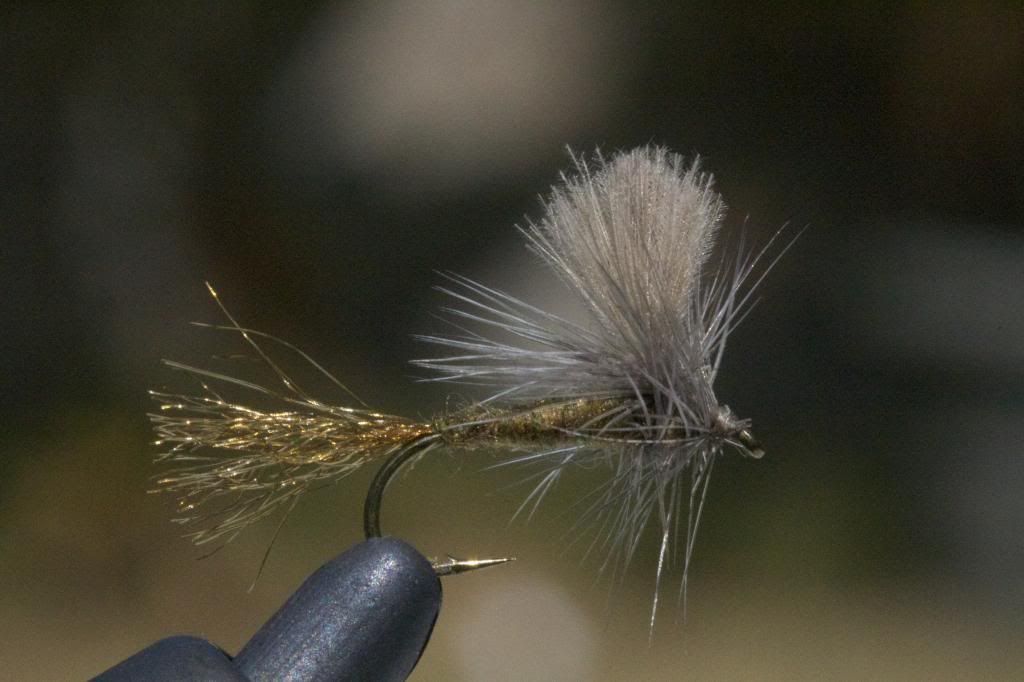
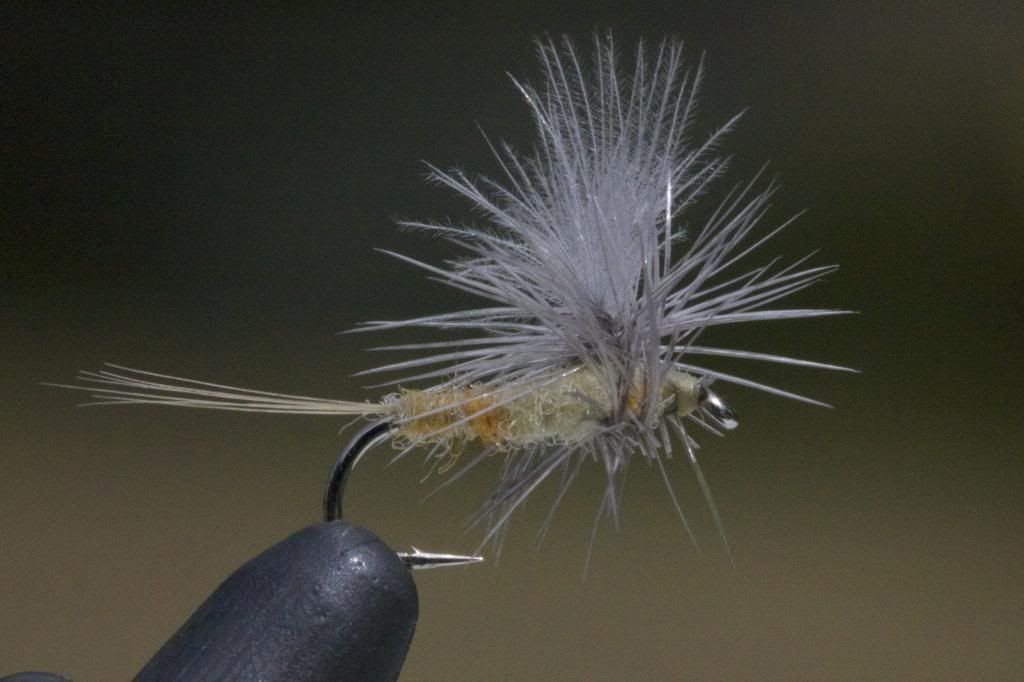
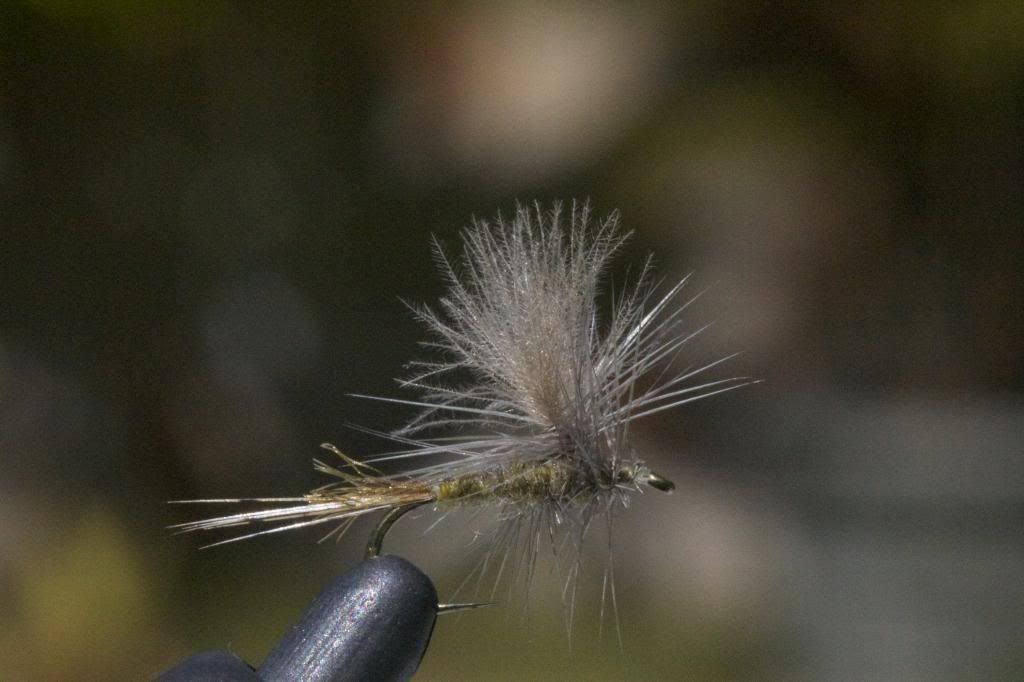
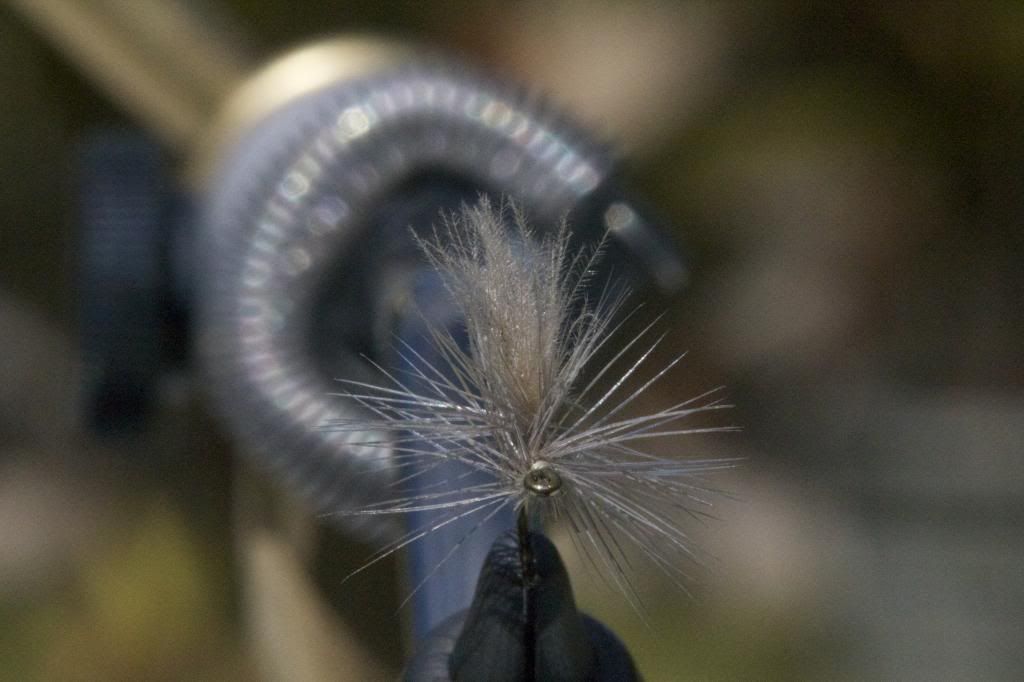
I saw John’s fine little emerger on the home page with step by step instructiions. I applied his method to my favorite hatch: The Flav. I cut a very narrow “V” to the 90 degree hackle.
A actually, an emergent flav with his trailing shuck.
John: I hope I have done a reasonable job with your style fly?
Byron
That’s for the fishies to say. I have used the 90 degree hackling technique on five or six different patterns now, and all have proven to be very consistent producers. As usual, I need to point out that I only fish for nearsighted, colorblind, dumb and starving trouts.
So what problem does this design fundamentally solve, or is it just an experiment to see what else might catch fish? While I understand the latter desire, does this pattern have any advantages over the Catskill and the parachute patterns?
While in some sense it does matter because tyers love to tinker (myself included), overly complicated patterns that do not perform any better than simplier files are counterintuitive to me. Of course, I do not have as much time to tie as some, so efficiency is always key. Not a criticism, just a question.
I will let John explain. I just copied his style. With the notch in the hackle, you have more support and have all “legs” out to the side - the 90 degree hackle as well as the parachute hackle. It is actually EASIER to tie as you don’t have the difficulty tying off the parachute hackle at the front of the hook as in most standard parachutes. I realize you can tie parachutes off by whip finishing around the wing. However, most tiers still tie off at the eye.
Will see what John says…
I sure like the looks of his style and I have a feeling the fish will too.
… to a similar question raised on the Duck’s Green Drake thread a while back -
"The 9DH hackling is one of my innovations from last summer. It serves a dual, or triple, purpose. Floatation. Profile - as in legs near the front of the fly. And profile - as in the hump in the top of the drake’s thorax and perhaps as the emerging wing.
“I think this fly worked so well because it does ride very low and suggests a cripple which has made it out of the shuck but doesn’t have fully formed wings ( versus an emerger which still is dragging the shuck ). Part of that speculation is the fact that there were no duns on or being taken on the surface, but the rises were typically at the surface and pretty aggressive. There was probably a stew of emergers and cripples in or just below the film, and this pattern was readily mistaken for a food item.”
Part of it was the tinkering around thing, but the larger part of it was coming up with a better imitation for a particular hatch, with more “leggy” stuff out front, kind of like what some do with soft hackle, while maintaining the advantages of the parachute, but minimizing the wing and maximizing some clutter in the thorax area.
For me, this is not an overly complicated pattern - to the contrary, for some flies it eliminates the dubbing process as unnecessary, redundant, and possibly as an impediment, and it is easier for me to tie off the hackle.
Can’t speak to the Catskill patterns 'cause I don’t really know what that is all about, and I think the above comments address the parachute pattern. What I can say is that this hackling technique initially accomplished a specific goal ( whether better than any other approach is unlikely and unanswerable ), and since it is easier for me to use I’ve opted to use it on a variety of patterns, including the PT MDE 9DH mahogany dun emerger which Byron was refering to, all of which have worked for the nearsighted, colorblind, dumb, and starving trout that I fish to.
I think any of us who have been tying more than 30 years grew up tying Catskill (or traditional English dressed dry flies) patterns. Had no one experimented we would have no parachute flies, sparkle dun/comparaduns, no hackles, thorax flies, etc., etc.
Personally, I am always messing around with different designs as I am a tier and enjoy tying…